Catholic Girl Journey Logo

Just a word

With a headline of “By comparison, homilies are not too long,” I was intrigued to read the article in a recent edition of The Catholic Virginian. The article discussed comparisons, based on Pew Research of the length and the topics various Christian religions use in the homily or sermon.

Unlike the Catholic Mass, most Protestant services focus on the sermon, with average length ranging anywhere from 24 minutes to 54 minutes, according to the data from the research. The average for a Catholic homily is only 14 minutes. As Protestants don’t believe in the Real Presence of Jesus in the consecration of the Eucharist, it’s logical that the next important thing to focus on is the Word of God from Scripture. I’ve noticed that the Presbyterian Church around the corner from me usually advertises the sermon topic on the signage board several days before Sunday.

All homilies or sermons can be moments of teaching. In the Catholic faith, the priest or deacon may give instruction on the season, the feast day being celebrated, or the readings of the day. Homilies can give context to the ancient customs and how to apply God’s Word to our modern lives. While the average Catholic homily may be short now, that wasn’t always the case. In previous centuries, especially when most people didn’t read, the homily was a key way for people to learn and grow deeper in their faith. While the homily can and still does strengthen our faith, the plethora of Bible studies and commentaries, stories on the lives of the saints and the saints’ own writings also provide us opportunities to grow deeper in faith in addition to attending Mass.

One of the excuses commonly used for not attending Mass is that it’s boring, with people often citing the priest and his homily.  But with the homily taking up only a small amount of time in the Mass, why would people let such a short amount of time limit them from building their relationship with God by attending Mass and partaking in the Eucharist? For those who face this dilemma, perhaps one alternative is asking God to speak to them through the homily? If they’re listening for God, they may just hear the homily totally differently than if they were listening out of politeness, or just feigning to listen. I’ve visited churches when the homily, or part of it, was used to discuss funds or the time and talent opportunities. Since I was not a regular parishioner, I see those as moments when I can ponder what jumped out to me during the readings and or just soak up being in the presence of God. Even when the priest is teaching something I already know, I find it a helpful reminder and a unique opportunity to see the topic from a different perspective.

At the very least, the homily is time to prepare yourself for receiving the Eucharist. After hearing the Word of God through the scriptures, the homily can help you reflect on God’s will for you and how you can welcome His Most Precious Body and Blood to strengthen you for your mission to bring His Kingdom into the world. 

Catholic Girl Journey Logo

What a gift!

Christmas is the gift-giving season; from the December 6th feast of St. Nicholas to the celebration of the Epiphany a month later on January 6th, there are many opportunities  for giving. The term gift is used so much, but what does it really mean?

As a word, gift has been in the English language since the 12 century. According to Merriam-Webster, a gift is “something voluntarily transferred by one person to another without compensation.” While that definition does make sense, there are a lot of words in that definition that could also be broken down a bit further. In seeing the word voluntarily, I immediately think of the word volunteer, which shares an etymology, although the words developed at slightly different times. Some of the definitions include: proceeding from one’s own choice, intentional, and uncoerced. However, I think my favorite definition of the word is: done of one’s own free will. Digging deeper into the word transferred, definitions like to convey or to pass seem to fit within this definition, but I was surprised to see it can also mean transform/change as well as to print or copy from one surface to another.

This season there may have been gifts we really liked and others that we may, or perhaps have already returned! Many of these may have been part of a gift exchange, where one person gifts another and receives a gift in return. While I would hope we don’t expect gifts from others this season, it’s almost hard not to expect some sort of “compensation” or gift in return for one we give another. However, our gift giving is supposed to be a reflection of God’s gifts to us: our life, our free will, and His Son as our Savior. 

God does not make us do anything, but He does ask us to participate in bringing His Kingdom to our world. He has given us the free will to say “Yes” or “No,” each having its own benefits and challenges. If we say Yes to God, He will reward us, either in this life or the next, and most likely both! However, doing God’s will may make life a bit difficult, since the culture encourages us to do the opposite. If we say No to God, it may seem that we’re in control and writing our own life story. It may even feel like we are succeeding, but in the end, we are living away from God and not taking the opportunity to have a relationship with Him. We also risk saying a final No to spending our eternity with Him. If we are mirroring God’s gift giving, it can transform and change us. We’ll be thinking of those receiving our gifts,  as we intentionally selecting the gift specifically for each recipient. As God has bestowed precious gifts to us, so we can convey meaningful gifts to each other that bring us all closer to Him.  

The gift we all celebrate this season is Jesus, God’s Son becoming man to be our Savior and repair the damaged relationship mankind has with God due to original sin. Jesus is a gift, freely given, uncoerced and without expectation of compensation. The choice is ours to either receive and accept The Gift or refuse and ignore it. 

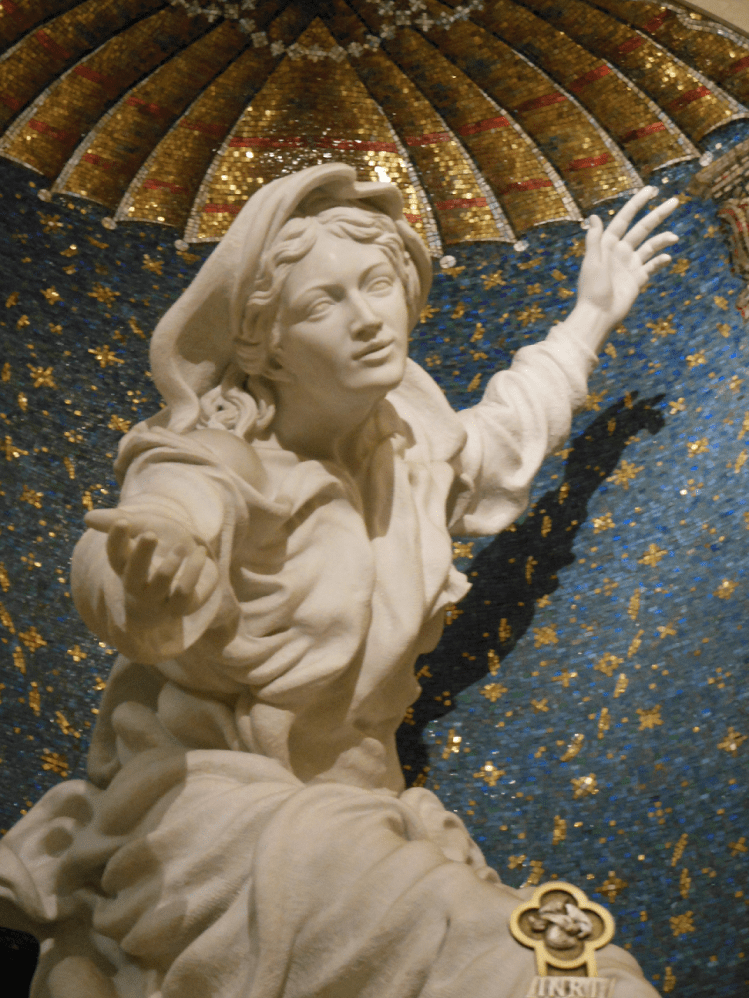
Mary at the Cathedral of St. Matthew the Apostle, Washington DC

Just say yes

Welcome to the third decade of the second millennium! We begin this year and decade as we do all of them, by celebrating the Solemnity of Mary, Mother of God. The Church holds Mary up as a role model for us, even obliging us to attend Mass.

While there are many feasts and solemnities throughout the liturgical calendar, there are only a handful that require Catholics to attend Mass. As we begin the new year, it makes sense for us to start by invoking God’s blessing on us, and what better way than the Mass? Yet the Church does not ask us to celebrate the new year, but to celebrate the Mother of God. Eight days ago we celebrated the birth of Mary’ son, Jesus, so why wait to celebrate her motherhood? Christmas is celebrated for a full eight days in the Church calendar, known as the octave of Christmas, while the days beyond that through the feast of Jesus’ baptism is known as the Christmas season. The Solemnity of Mary, Mother of God, seems to bring the intensive Christmas focus to a full-circle conclusion.  After all, we wouldn’t have Christmas without Mary’s “Yes” to God.

Mary may have been aware of some of the hardships her fiat would bring her, like Joseph’s reaction, not to mention those in her small town and their possible treatment of her. Yet she trusted in God to see her through. Perhaps it was the reflection of the events surrounding Jesus’ birth that gave her strength to stand at the foot of the cross 33 years later. Her relationship with God was total trust, total commitment, and total love. God rewarded her trust, not by making everything easy for her, but by giving her what she needed to complete her mission as Mother of God, starting with the protection by Joseph.

As we begin this decade, let us ask Mary, as our spiritual mother, to help us say yes to God’s will for us and to notice and give thanks for the help He sends our way.

Catholic Girl Journey Logo

Celebrating with music

Merry Christmas! It’s finally here and it’s time to celebrate! One of the ways we do this is by singing Christmas carols. We all have our favorites, based on what we heard as we were growing up. Many of these songs, like our faith, go beyond nations and become universal.

Perhaps one of the most iconic Christmas carols is Stille Nacht, or as we know it in the U.S., Silent Night. This lullaby carol is just over 200 years old and debuted in 1818 at a Christmas Eve Mass in Austria. I’ve heard versions in Spanish, Noche de paz, as well as Polish, Cicha noc, and it is said to have been translated into 140 different languages! The slow rhythm of the song, and the softness of the words, make it an ideal lullaby and reminds us that Jesus, as a newborn baby, was just as helpless as any other. 

My favorite is Joy to the World, as it is an exciting and celebratory song. It’s almost at the total opposite end of the scale to Silent Night, as it’s fast pace and message is not something to sing to a baby, but rather shared to others with excitement. This song is 300 years old, written in English in 1719. While it is sung at Christmas, it’s not about Jesus’ birth in Bethlehem, but rather His second coming. It makes a wonderful conclusion to advent, since that also prepares us not just for Jesus’ first coming, but to also look forward to His second coming. 

From Angels We Have Heard on High which is about the shepherds encounter with the divine, to We Three Kings, about the magi visiting Jesus, from fast and jubilant to soft and slow, there are many carols to express our Christmas perspective. I hope your favorite is played at Mass so that you can sing along and fully participate in welcoming Jesus.

Catholic Girl Journey Logo

Coming

I remember my parents’ response when I was young and they would call me to dinner or whatever. I would respond with, “I’m coming” and they would reply, “So is Christmas!” To a youngster, even in December, Christmas always took a long time coming, and sometimes to parents too!

Jesus promised He would come again. The early Christians thought that it was imminent, but over 2,000 years later we still need to learn a thing or two about God’s timing. With Advent we are given the opportunity to practice preparing for His future coming while celebrating His first coming. In the time between the two there are many generations that live and pass. For these, Jesus second coming is that at the end of their lives. It may not be as nice a topic to think about as baby Jesus lying in a manger, yet it is one we will need to face, sooner or later. 

My family experienced the passing of my uncle and my aunt in consecutive days this Advent. For them, Christmas came early this year. It’s just a week away to the calendar date for Christmas, and I can’t help but think about them and how they experienced the true meaning of Christmas. As I keep them and their families in my prayers, their passing has made Christmas so much more real this year. Christ comes; that is what our faith is all about. Like the shepherds and the magi, we seek Jesus now, so that when He comes again, it will be like welcoming a good friend that we are excited to spend time with, and that being all of eternity. The wonder and joy that Christmas is on earth will be beyond whatever we can imagine in heaven, since we will be with Jesus.  

This last week of Advent may pass very slowly for some and for others all too quickly. But no matter what happens, we will welcome Jesus into our lives as we celebrate Christ’s Mass*. It’s time to make haste and make ready for the coming of the Lord. Will you be ready?

*Christmas is derived from the Old English of Christ’s Mass, that is the Mass celebrating Christ’s birth.

Catholic Girl Journey Logo

Waiting and joy

It never ceases to bring a smile to my face when I pull up to my home and Vera, my cat, is in her sentinel stance looking out the window for my arrival. Her posture may change depending on if the blinds are up or if they are pulled low, but there is always enough space for her little face to peer out in watchfulness. Even if I’m gone for a short time, and she has a full belly, it’s a very rare occasion when she is not actively waiting for my return. I realized the other day that I have started looking for her in the window, as I’m driving up. I started to ponder what her watchfulness can teach me about advent.  

Waiting does not sound active, but the degree of attentiveness when one is waiting can make it a participatory activity. When one’s eyes, ears, mind, and body are tuned to the pending arrival, it is, indeed, active. When we are using our senses fully, our saturated spirit can’t help but explode in joy when we finally behold the person. For the arriving person, seeing valuable time was spent in eager and active anticipation stirs up the bond of kinship. For me, if traffic is bad or I’m feeling cranky, when I see Vera waiting for me, all that melts away. There is definitely joy in the arrival, but what about in the waiting?

Actions are choices and when we choose to actively wait, the precious time spent is an investment in the relationship we have with the expected person. In a way, we borrow the anticipated joy of seeing the person as we wait, which helps us stay focused for the arrival. After all, if the arrival is something we are dreading, we would probably find 101 tasks to occupy our time in distraction. Active waiting also requires us to be ready, otherwise our time would be spent on the tasks that have to be completed prior to the arrival. 

We can always practice waiting for Jesus in every Mass we attend. Each Mass is like a little Christmas, since Jesus becomes present as the bread and wine are consecrated into the Body, Blood, Soul, and Divinity of Jesus. Do we wait with eager anticipation, listening attentively to the Liturgy of the Word and keeping our eyes focused on the altar during the Liturgy of the Eucharist?  Do we welcome Jesus the moment we receive His Precious Body and Blood? Are we filled with joy as we share prayer time after we receive Him? 

Perhaps as we see the rose-color candle lit in the advent wreath this weekend at Mass, it can remind us to practice active waiting and rejoice that Jesus is coming soon. 

Catholic Girl Journey Logo

Preparing the spirit

Advent is a time of preparation for Christmas. From a physical standpoint, we prepare for Christmas with decorating, baking, purchasing and wrapping gifts. But how do we spiritually prepare for Christmas? Do we just pray more? Do we pray different prayers?

As with any preparation, the first thing we need to do is make an account of what we have and what we need. Translating that into spiritual terms becomes more than just an examination of conscience, which typically focuses on where we fall short of God’s will for us. However, examining our conscience and going to confession is a great way to clear the clutter and the spiritual baggage we have, so that we can proceed with our preparations. 

It is fortunate for us that Advent begins the new liturgical year at the end of our calendar year. This juxtaposition encourages us to review the calendar year that has past so that we can ask ourselves:

  • What have we learned about Jesus this year?
  • How has our relationship with Him changed?
  • Has it grown colder, warmer, or stayed the same? 
  • What is the quality of the time we spend with Jesus?

Like any relationship, we need to spend time with God and practice doing His will. We will not always succeed, but reflecting on a calendar year of moments and activities can help us see the direction in which our relationship with Him is going. Often it’s in reflection of events over a period of time that we can see the hand of God in our lives, and how He is actively working with us daily! 

Advent is almost four weeks of reflection, not a once and done thing to check off the list. It’s an opportunity to look at our daily tasks, both spiritually and physically, and determine how we can better praise God with what we are doing, asking Him to show us areas where we can grow closer to Him. As we reflect, we may also see areas of where God is calling us closer and where we’ve resisted that call. It’s these challenges to our faith that identify where we need to focus in the new calendar year. 

With clean souls, acknowledgement of God’s work in the calendar year coming to completion, and riding the wave of openness to the direction of growth in our relationship with Him in the new year, we will soar rejoicing in the Christ Child’s coming on Christmas day. 

Catholic Girl Journey Logo

Expecting Jesus

The first Sunday of Advent occurs this weekend. That means Christmas is coming really soon. Have you started your gift shopping? How about the decorations? Planning the parties? There’s so much to do and so little time!

The season of Advent is a time to prepare, but what exactly what are we to prepare for? It’s not the parties, gift giving, or how many lights you can string together before blowing a fuse. Advent is calling us to prepare for Jesus’ coming, not only as an infant thousands of years ago, but also His coming in glory at the end of time. The feast of Christmas marks Jesus’ first coming, when He was born of Mary and lived as a man. His mission was to bring salvation of the Kingdom of God to all the earth through His Passion, Death and Resurrection. After completing this mission, He ascended into heaven, setting the expectation of His return, or His second coming. While Jesus is always with us through the Church, His Mystical Body, and He remains with us in a remarkable and intimate way in the Eucharist, both His humanity and His glory are hidden from us. Advent invites us to prepare our hearts for Jesus. We look at Jesus’ first coming to remind ourselves that God became one of us in order that we might become His adopted children. True to His promise, Jesus is with us always, but we look forward to His return at the end of time  when we will see Him in His glory. 

When preparing to decorate for Christmas, we have to take stock of  the everyday items that make up our home decor. Chances are a good number of those items need to be packed up and stored away while the Christmas items are out. And in the midst of the transition, we probably do a cleaning of those spaces, otherwise everyone will see just how much dust can collect. Similarly, we need to take stock of our spiritual life and see what needs to be cleaned up. We look at our prayer life to see if it’s really central in our lives, or if it has been packed away like the Christmas decorations. To purchase a gift for someone, we examine how well we know the person and from what we know, we attempt to pick something they will like or that is meaningful to them. Suppose the gift were for Jesus, how well do we know Him? 

But this season is so hectic, how can you spend more time in prayer and on your spiritual life? Maybe it’s a few less decorations or one less party. Maybe it’s donating to a mission or charity in honor of those with whom you normally exchange gifts. The decor, gifts, and parties are meant to be a sharing of our joy in the season, not the goal themselves. Perhaps Advent is all about considering that if Jesus’ second coming was December 25th, 2019, would you be ready? 

Catholic Girl Journey Logo

The praying community

The Church has three distinct praying communities: the Church militant, the Church suffering, and the Church triumphant. Prayer is the common language and bond between us all. 

The Church militant is us: those still on earth. The “military”portion of it is the daily battles we face to avoid temptation and to endeavor to follow God’s will. There are many battlefields, not just one. Our soul is spirit, so one battle is in the spiritual realm. Another is in the realm of thoughts and actions. Having a mind that can think and ponder is both a blessing and a challenge. Good thoughts are just as easy to think as negative ones, but because we are human, we are often swayed by our emotions and attitudes. Those are yet another challenge.  We might be compassionate towards others or we might want to take justice into our own hands. By far the most difficult battlefield for most of us is our body, we can choose to use it to help others or to indulge in our own pursuits and escapes. It is upon all these battlefields — soul, mind, emotions, and body, that we apply the language of prayer. We pray for one another and for those who have gone before us. We ask the intercession of the saints to help us in all our battles.

The Church suffering sounds rather miserable, but the root of the word suffer, is to submit or endure. It also means to feel keenly. These are the souls in purgatory. They are often referred to as the holy souls in purgatory because they are on their way to heaven, but need the opportunity to purge the last vestige of impurity before they see God. After being divested of our bodies in death, purgatory gives us the opportunity to let go of the spiritual baggage. Time, space, and the physical realm can affect our souls; in purgatory, we can concentrate on what is holding us back from a full relationship with God. The souls in purgatory are destined for heaven, but our prayers can aid them on their way. And their prayers for us, can aid us in our earthly struggles to follow God’s will. 

The Church triumphant consists of the souls in heaven. They have completed their earthly battles, purged the residual taints of sin, and are now experiencing the beatific vision in heaven. While they no longer need prayers for themselves, they want to pray on our behalf. Their prayers are intercessory; they ask God for the graces we need in our various battles. While God alone is the one who makes miracles, we often attribute the good deed to the fervent prayer of a particular saint. 

Prayer is the language of God. It spans across life and death. It is a language that we share across the realms, praying for one another and praying with one another. It is a unity we participate in whenever we think, feel, say, or do good. We are not on the journey alone, and it only takes a prayer to be spiritually linked to a vast community seeking to do God’s will.

Catholic Girl Journey Logo

Word power

A response to a LinkedIn survey about using cuss words in the workplace made me frown. The effect of the message was: it’s just words, get over it. 

I’ve noticed in the workplace that it is now commonplace to use profanity, even during meetings. At first I thought it was being used for shock value, to make people pay attention. In some cases it may be used to illustrate the extent of frustration at a policies or roadblocks in a project. But there are some that use that type of language in their everyday speaking. In these cases too, there is that sense of, “This is the way I talk. You’re not going to change me, so don’t even try.” But when you hear these words over and over again, they seem to come to mind more readily than the words you want to say. Words have an impact.

While no words we say are as mighty as God’s who spoke creation into being, they are the basic building blocks of communication. The first thing Adam did in the garden of Eden was to identify each animal, basically giving each a name or a label. This allowed him and his descendants the ability to have order and reference points in their communications. When later in the Bible we see man trying to grasp at divinity by building the tower of Babel, God stayed true to His promise to Noah and didn’t destroy man, but rather confused his language.  Because they were unable to communicate effectively with others, the tower project was abandoned. And when Jesus stood before Pilate, it was the crowd, stirred up by those plotting against him, who called for the crucifixion of Jesus. Pilate, fearing an uprising gave into the demands of the crowd. Words have power. 

The words we say, even those that may be sugar-coated, convey to others who we are and what we believe. We can use them to build up others and the Kingdom of God, or we can use them to cause hurt, strife, doubt, and destruction. Those that subscribe to the belief that they can use whatever words they want and it’s up to others to “deal with it,” demonstrate a prideful sense of self and a complete lack of compassion towards others. For those of us who have to live and work alongside these individuals, we must take up the battle daily to not let that language invade our minds, our tongues, or our peace in Christ. Let us strive to convey words that build up rather than devastate and destroy.