Recently I was chatting with someone who questioned why there are Marian apparitions. After all, Jesus was God and revealed all, so why does Mary keep showing up?
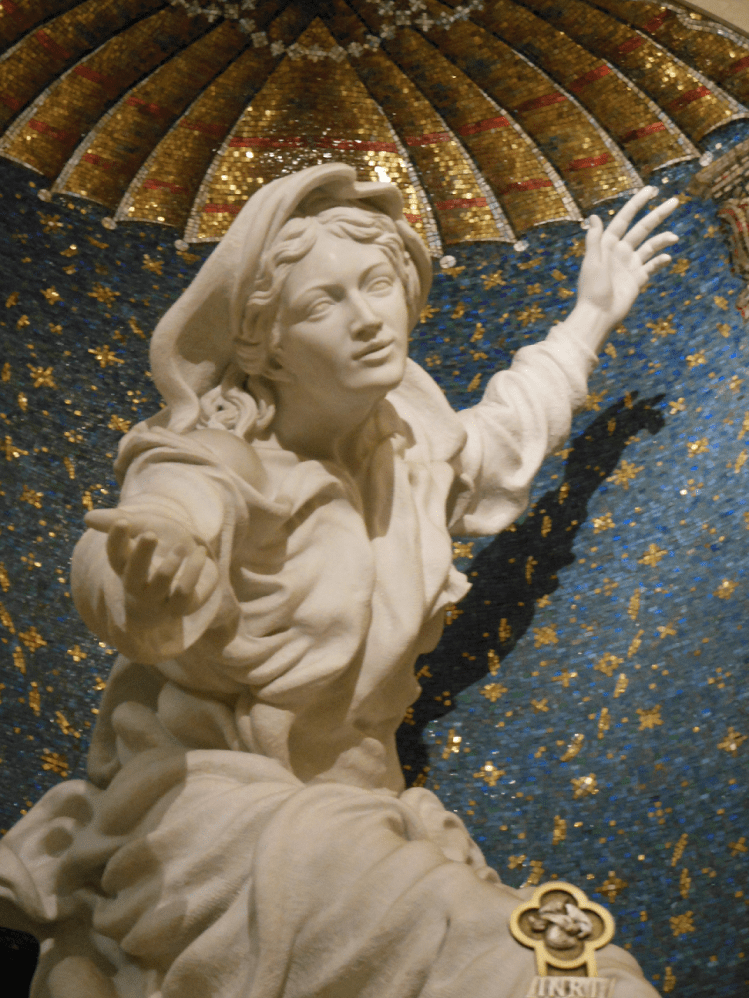
While it is true that nothing can be added to the deposit of faith, when we look at her appearances, they have a pattern to them. From an outward perspective, Mary picks the poor and uneducated. But Mary is in heaven with God, so perhaps she sees deeper than we can. Maybe she sees that the soul is searching for God. Perhaps she sees the hunger for God is more important to the person than food, since they are used to going without. Or it could be that she can see the soul is open to receiving her and her message as well as dealing with the after effects. We will never know the reason why certain people are chosen, and that mystery does not need to be solved. Nor are we required to believe in any appearance that she makes. Yet Mary continues to show herself, so that all generations call her blessed.
Our Lady of Guadalupe appeared to a poor native man in Mexico. Not only did she leave a lasting impression on Juan Diego himself, she left a physical image on his tilma. The image of a virgin mother dressed in native garb spoke volumes to the people more than any missionary could. While the conversion of millions are attributed to Mary, the actual work to baptize and teach the faith still relied on the missionaries. And 500 years later, the tilma survives to call us deeper into our faith.
Bernadette Soubirous saw a Lady in the grotto of Lourdes. Very poor and uneducated, Mary appeared to Bernadette in a number of appearances that attracted people on pilgrimage even as the visions were happening. While the Lady Bernadette saw mostly didn’t speak, she did finally reveal herself as the Immaculate Conception, a dogma pronounced only four years prior, and possibly unknown to Bernadette. She also had Bernadette wash in an unknown stream, which Bernadette needed to dig to find. The healing waters of Lourdes bring millions of pilgrims each year with hope and trust in God.
Mary never seeks fame for herself, but uses her motherly instincts to identify what her children in the Church need. In Mexico, it was conversation to faith in her Son that ended the ancient practices and human sacrifices prevalent in their culture. In Lourdes, it was the hope of healing from special waters, and made evident by the crutches that were left behind. There are other places she is said to have appeared like Fatima, Knock, and Medjugorje. There are also many more shrines built in her honor. Mary was only human, and that makes her a comfort to those seeking God, Creator of All. We can take her hand, by praying the rosary and seeking her intercession, and she will lead us to her Son, Jesus.
Mary knows what we need and she is willing to do God’s will for His Glory. She appears when and where there is the most need, not for her benefit, but for ours: to shine the light of faith into our hearts and souls, calling us back to a relationship with God. Jesus allows His Mother to be our Mother. The appearances of Mary are just a mom thing, coming to help us just when we need it.