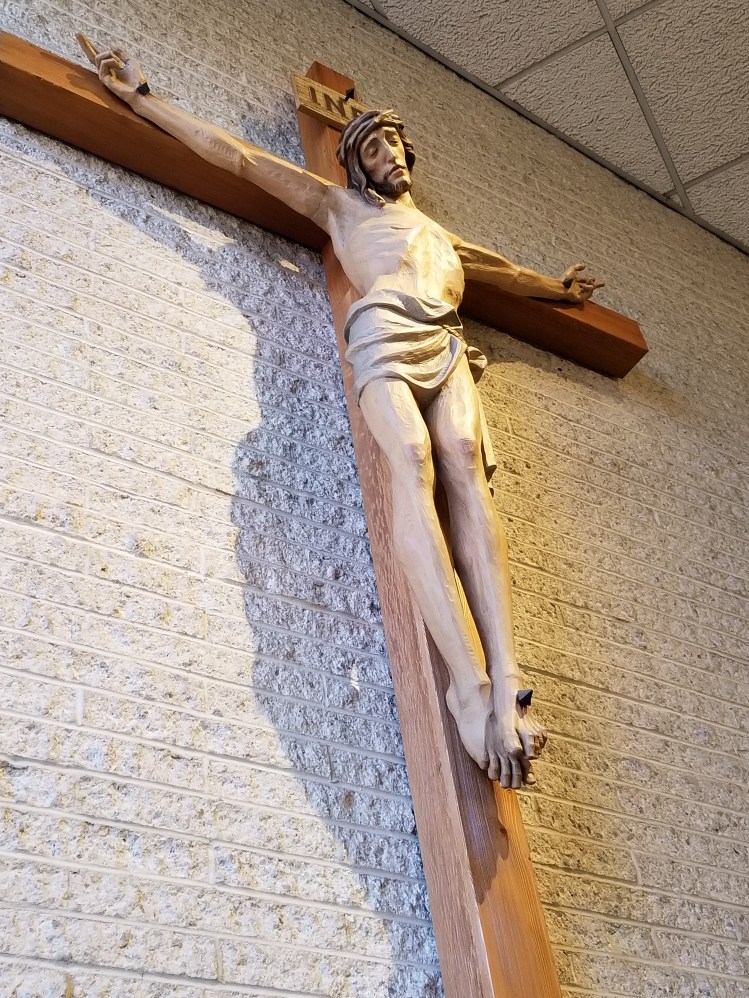
Loved to the end

“Then Jesus said, ‘Father, forgive them, they know not what they do.’” (Luke 23:34) In the last moments of His life, Jesus asked God the Father to forgive those who had crucified Him. If Jesus could love His enemies in the most painful part of His human life, why is it so hard for me to forgive those whose only fault is to annoy me? 

What makes one an enemy of God? I would say it’s when that someone tries to prevent God’s will from occurring. The top enemies of God that come to mind are Satan and all the fallen angels. But they would be just as quick to accuse all of humanity of the same crime because we often seek to do our will rather than God’s will. And yet all the fallen angels continue to exist because God not only created them, but continues to love them. I’ve heard it said that the fire of hell is because those in hell reject God’s love and so it burns them. God IS love; if He ceased to love them, they would no longer exist. Even in their fallen state, He allows them to play a role in turning people back to Him.

If we seek to know more about the enemies of God, we only need to read the Gospels, especially the parts about the Pharisees. Time and again they put Jesus to the test, trying to “catch” Him in some offense. They were so sure of themselves and their superior knowledge of God, their resistance to Jesus is so absolute, it’s almost comical. Of course two thousand years later and voluminous reflections on the Gospel passages allow us to see how wrong they were. Yet how many times do we think we know who God is and how He works? How many times do we pass judgement on others based on our understanding of the commandments? Do we always look at things in black & white, right & wrong? Or do we look through the lenses of mercy and justice? 

Jesus sets the bar very high for us to forgive those who we see as our enemies. However, He also gives us a method to use: ask for God the Father’s help. We cannot forgive others all on our own, we’re only human. But each time we pick up the thought of how we have been wronged, we can ask God to help us forgive the individuals responsible. It’s not easy, but then again, we may not be aware of just how many times others have prayed for our forgiveness when we have wronged them. We can’t expect God and others to forgive us unless we seek to forgive those who have hurt us. 

In these last days of Holy Week, let us ask God for help in purging the grudges, hurt feelings, and all other annoyances — both superficial and serious, from our hearts and minds. It may not happen in an instant, but if we could lessen our anger against our enemies, we may find a little more peace and joy the Easter season brings. 

Catholic Girl Journey Logo

Connecting the dots

If I were bold, I would do it in pen, but it seems I would always make a mistake and the picture wouldn’t look quite right. I enjoyed the connect-the-dot pictures I used to do as a child. Sometimes the images were simple and had a few dots to connect, others had more details and were much more complicated to follow. The end result was a picture that I had drawn, and for a girl who did not get that creative gene, it was always a proud moment of accomplishment.

I’m 80 days into the Bible-in-a-year podcast with Fr. Mike Schmitz, and I’m starting to connect the dots for a much more detailed image of the story of salvation. A story that isn’t just history, but the present and future too. For about the past 30 days, the story has been of the desert wanderings and I’ve realized that my education about salvation history has been the Cliff Notes version, the punctuated key points. However, it’s in the minutia of text that is both the foundation and explanation of why the key events were important. I remember learning that because the Israelites worshiped the golden calf, while Moses was meeting with God and receiving the 10 Commandments, they were punished by being made to wander in the desert for 40 years. That is true, but it’s really only part of the story. 

Taking the story back to Egypt, why did God send the plagues on the Egyptians? The high level answer is that Pharaoh would not let them go. The deeper answer is that the Israelites were starting to behave like the Egyptians, worshipping their deities and following their customs. The plagues that God brought on Egypt were symbolically denouncing their deities and illustrating that He, and He alone, was the all-powerful God. Each plague corresponded to an Egyptian deity, and by controlling those created elements, God was educating the Israelites and breaking their erroneous beliefs. When they slid back into worshipping a false god, God had to give them additional education, thus the 40 years wandering in the desert. 

I’ve heard many homilies that link the 40 years the Israelites spent in the desert to the 40 days Jesus did, as well as the 40 days of Lent. Yet it’s only been after reading what transpired in the 40 desert years that I see how God was instructing the Israelites, giving them opportunities to practice trusting in Him (which often revealed itself as an issue). Living in the Promised Land was not going to be an end for the Israelites, but rather the beginning. Living according to God’s law, they were to be an example to the world as it was known then. They were to be a shining beacon that would gather all the peoples and bring them into belief of Yaweh, the personal God that took care of those who believed in Him and followed His commandments. That was to be the Israelites’ mission: to evangelize the world for God. Likewise, Jesus spent 40 days in the desert preparing for His mission: to preach, to heal, to die, and to rise again. Every year we are called into the desert of Lent to learn from God and to practice trusting in Him. Even though at the end of every Mass we are called to, “Go in peace, glorifying the Lord by your life,” we use the time in Lent to dig deeper into what God is calling us to do: our mission.

In connecting the dots of the desert wanderings to Jesus’ time in the desert and our Lent, I see that while times and details change, the pattern remains. And yet while the mission is to evangelize the world to God, how we do it — the focus of our activities, may change from year to year. Some years we may be called to spend in prayer, other years may be to donate to a particular Catholic charity, while other years we may be asked to be active participants helping to serve the needs of others, bringing the light of Christ to those who need it most. We are all called to a mission. When we fully embrace our own unique one, there is no limit to what God can achieve working in us. We only have let go and let the picture emerge, just like it does when we connect the dots, not just in pen but in permanent marker!

Catholic Girl Journey Logo

Return to sender

To whom do you pray? You may answer, “Why God, of course!” or perhaps, “Jesus Christ.” But is that truly whom you are addressing? The Gospel for a recent daily Mass caught my attention with a double meaning that made me ponder how I pray.

It’s a story we’ve heard many times over of the Pharisee and the tax collector praying in the Temple. “The Pharisee took up his position and spoke this prayer to himself…” (Luke 18:11) When I first read it, I was assuming it meant that he was praying silently, that he didn’t speak out loud, but rather spoke his prayer interiorly. I think that is a valid understanding and could be one way of interpreting the story, but I don’t think it’s the only way to understand it. Even though the Pharisee does say, “O God, I thank you…,” the prayer he continues with is not a prayer of thanksgiving, but rather an inventory of how he perceives his superiority. While I do believe that God hears every prayer, there are some that He listens and reacts to and some He just allows to float on by. 

Prayer is meant to be a conversation with God. It’s a way we learn to prioritize what’s important. We praise God, we acknowledge our deficiencies, we thank Him for His blessings, and seek His assistance for ourselves and others. This is the way Jesus taught us in the Our Father. However, the Pharisee was so enamored of himself, that rather than giving God the praise, he was giving himself the praise, in the space of one sentence, he uses the word ‘I’ four times! “I fast twice a week, and I pay tithes on my whole income,” is not a prayer of thanksgiving for what God has given Him, but sounds like a justification as to why He expects God to listen to Him. He assumes it is his own effort that allows him to fast and tithe, when in reality, it is God’s blessings that allow him to be able to fast and His generosity to tithe. 

We can play Monday morning quarterback to a 2,000 year old Gospel story and say how wrong the Pharisee was, but back in those days, the Pharisees were looked upon well. They were assumed to be close to God because of their prayers and knowledge of Scripture. But knowing it and living it are two different things. 

It may be a subtle thing, but I think the bigger impact is the tax collector. Tax collectors were Jews who would collect the Roman taxes. They were not paid, but rather had to take their payment from the people. Can you imagine someone collecting a percentage of your earnings for the government and asking you to chip in a bit more for their own living? Tax collectors routinely charged the people more money than the tax and then kept the difference, sometimes at exorbitant rates. Tax collectors were not very welcomed in Jewish society. Yet the most marvelous thing for this tax collector is that he went to the Temple to pray. He went to God and he admitted his sin. He took a step closer to God and closer to being spiritually healed. While it is only a story that Jesus told, I wonder about how the story would unfold for that tax collector. Was he able to do his job without extorting money from his countrymen? Did he find another occupation that allowed him to live an honest life? He obviously wanted to correct his relationship with God, to the point of publicly seeking God in the Temple, a very bold step indeed!

When we put God at the center of our life, our way of praying evolves. We acknowledge His providence in every aspect of our lives. We look to Him for guidance and strength. We realize our lives are not about us but about the relationships where He has placed us. It’s less about me and my needs, but about God and what can I do for others through His grace and blessings. Let our prayer language indicate our reliance on God, otherwise we are just praying to ourselves. 

Catholic Girl Journey Logo

The cost of living

If I say there is a high cost of living, most would agree; however if I say living is priceless, that may not completely compute. Most would think I’m talking about the daily essentials like shelter, clothing and food, yet these are all incidental to our very lives.

We are created by God, each and every person to be unique, each with his or her mission and purpose. Every action we take, every word we speak, every thought we consider is a reflection of our relationship with God. In a recent homily, Fr. Mike Schmitz said, “Every choice has a cost and every decision has a price.” Even when I am careful about making a decision, it’s usually because I’m concerned about the consequences in this life. Most times, I don’t think about how a  choice I’m making has an eternal consequence as well. However, if we love God, our hearts should pour out in all we say, do and think with actions allowing His Will to be done. When our choices are made from selfish desires, we may be hampering His Will, causing others as well as ourselves to be deprived of God’s glory and peace since our choices are not reflecting His presence in our lives.

It can seem rather overwhelming to be concerned about every little decision. For example, is God really concerned if we eat breakfast or not in the morning? That is a decision we have to make, but it affects the body God has given us, a body that is His temple on earth. The decision about breakfast, including the choices of foods, is one about fueling the body for the day. By feeding our bodies the right nutrients, we can better perform the tasks He has for us throughout the day. As we heard in Ash Wednesday’s Gospel, Jesus tells his disciples to not neglect their appearance when fasting, but to be sure to groom themselves as if they are not fasting. (Matthew 6:16-18) At all times, we also should make sure we are well groomed. That doesn’t mean wearing the most expensive clothes, but ones that are cared for, showing appreciation and respect that God has blessed us with the ability to clothe our bodies. 

The true cost of living, however, is not the one we pay with careful attention to our choices. Rather it is the price that Jesus paid for us to return to God when we fall away and choose our own path. All the right choices in a lifetime still would not warrant eternal life with God. Jesus died and rose in order that we can spend eternity with God.  We have the freedom to choose life or death, heaven or hell. He will allow  us to become separated from Him, if that is our choice. We are given a lifetime on earth to practice choosing, and though we will make many mistakes, God loves us through all of them!  When we learn from our failures as well as our good choices, we will be able to make the final choice at the end of our lives: eternal life with God.

Lent already?

Is it Lent already? It can’t be! I’m not prepared for it!

I knew Lent was coming. I made notations on my calendar to remind me of days requiring fasting & abstinence. I’ve been bombarded with options to sign up for daily Lenten reflections from a half dozen organizations. I even bought a jar of peanut butter to have on hand. But I’m just not ready for Lent to start. And yet, here it begins, no matter how unprepared I am for it.

My routine changed when I moved down to Virginia two years ago and I have had a challenging time putting the puzzle pieces of my schedule together. The introspective side of me wants to tell the judgemental side of me not to be so harsh because I’m not doing the same routine I had in Pennsylvania. Things aren’t the same here, and I should expect Lent to be different as well. My former routine took another hit  in 2020, and now I’ve realized: we were in Lent when everything turned upside down. In a way, it seems like it has been one long Lent, even though we did, in a very odd way, celebrate Easter and in a somewhat more normal way, Christmas. Wearing masks, reducing travel and social distancing has felt like one long penance practice. How can I think of what to focus on while we’re still facing this challenging pandemic? 

The Church calls us to focus on three areas during Lent: prayer, fasting, and almsgiving. It’s not meant to be a rigorous schedule executed to perfection. Rather it’s supposed to be practice, where we work to improve on our weaknesses. To do this, we take corrective action and really focus on what we are doing. We need to apply our bodies, minds and souls, together in our efforts. Do you engage your body in prayer? Does your soul participate in your fasting actions? How eager is your mind to write that check out for a donation? Just typing those questions has me thinking that I have a lot of practicing to do. However, I don’t have to tackle everything at once. I don’t have to have everything planned out down to the second. What I do need, with some guidance by the Holy Spirit through prayer, is a goal for each week within one of those three areas. Just as if practicing on a musical instrument or for a sport, you wouldn’t over-do it in the first few days, but rather work on the basics and grow from there. The same rings true for practice in the spiritual realm. The things you find yourself stumbling over indicate where you need to spend time practicing. 

The main goal of Lent is to prepare us to celebrate Easter feeling a little bit closer in our relationship with God and His Will for us. This results in heightened care and concern for all that God has created and lessened interest in our wants. Just as in sports, training and practices never end; the focus just shifts from intense training to get conditioned for the season to the actual games themselves. Lenten practices don’t have to end either; they can be incorporated into our lives, if not daily, then on a regular basis so we can keep ourselves in top spiritual condition.

While others may have different reasons as to why they are not prepared for Lent, I’m sure I’m not the only one. The Church in her wisdom gives us a place to start with fasting and abstaining from meat.  If you do that on day one, it is a solid start. You then have 39 days to focus on what to practice in additional areas. And with grace and guidance from God, those days will fly by so fast, we’ll be amazed when it’s already Easter! 

Blessing withheld or bestowed?

I would hazard a guess that most, if not all believers, at some point question why prayers for assistance are not answered, at least not the way they expect. I had a little insight on that dilemma with Vera’s recent trip to the vet. 

Vera and car rides are polar opposites like water and electricity, a dangerous combination when mixed. The vet’s office is less than 5 minutes away, a whooping 1.3 miles, yet to hear her, one would think she was undergoing the most horrendous torture. To some degree, I can’t fault her for crying so much when she is imprisoned in her carrier going at a rate of speed that is outside of her control. Much like me on a roller coaster minus the hills, although at least I choose to go on the ride; she didn’t have any choice. To add insult to injury, I only fed her the wet food portion of her morning meal, withholding the kibble portion until we returned. I’ve learned from previous experiences that all that crying and stress makes her vomit and the dry food is not as quickly digested as the wet. Add on the shot and being poked and prodded by a person she doesn’t know and that is the recipe for total misery. 

While I’m sure Vera understands some English, her comprehension of the language is on a par with my understanding of her meows. They get my attention and may give me a rough idea of what she wants. Unfortunately, there’s no way to explain to her why she doesn’t get kibble before a car ride. All she knows is that I’m not feeding her. That thought prodded me to reflect about how I feel when praying to God for some blessing: help with a job, healing for a friend, understanding Scripture better, etc., and those prayers seem to go unanswered. Just like Vera wanting her morning kibble, I want my request to be answered immediately and in the way I expect it to be. 

Sometimes when I am cognizant that God’s answer seems to be delayed, I wish I could understand why. If Vera did understand why her kibble will be given at a later time, I’m not sure I would be able to find her and get her into the carrier to take her to the vet. Who wants to go to the doctor and get a shot? I know there are some people who avoid doctors completely. So, if God wanted to communicate why the answer to my request was not forthcoming, in reality, I probably would not want to know. 

I also couldn’t help drawing a parallel with the pandemic situation. It’s been almost a year, and while the vaccine seems to herald the promised return to normalcy, we’re still in the midst of this challenge. Here too, it seems like our “kibble” is being withheld from us. It’s hard to see that this could actually be a blessing for us. And like Vera, when we do get our kibble, we will be able to  enjoy and benefit from it, because the stressful situation will be over and we’ll be able to more easily calm ourselves down. 

God does work in ways mysterious and hard to comprehend. We need to remember the vastness of His creation reflects His infinite care for all His creation, down to the tiniest detail. He knows what’s best for us, even when we think we already have the answer. And, if a blessing seems to be withheld or delayed, it just may be that the blessing is the delay. We can trust Him and His omnipotence. 

Catholic Girl Journey Logo

Reading the Word

Have you ever read an entire library worth of books? Just that thought of it sounds intimidating. What if that library was contained in one large book, would that make it any easier? If you have ever read the Bible, cover to cover, then congratulations! You have read an entire library!

I have taken a number of Bible studies that either incorporated sections of the Bible or focused on one specific book. I remember, quite a number of years ago, I attended a weekend parish presentation by Jeff Cavins, the developer of the Great Adventure Bible guide and “The Bible Timeline, The Story of Salvation”. I learned much, took many notes, and started reading the Bible each day based on the plan outlined in the materials I received. But it was hard, especially reading it myself. 

This year, it’s a bit different. I’m following the podcast by Fr. Mike Schmitz, The Bible In a Year, which is based on the salvation history story developed by Jeff Cavins in the Great Adventure Bible study. I can tell this time will be different. The sessions are about 20 minutes long. These can easily fit into my day, and for those days that are jam-packed, I can always do two sessions another day. By subscribing to the podcasts within my Google app, I can see where I’m at, especially if I need to catch up. The format for the session is that Fr. Mike reads the Bible chapters, does a short prayer, and then gives reflection on what was read. Even though I’m following along in my Bible, hearing it read makes the difference. 

When I was a lector, I was told to practice delivering a reading by reading it aloud three times in a row. I did find that when I heard the word spoken out loud, it changed my comprehension of the text. I found this a critical practice, especially when the readings were from St. Paul, as he often dictated his letters to a scribe. I could almost see him pacing back and forth as he was forming his thoughts and speaking them aloud. Since we’re only a month into this year-long plan, we’ve only covered a few books, yet I am beginning to see that in some respects, the early books are much like poetry. They tend to repeat phrases and sentences numerous times. I interpret that as a way for the ancient people to learn the stories so they can pass them along. To get the details right, you repeat it again and again, and if you only take away 10% of what you heard, chances are you’re recalling the repeated text that conveys a particular message. 

While we will not cover every book in the Bible, we will cover the books that include the salvation history narrative, as well as a number of the complementary stories and books that support the main story. For most of January we read Genesis, and along with that we read the book of Job as well as a number of Psalms and some chapters from Proverbs. We recently moved into Exodus and its companion, Leviticus. Previously, I would groan when I had to read passages from Leviticus, giving the instructions to the Israelites of how they were to worship. In the past, I would’ve said it’s boring. However, by reading only one chapter of Leviticus at a time, in conjunction with the story of the Exodus, somehow it doesn’t seem quite as dry. Hearing it read at times it actually sounds a bit poetic. Perhaps it’s because of the repeated line, “a pleasing odor to the LORD” that seems almost like the refrain in a song. 

I’m familiar with the Bible from reading the daily Mass readings, but I know that only gives passages from the Word of God. Granted, they are the really important passages, but diving deeper into the Bible offers us a way to strengthen our relationship with God.  I’m excited to be on this Bible adventure, and grateful that Fr. Mike is a great leader (and lector!) who will shepherd all podcast followers through this amazing story of salvation history. 

Catholic Girl Journey Logo

Clean praise

I know it will sound weird. I found it odd as I was doing it. Yet at the same time it seemed like the right thing to do. I was singing praise songs as I was cleaning my home.

Yes, it’s one thing to sing while vacuuming, as the sound of the machine drowns out any other noise. But singing Glory & Praise to Our God while scrubbing the toilet, shower and tub did seem incongruous. I had one voice saying that the work was not appropriate for the song; another voice was quoting scripture reminding me of what St. Paul wrote to the Phillippians: “Rejoice in the Lord always, again I will say, Rejoice.” (Phil 4:4) Cleaning, especially the bathroom, is one of my least favorite chores, second only to taking out the trash. I don’t mind laundry, grocery shopping, or vacuuming. I enjoy cooking and baking, so I actually find them fun. If offered the option to clean a baked/burned on cheesy mess from a casserole pan versus the bathroom, I will take the casserole pan (and any other dishes with it) hands down. Oddly enough, I think that if I did sing while cleaning the dishes, I wouldn’t find it strange to praise God in that moment. 

As I continued singing,  moving onto O God Our Help in Ages Past, one of my favorites,  I was still wrestling with whether or not it was sacrilegious. I recalled St. Thérèse once taught that you needed to do the little things with love. It’s hard to do something you wish to avoid with love. I know it needs to be done, it’s not like I’m not going to do it, and it’s really only for my benefit, so does it matter if I do it with love? Well, yes, it does, because it’s a matter of attitude. I found that when I was finished, instead of being tired and relieved that the chore was completed, I felt joyful that it was accomplished and did say a Glory Be in thanksgiving. I also found that I had a little extra time to myself to knit a few more rows in my current project. 

I do listen to Christian music quite regularly, yet realized that the songs I was singing were not  those I heard recently, but songs learned as a child. These were hymns taught for Masses in which my class participated, and regular practices were conducted until we learned them. While there are many modern songs that come to mind from time to time, they seem to drift in and out of my head. However, these hymns are woven into the fabric of my being as they became part of my journey  learning the faith. I guess I shouldn’t be surprised that when God is trying to teach me something, He goes back to the basics.

Just because a task is unpleasant doesn’t mean that God is not right there with you. For activities that we like to do, praising God can come naturally in the midst of them. Some may find mowing the lawn to be a time for meditation and reflection. Others may dread that as a chore. Perhaps adding a dash of love and a smidgen of praise to these domestic activities, we can find the recipe to make them less burdensome and more of a blessing. 

Catholic Girl Journey Logo

Gem of lump of coal?

“You’re a gem!” I told my colleague recently. He responded that he was merely a piece of coal being transformed. Well, that response stopped me in my tracks. 

When folks do a good job, I do like giving positive feedback. At one time, I was known for giving “gold stars,” and if I didn’t say it, sometimes they would ask if the job was worthy of any gold stars. With the regular shifting of resources and reorganizations at the company, the gold stars fell out of use. I’m not sure why exactly I used the term gem this time, but I truly meant that the work provided was a shining example. I was so surprised by not only the humility of the response, but how deep of a meaning could be teased out of it. In some regards the amount of pressure from the volume of work that needs to get done could be one explanation of the analogy. Knowing that I used the term gem, the first thing that came to my mind was a diamond. From there I thought of one of my favorite songs, Diamonds from Hawk Nelson, a topic covered in a previous blog

My contemplation of that analogy continued, and I started thinking about the saints. We see saints as beings who are perfect, but they certainly were not so while on earth, at least not for their entire life. St. Augustine wrote a full book about his Confessions. While on earth, each of these carbon-based lifeforms, were slowly being transformed into diamonds shining brilliantly from the light of Jesus Christ. They faced adversity and hardship, poverty and disbelief of others for their vocation. Yet they walked with Jesus to do God’s will, keeping their focus on Him. Now we see them as God has always seen them: as perfect gems.  

It can be very difficult to see ourselves, especially our inner selves, as anything other than a dirty piece of coal, ready to be thrown into the fire. Yet God can see the diamonds we can become. He is calling us not to take the easy way out and escape the pressure, but to lean into Him and walk with Him through the difficult times. We may be dust, but we are beloved dust in His eyes! He does not want us to settle for the way we are now, He wants us to sparkle like the diamonds He knows us to be. While my human instinct wants me to flee from hardship, my spiritual soul asks me to rejoice in the difficulties of life since these are the tools God can use to transform me.

We are all called to be saints. We are also not yet saints. Let us not judge the coal-side of our lives too harshly, but rather look to God to lead us through the pressures of life so that when we reach heaven, we too can see the gems He has called us to be.   

Catholic Girl Journey Logo

Thoughts and actions

The world seems like a scary place at the moment. With the rising rates of the pandemic and civil unrest, not to mention a heavy workload for a tiny team, it is very difficult to process just what is happening and how I need to react to it all.

 As the infection rates increase, I’m starting to re-think what I’m doing and where I’m going. My workout has gone virtual since the owner had to close the physical location. I still go to Mass, to the grocery store and to visit my Mom. Since attending Mass in person is a possibility, the decision to attend is mine. I am now the one to determine if the safety procedures that have been put into place are sufficient to limit any exposure to the virus; I have  to weigh the probability of contracting the virus against receiving the Eucharist. 

In a video message, Bishop Barron called for a nationwide examination of conscience after the violence in DC. I saw the video while I was waiting for my dinner to warm up, and it was the first I had heard that something happened. It wasn’t until I turned on the 10 PM news to catch the early weather report that I saw the magnitude of the calamity. I still don’t think I’ve processed the events fully, and I’m not sure I will ever be able to comprehend why. 

An examination of conscience is not just a spiritual exercise, but a call to deeper reflection on what we are thinking and what we are doing. Our thoughts and beliefs help us bring order to the information we take in from the world around us. We are bombarded on a daily basis with noises from nature and from machines, with data from our technology and our interactions with others; there’s a tremendous amount of “stuff” our brains need to churn through! As we process all the information, we make decisions as to what’s right and wrong, what we like and what’s not important. The result of all this can be seen in our words and actions. 

In a spiritual examination, we look to see how our thoughts, words, and actions align with the direction that God has provided for us in Scripture and the example Jesus gave us. For Catholics, this exercise is to help us as we journey towards heaven. We know we’re not perfect and some days will be harder than others. We will fall, many times. However, by reviewing the what, how, and why of our daily life, we can ask God’s forgiveness for what we’ve done wrong, ask for His strength and grace to do better tomorrow, and give Him praise for allowing us to be His light on earth. 

A national examination of conscience is a call to stop and reflect on what we think, how we react, and why we choose the actions we take whether or not we use God’s commandments as a baseline. It’s not unlike the way we evaluate our activities in light of new information about the pandemic.  The escalation in political turmoil calls all Americans to question their responses and to make choices to align ourselves more firmly with our beliefs. 

I’ve been following Fr. Mike Schmitz’s Bible in a Year podcast, which has included readings from the book of Job. Seeing the tragedy of Job has reminded me that calamities happen, tragedies happen, bad things have happened for many millennia. Yet God is here with us. God will use even the bad stuff to bring us closer to Him. The world will always be a scary place, yet when we keep our eyes on God, and examine our thoughts and actions to become the best version of ourselves, we can rest in the peace of God like a hug from our Father, giving us the confidence for another day.