In the first moments of His life, Mary held the baby Jesus. And after being taken down from the cross, Jesus’ body was placed in her arms. It had come full circle. The sixth sorrow of Mary is Jesus being taken down from the cross.
Over the years I’ve read many reflections upon the crucifixion, and it is significant to note that in this instance, the body of Jesus was removed from the cross. Usually the point of a crucifixion is to be a deterrent for others. The Romans wanted the bodies to be hung for the maximum amount of time to dissuade others from repeating the crimes of those who hung on the cross. Crucifixions always took place in a highly visible area, just outside of the city or town, so that as many people as possible could see them. It could take several days for a person to die on a cross. The bodies were left hanging for all to see and the scavenger birds picked at the remains. Guards were often stationed there to prevent families from removing and burying the bodies. For Pilate to grant Joseph of Arimathea permission to remove the body was surprising from the perspective of Roman tradition. However, since Pilate had not wanted to crucify Jesus, granting this favor may have been a way Pilate sought to relieve his guilt of his part in the death of an innocent man.
While the Gospels do not specifically state Mary’s presence during this event, each does describe the burial of Jesus beginning with Joseph of Arimathea receiving permission to remove and bury the body. But if Mary was present at the foot of the cross, how could she not be involved with His burial? With the strength and grace she received from God for this moment, it is only logical that she would cradle her Child one last time. As part of the stations of the cross, many depict Jesus removed from the cross and being placed in Mary’s arms. Perhaps the most iconic image of this is The Madonna della Pietà, informally known as La Pietà, a marble sculpture of Jesus and Mary located in the Vatican’s Saint Peter’s Basilica. Here a larger-than-life Mary holds Jesus’ lifeless body, with her serene demeanor illustrating her trust that this was God’s will. Jesus’ passionate suffering had come to a conclusion. Her suffering, however, lingered. She must face each moment now without Him.
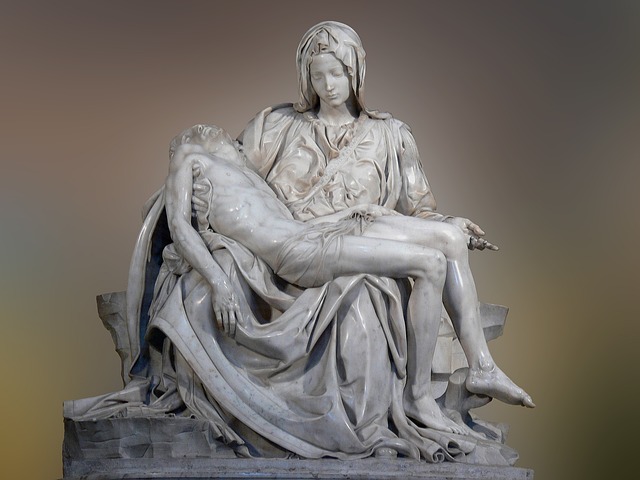
Mary keenly understands loss: the loss of a loved one, the loss of a child, and the loss of a family member convicted of a crime. We may not see her tears on the Pietà, but even with her trust in God, I’m sure she shed her fair share of them; just the sheer overwhelming emotion of Jesus’ Passion and Death would cause that. Sorrow and grief can only be relieved when we share the pain with others, otherwise it becomes a burden too heavy to carry.
In these last days before Holy Week, let us pray to Mary to share her sorrowful burden, as well as for her to help us with ours. She is our mother too and wants to aid us in all our needs, carrying us in her arms like she did Jesus.
 catholicgirljourney.org