My parish offered a pilgrimage for the Jubilee of Hope to the Basilica of Saint Andrew in Roanoke, Virginia. It was like a mini retreat and we had a wonderful trip there. We received a tour of the basilica and the guide asked if we knew the difference between a basilica and a cathedral and if a church could be both. While I was positive that a church could be both, it got me wondering about the first question.
Growing up in the Archdiocese of Philadelphia, I recall people using one of the following: the basilica, the cathedral, or the cathedral basilica. However, as I was thinking back to my time in Philly, I couldn’t recall the actual name of the church! There was a part of me that wanted to call it St. Peter’s, but I squashed that thought, as that would be the Vatican. I was partially correct. The name is the Cathedral Basilica of Sts. Peter and Paul. But what makes a church either one of these designations, or both?
The easy one to start out with is the cathedral. It gets its name from the Latin cathedra meaning throne or chair. This designation is for the church that serves as the parish for the bishop, archbishop, or cardinal of a diocese or archdiocese. There is a special chair reserved for the use by the bishop on the altar of the cathedral. One may consider it the chief or main church of that diocese. If the diocese is large enough, there may be more than one cathedral serving that diocese, although each would be in a different location.
It was interesting to learn what makes a church a basilica. First, it is a church of historical and architectural value and the designation can only be granted by the Pope. A basilica is tied to the Holy Father and is his home base to celebrate Mass when he travels to that region. The seal of the basilica will contain the crossed keys to indicate the connection with the Pope. Other signs of a basilica are the ombrellino, an umbrella-like structure made of red and gold fabric that originally was used to shelter the Pope, and the tintinnabulum or little bell, that is used to lead the procession when the Pope is celebrating Mass. The expectation of a basilica is to celebrate liturgical feasts with enhanced solemnity. They also serve as a place of pilgrimage and can bestow an indulgence when the specific criteria is met.
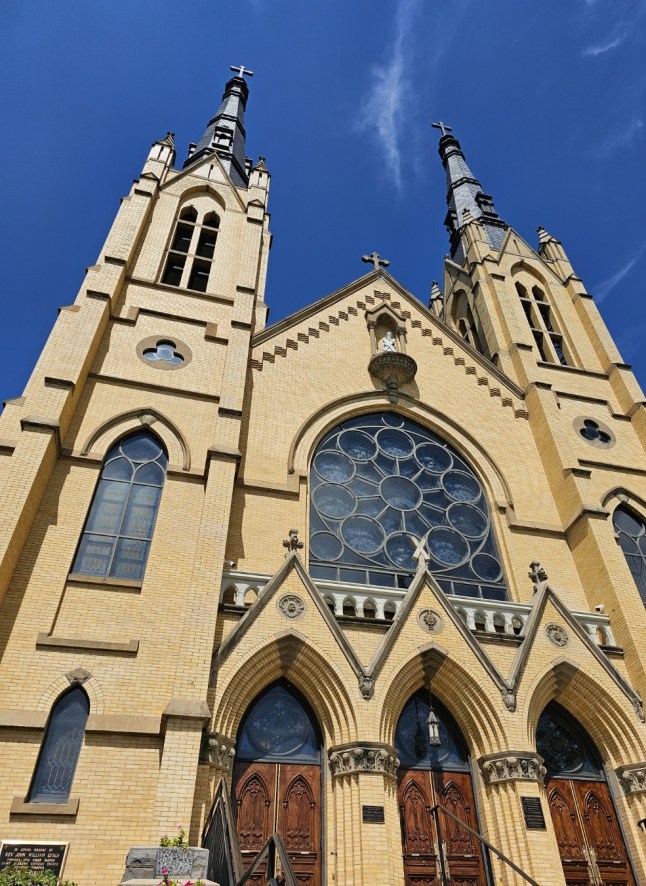
When I was chatting with folks outside of my parish about my trip to the basilica, most initially thought of the one in Washington DC. However, that church is not just a basilica, but also a shrine. The Basilica of the National Shrine of the Immaculate Conception is a place to foster devotion, in this case, to the Blessed Virgin Mary under her title of the Immaculate Conception, since the United States is under her patronage via that title. A shrine is a sacred place and may contain a special relic, be on the site of a historical event, or the site of a spiritual event, like an apparition. When I hear the word shrine, especially as one who was raised in the Philadelphia area, I think of National Shrine of St. John Neumann and National Shrine of Our Lady of Czestochowa. These are places for pilgrims to travel and learn more about the faith, and participate in the Mass or other events hosted by the shrine.
There are 70 national shrines in the United States, and over 90 basilicas. These sacred locations are a wonderful way to explore the spiritual riches in your own backyard, or to venture out somewhere new and seek God from a different perspective.
 catholicgirljourney.org