Catholic Girl Journey

A Story in a Story

“So what’s the game plan?” I’ve heard (and said) on many occasions, but it was never anything regarding a sporting event.  People who have never been professional racers use, “I need to make a pit stop” when they have an errand to complete during their travel from point A to point B. How many of us play “Monday morning quarterback” when we offer our thoughts on how we would have done something differently?

These analogies are familiar to us, yet most of us do not play the sport referenced in our saying.  We may not even follow that sport. I have never watched a racing event, yet I know what a pit stop is, and I’ve used that saying. I may not understand the specific dynamics of the offense versus the defense in football, but I can generally understand the analogies when they are mentioned because the sport is part of our culture. We use these sayings all the time, and as long as people understand the culture, they can understand what we mean. I’m sure in other foreign countries, there are also unique sayings that although composed of familiar words, may not make any sense to us.

Jesus understood this and used parables to teach about the kingdom of God. Our human limitations allow us to only partially begin to understand the divine kingdom. To help us comprehend, Jesus compared it to things we know and understand. Sheep and shepherding were common in His time, and even if the people themselves were not raising sheep, they either knew someone who did, or had enough dealings with sheep that they could understand the references He was making. I have occasionally attended the Maryland Sheep and Wool Festival to purchase fiber, tools, and wheels for spinning yarn. While at the Festival, I have had plenty of time to observe sheep. I’ve seen a sheep crane her neck out of a pen to munch a particular flower – even though the pen was set up over many of the same flowers. My first inclination was to smile and think, “what a silly sheep,” but after hearing the various parables about sheep, I’ve started to see how my actions are similar to those of that sheep: not happy with what I have and straining elsewhere to try and get it.

We hear parables often during the Gospel at Mass, but because times have changed since then, some of those stories can be hard for us to fully appreciate. It’s all too easy to say “I don’t understand therefore it’s not important to me.” I’ve often wondered what sort of sport Jesus would use in telling his parables today and if I would be able to understand them better? Maybe the parables are given to us to make us think a bit more about the story and to remember the point more easily.  When you encounter a difficult parable, it helps to ask Jesus in prayer what He meant. Perhaps these stories are to instigate a deeper relationship with God by drawing the listener in little by little as the story is pondered and prayed about, calling us to use the experiences in our daily lives to go deeper the next time we hear that story. And maybe someday we will see the story of the kingdom of God unfolding  from the everyday because of the framework provided by Jesus’ parable.

Catholic Girl Journey

The Healing Touch of God

In a prayer he composed to recite before saying Mass,  St. Thomas Aquinas says he comes, “as one infirm to the physician of life.” One doesn’t necessarily think that a saint would be infirm or sick, especially approaching Mass. Yet that is what we all are, since we are all sinners.

Sickness, disease and wounds have all been physical metaphors for sin. There are numerous Psalms (6 & 32 come to mind) that speak of physical ailments and call for God to heal the soul. But in this age of modern medicine and technology, can this metaphor be maintained? Actually, I think it may even enhance the way we look at sin and the struggle we have against it.

God is the Divine Physician, but healing may not come overnight.  Sometimes, it’s a lifelong process or “treatment” like for someone who has high blood pressure. It needs to be monitored, and medication and diet changes may be needed to keep it under control. For other sins, God may need to do a bit of “surgery” on us that could leave some scars. It takes time to heal after surgery and for the scars to lessen, but they may not ever really go away. In a way, those scars can remind us of the pain and suffering a particular sin caused and help us better avoid it in the future. And other sins can be like overindulging in food; we can’t avoid it since it is necessary to live, but we can be on guard of the temptation to eat too much.

A sin can be both simple and complex. It’s all too easy to look at the 10 commandments superficially and say that you follow them all. But take a closer look, and they go much deeper than just the words. For example, “You shall not kill,” is not just about not taking a life, but about being life-giving, treating people with  the respect and dignity they deserve as children of God. It’s also about forgiving those who may have injured us.

Jesus once answered the Pharisees by saying, “Those who are well do not need a physician but the sick do. I did not come to call the righteous but sinners.” (Mark 2:17). Jesus is calling us, you and me. He wants us! He wants to heal us. He want to forgive our sins and tell us, “do not sin again.” (John 8:11) But in order for that to happen, we need to present our sins to Him, admitting the bad habits and ugliness of our lives. Only then, can we get the medicine, the treatment or the surgery that our souls need in order to live in Christ.

Catholic Girl Journey

One Step on the Journey

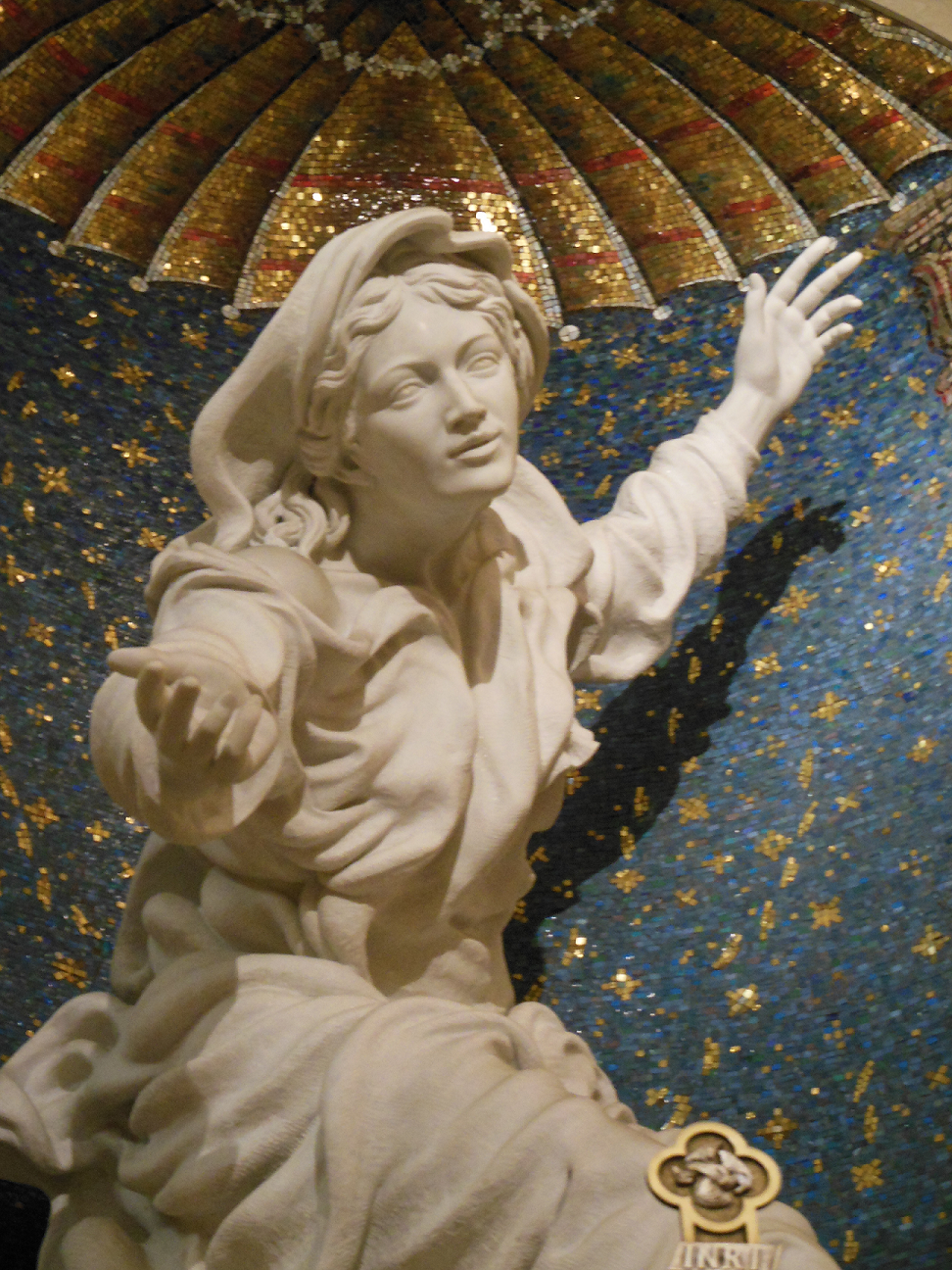
Image at Nashville CathedralIt was a very special occasion. Besides his attire, he looked no different than you or I. But he has been marked by God. As for me, it was all chance (or God’s design) that I happen to be there. If it hadn’t been for the announcement prior to the celebration, I would have never known.

Work had brought me to Tennessee, so I extended my trip to see a bit of Nashville, scheduling in Mass at the Cathedral of the Incarnation. I was excited to see what would be different. That’s one of the fun things about going to Mass when traveling, each church does things just a bit differently. Sometimes it’s the music and sometimes it’s the way you’re greeted or a special prayer that is said before Mass starts. I had no idea it would be such a special celebration. It was the first Sunday Mass of Father Andrew Bulso and only  the second in his ministry. He had been ordained just the Friday before.

Beautiful. Both the Mass and cathedral. I think what amazed me most, is that just three days prior, Fr. Bulso did not possess the ability that he had that day, to say Mass and to consecrate bread and wine into the Most Precious Body and Blood of Jesus. Through the imposition of hands and the anointing by the bishop, Fr. Bulso had become a priest marked by God. The priesthood is a gift Jesus gave the Church to continue His mission of bringing the kingdom of God to us. Although it was not my parish, it reminded me that tomorrow’s priests come from our church family of today. We may not know who they will be, but they are among us.

Holy Orders confers an indelible mark on the soul; it cannot be seen, but it changes the individual. While the preparation for the ordination does take years of study, it is a moment in time that changes the person. Much like the Last Supper for the Apostles, the time spent learning at the feet of Jesus prepared them for that night when He instituted both the Eucharist and Holy Orders. Jesus gave his priests  the ability to feed His Church, both in Word and deed. It continues down to our day, as each bishop ordains the priests, who may one day become bishops and repeat the process.

There are men in our parishes and dioceses who are called to this most unique vocation. So say a prayer they will be open to God’s call. Say a prayer for those who have answered and are in formation for the priesthood. And say a prayer of thanksgiving for priests  who celebrate Mass, from their first to their 20,000th and beyond; for each one is just one step on the journey of faith.

Catholic Girl Journey

Going the Distance

It’s summer now and I as I was walking on a trail by my home, I was thinking of the apostles and the disciples who walked the Roman roads to spread the Kingdom of God. Now the trail that I was on, was a former railroad that has been paved over with nice, smooth asphalt. The Roman roads, however were engineered with stones. While they may have tried to make them as flat as possible, I’m sure all the people, carts and animals that used those roads made for less than a flat walking surface.

It’s over 1,000 miles from Jerusalem, Israel to Rome, Italy. That’s a lot of miles! Now some of the journey could have been by sea as well. We know that Peter and Paul were both martyred in Rome, so they made that journey. Peter also did a lot of traveling with Jesus, from the Sea of Galilee to Jerusalem and around the surrounding countryside. Their journey of faith was both a spiritual and a literal journey. They went to places where they did not know people and tried to share the Word of God with them. In some places they were welcomed and received well, other places they may have been harassed or even threatened with death. Yet they still kept going.

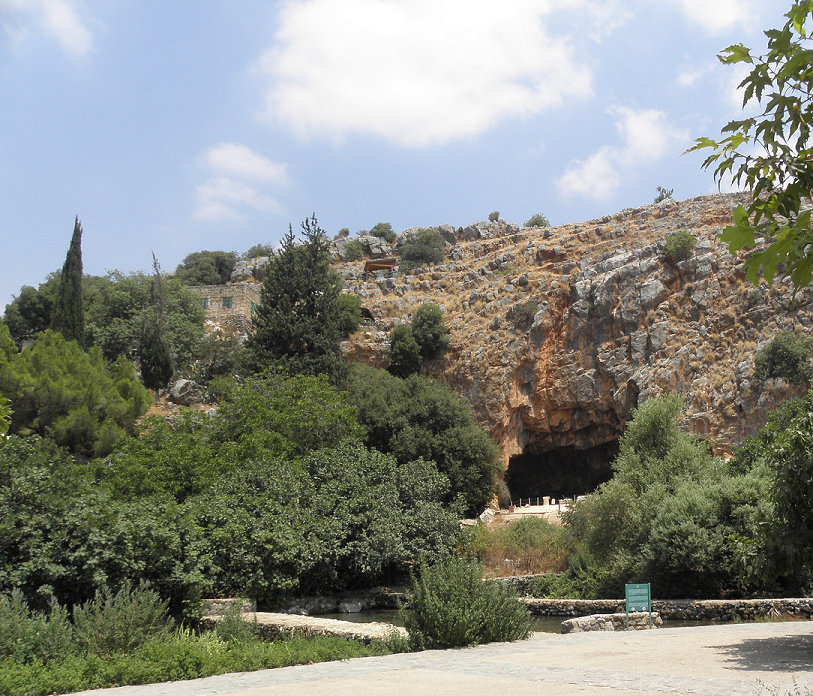
Countryside in Israel

Countryside in Israel

I made the mistake of using my hiking sandals for my first walk of the season on the trail. As my feet started complaining about the walking, I wondered about the apostles and disciples. How many pair of sandals did they go through? Or did they even wear any type of footwear at all  when walking? While I’m proud of the two and a half mile walk that I made, at least I was able to come home and rest. For them, reaching the destination was just the beginning. The real effort was teaching about Jesus.

So the next time you’re out walking/hiking/biking in the wonderful summer weather, remember those first Christians and say a prayer of thanksgiving for all the miles they logged. Then ask yourself, how far would I travel for Jesus?

Catholic Girl Journey

Standing for Faith

Be bold. Be Catholic.® That is the motto at Dynamic Catholic, a lay organization whose mission is to re-evangelize Catholics in their faith. I’ve often wondered what that could entail, as I am a very shy person and talking about my faith to strangers does not come easily. However, to be a bold Catholic does not mean you need to preach on the street corners, but rather to be bold enough to stand up for the faith in the every day.

I was at dinner with colleagues from work and the conversation turned toward our education. When I mentioned that I had 16 years of Catholic schooling, one colleague said he could commiserate and that he was “recovering” as well. Quite honestly I was shocked and somehow my response was, “I’m not recovering from anything. My education has made me the person I am; I’m happy to be a Catholic.” I don’t know if he was joking or or trying to be funny, but it was then that I realized how important it is to stand up for the faith. It’s one thing to make a joke about the exercise one gets participating in a Mass with all the standing/sitting/kneeling. It’s quite another to compare Catholic education to a bad habit that one needs to learn how to overcome.

In Luke 5:9-11. Jesus calls the first disciples, Simon Peter and Andrew, by telling them, “Do not be afraid; henceforth you will be catching men.” When we are faced with awkward situations, we need to lean on the Holy Spirit, as the first disciples did when standing strong for the faith. We do not know how the Holy Spirit could use our witness to the spiritual betterment of another. It’s not our job to convert someone, but our job to be a faithful witness to allow for the conversion. It could be as simple as blessing oneself before a meal in a restaurant. It could be objecting to the use of Jesus Christ as a profanity alternative. Or it could be taking pride in the Catholic faith you confess. Others won’t learn to respect the Catholic faith unless we Catholics demonstrate our respect  first. And that is what is standing up for the faith is all about.

Catholic Girl Journey

Walking with Mary

I’ve heard that saying the rosary is like presenting a bouquet of roses to the Blessed Virgin Mary. For me, though, it is a walk through Mary’s life with Jesus.

The Rosary may sound simple enough with the main prayers consisting of the Our Father, ten Hail Marys and the Glory Be over 5 decades or repetitions. But the gold of the rosary is the mysteries that are pondered during each of those decades. There are 4 different sets of mysteries that present Jesus’ life.

The Joyful mysteries start at the beginning of Jesus’ earthly life. In fact, it could not start any earlier than His conception in Mary’s womb. The first joyful mystery is the annunciation of the angel Gabriel to Mary, where she consents to be the Mother of God and conceives Jesus. The second joyful mystery sounds like it’s all about Mary visiting Elizabeth, but one only needs to read Luke 1:39-56 to see the impact of the presence of Jesus on both Elizabeth and her unborn son. The third and fourth joyful mysteries present the nativity of Jesus and His presentation in the Temple. The fifth joyful mystery is one of my favorites, the finding of Jesus in the Temple. At age 12 Jesus is “left behind” while His parents, thinking He is part of the caravan, start the return to Nazareth. For me it is a reminder that whenever I feel far away from God, He is as close as the nearest Church.

After walking with Mary during the formative years of Jesus, the Luminous mysteries walk with both Mary and Jesus through his ministry: the baptism of Jesus in the Jordan, the wedding feast of Cana, the proclamation of the Kingdom of God, the transfiguration on Mount Tabor and the Institution of the Holy Eucharist. While Mary may only be explicitly mentioned in the gospel  for the wedding feast at Cana (John 2:1-11), I’m sure she was as close as she could be for these and all the other events of Jesus’ life.

The sorrowful mysteries walk us through the painful events leading up to and including the death of Jesus. Beginning with the agony of the garden, then the scourging at the pillar, the crowning with thorns and the carrying of the cross, praying the Hail Mary while contemplating these mysteries can help us have compassion for Jesus and more fully explore what Jesus went through to save us from our sins. I don’t think most people want to dwell on these sorrowful events, however praying these mysteries, or walking through them with Mary will help us to the fifth mystery, the crucifixion. To pray the fifth sorrowful mystery, is like standing with Mary at the foot of the cross. It is only through Mary’s strength that we can pray with her.

The glorious mysteries of the resurrection and the ascension round out the earthly life of Jesus. Yet the descent of the Holy Spirit was Jesus’ promise to the disciples and Mary was there (Acts 1:14). The fourth and fifth mysteries seem to be about Mary: the assumption of Mary into heaven and the coronation of Mary as Queen of Heaven and Earth. However, she is assumed into heaven, that is by the power and will of God, not by her own power.  God brings her body and soul into Heaven. Nor does Mary crown herself, but it is the Trinity that confers this honor to Mary.

Each set of mysteries provides much to contemplate during prayer. Saying just one set of mysteries a day recalls just a portion of Jesus’ life. But with Mary as our guide, we can come closer to her Son and appreciate all He has done for us. It is truly a walk of life.

Catholic Girl Journey

The Grace of Confession

Once as a child, I was sick on my birthday. Cards that were sent from my extended family were brought to me, and one unopened one got mixed with the empty envelopes. It was discovered only as they were being torn in two before being thrown away. I was very happy that it was noticed, as it contained a five-dollar bill. While five dollars might not mean as much now, to a young child many years ago, I was upset that it could have been trashed.

The sacrament of confession is a lot like those birthday cards, it is the delivery method of something special, the grace of God. I think that gets forgotten by many Catholics. Often they go before Christmas and Easter because they think that’s when they are supposed to go. Maybe they don’t go at all if it’s not convenient. But that’s just like throwing the gift of God’s grace away.

No one is perfect, God knows that, so he gave us the wonderful sacrament of healing. Confession is work; one must prepare by examining all they have thought, said, done, or failed to do. But the fruit of that labor is not just to apologize to God and ask for His forgiveness, but to seek to avoid those sins that are confessed. It can be frustrating to confess the same sin time after time, but each time we receive the grace to help avoid that sin either for a longer time or lessen the impact when we do commit it. While it may seem that we’re not making progress, we are actually being “spiritually strengthened” (Catechism of the Catholic Church 1496) and should take comfort and peace that we have been reconciled with God and the Church.

In my parish, there is a priest available each week, however according to the Catechism, priests  “must make themselves available to celebrate this sacrament each time Christians reasonably ask for it” (CCC 1464). While confession is needed for someone who has committed a mortal sin in order to participate in the other sacraments, the graces are available to all as often as they celebrate this sacrament. And to be healed by God is something to celebrate!

Catholic Girl Journey

Glory Be to God

I was once asked what my favorite prayer was. I had to think about it, but my answer ended up: The Glory Be. Some may think it’s because it is so short. Others may think it’s because it provides the opportunity to both praise and ponder the Glory and Eternity of God. But really, I like it  because it gives praise to God as Trinity: Father, Son and Spirit.

The Trinity is one of those mysteries of the Catholic faith that we humans can never fully understand with our finite brains. I think most of us have an idea about it that makes sense to us, either that or we just don’t think about it much. While I am no different than others in my lack of true understanding, what I can appreciate is God is one in three persons.  The Catechism tells us that the divine persons do not share the one divinity among themselves but each of them is God whole and entire.

Prayer is a conversation with God, so when you pray, who do you talk to? Do you pray to God the Father? Praying the Our Father is exactly that. How about praying to His Son, Jesus? Well if you hear the priest at Mass, most prayers are “through Jesus Christ,” and are offered on your behalf, so it’s as  if you said it yourself. But how about the Holy Spirit? While there are a few prayers out there for the Holy Spirit, the Spirit is not invoked as often in prayer.That is why I like the Glory Be, because it does include the Holy Spirit.

I like to use the comparison of speaking to another person. If you know someone who is a fan of a certain sports team, even if you don’t like the sport or the team, you would still inquire about that interest, because it’s important to that person. It’s the same way with God.  Sure, you can focus your attention on one of the Persons of the Trinity, but wouldn’t the relationship go deeper if you recognized all of the Persons?

The Glory Be is so simple, but it speaks volumes. It praises God in all 3 Persons and acknowledges this glory across time: in the beginning, now and evermore. How amazing is it, that we can pray these words and express what remains a mystery to us.

Catholic Girl Journey

Are You Mary or Martha?

I must admit, when faced with the question of whom I am the most like, I have to say I feel I’m more like Martha.

In this age of self-help and you can do anything you want to do, it is very easy to fall into the lure of control. While I know I can’t control everything, I do have a tendency to want things to go a certain way. It’s more than making choices, but trying to making the choices that will lead to what I want. As one who enjoys cooking and baking, I can sympathize when Martha asks Jesus to make Mary help her out (Lk 10:40). After all, she wants things to be just right for Him. Wouldn’t Jesus have asked Mary to help Martha if it was His will, even without Martha asking? I don’t think Martha realized than she was ordering God to do something for her so that her will might be done. How often have I prayed for things of that nature? Oh, just every time I go on a long trip, it’s: “God please see me safely there without incident.” While I don’t think anyone would actually pray for something to go wrong, I think the prayer should be modified to include, “as long as it is Your will.”

For Mary,  the food prep and serving would  always be there, but  she must have known that Jesus would not. Instead of being anxious about tasks, she sat  at Jesus’ feet and listened. Anxiety is the fear of not being in control. How can I be more like Mary and less anxious about things? By sitting at the feet of Jesus and giving over my concerns to Him and, most importantly, listening. I do try to turn things over to God, but then I start to wonder how situations will play out, or how I should prepare myself, and the old anxiety creeps in. It is important to recognize that and to always try. I know Jesus will always be there for me and with me in every situation.

How much more can my life be stress free if I turn everything over to Jesus? It doesn’t mean not planning things, otherwise nothing would get done. It’s more about planning and then turning the actual events/situations over to Jesus to watch over and guide me when the unexpected occurs. Sometimes it’s in the detours of life that the greatest blessings come.

Catholic Girl Journey

A welcome distraction?

Cars whizzing by, chirping birds and buzzing cell phones are just some examples of noisy distractions in our everyday lives. When you’re trying to quiet yourself to pray, those sounds seem like they are ten times louder.

I’m lucky enough to have an adoration chapel at my parish, but even in there, a cough, a clearing of the throat or the sound of turning pages in a prayer book feel like a conspiracy to prevent me connecting with God. One would expect that at Mass it would be easier, right? Not so, and in addition to the noises is added the antics of little children.

It’s at those moments that I recall my college Native American literature class. Not only did we read the stories, but we also learned a bit about the culture. One of the tribes from the central plains would allow the children to be, let’s say, mischievous during certain religious ceremonies. They were allowed to pinch people, sprinkle them with water and pranks of that sort without repercussion. The theory was that the adults would learn how to concentrate more on the ceremony and less on what was going on around them. I wonder if God is allowing those distractions for me to practice paying attention to Him. If I can’t put aside the distractions at Mass, how can I listen for Him in the everyday distractions?

Another thought that comes to mind is when Elijah was waiting for the Lord to speak to him (1 Kings 19:11-13). God was not in the strong wind, the earthquake or the fire, but rather in a tiny whispering sound. Perhaps God is speaking in what I’m calling a distraction and I’m not paying attention. Maybe that cell phone going off in the middle of Mass is a reminder for me to pay closer attention to what is going on instead of letting my mind wander. The crying child could be a reminder of the tears Jesus shed for me and that I need to be more open to His will for me. And the next time I feel distracted, I can use the distraction as an opportunity to ask Jesus to help me focus on Him.