Catholic Girl Journey Logo

Deposit of faith

The end of Matthew’s Gospel could be used as the statement to sum up the Catholic Church: “Go, therefore, and make disciples of all nations, baptizing them in the name of the Father, and of the Son, and of the holy Spirit, teaching them to observe all that I have commanded you. And behold, I am with you always, until the end of the age.” (Matthew 28:19-20)

The words recorded by Matthew were received by the Apostles. After being filled with the Holy Spirit at Pentecost, the emboldened disciples not only preached, but also most gave their lives for the faith. The direction is not just to the Jewish people, but all people. The call for baptism is a visible sign of the person’s change towards a life in relationship with Jesus. The baptized now become part of the community with the Divine. The teachings are more than the Mosaic Law followed by the Jews, but a law taken to a higher level, a law of being: the Beatitudes. Jesus promises His presence will remain, not just in the memory of the Apostles, but alive in the community — through the sacraments, especially the Eucharist, as well as the guidance of the Holy Spirit leading the Church. 

I’ve heard it on more than one occasion the suggestion that the Catholic Church is an old fuddy-duddy institution and needs to get with the times. The wheels of change seem to move too slowly in the Catholic Church. Yet the whole point of the Church is to preserve what Jesus taught and to continue teaching in each generation. Upon the publication of the Catechism of the Catholic Church, Pope John Paul II says, “Guarding the deposit of faith is the mission which the Lord entrusted to His Church, and which she fulfills in every age.” The revised Catechism is rich and deep, and is a product of the inspiration wrought from the Second Vatican Council. I love the words Pope John Paul II uses in describing it. “The principal task entrusted to the Council by Pope John XXIII was to guard and present better the precious deposit of Christian doctrine in order to make it more accessible to the Christian faithful and to all people of good will. For this reason the Council was not first of all to condemn the errors of the time, but above all to strive calmly to show the strength and beauty of the doctrine of the faith.” (emphasis added)

While some may think reading the Catechism is a great way to fall asleep, that can be said of any textbook someone tries to read for entertainment. The Catechism is not a story, rather it contains an in-depth plunge into each line of the creed, each of the sacraments, the necessities of living a moral life, the ten Commandments, as well as an entire section dedicated to prayer. This amazing tool can inspire the faithful and help guide and clarify when questions arise. It illustrates why we can’t ask the Church to change based on what our secular culture wants. 

In each generation the practices of the Church look a bit different, especially when compared to the societal ways of each time. I think it can be hard in our modern standards to realize just how rebellious Jesus was. No man would even talk to a woman who was not in his family, yet Jesus spoke to many, healing them too. While charity does have its roots in the Jewish faith, the Christian tradition took it to new levels. Today, it is so commonplace, it has become ordinary —  part of the fabric of what it means to be human. It is upon us Catholics to continue, as members of the Church, making disciples of all nations, by our being. As we observe the commandments of Jesus, we continue weaving the fabric of the Divine into our world.  

The faith is a true treasure, and the Church not only guards it against the cultural weaknesses in each era, but celebrates and brings to life all those who seek its wealth. I’m looking forward to seeing what the Holy Spirit will inspire next!

Catholic Girl Journey Logo

Routine interruption

My routine is about to be interrupted. In some ways it already has. While routine is good, perhaps a little shake up now and then is good for getting a different perspective. 

I’m in the midst of a bathroom renovation. While there has been some preparation work completed in the main bathroom, most of the actual work is waiting to be added to the schedule. My half bath has been halfway completed, as I’ll need to use that while the main bath is being done. As much as I’m looking forward to a brand new bathroom, I’m not exactly thrilled at the prospect of roughing it for a week or two. As I was packing up all the non-essentials to get ready for the work, I did need to take out only what I absolutely needed. While I don’t use bandages every day, do I really want to pack them away? What if I need them? The same goes for the pain reliever in the event I have a headache, which thankfully doesn’t happen often. If my chances for these happenings were the same as me winning the lottery, I could pack them with every bit of confidence. Yet I agonized over the decisions. 

What has been completed so far in the project is making me very excited for the final finished product. I’m looking to enjoy many years and decades from this investment; but it made me wonder…do we look at our spiritual lives in the same sense? Are we investing in our relationship with God so that we can be excited about heaven and look forward to spending eternity with Him? Perhaps we need a little interruption to our spiritual routine, one that is an investment that we seek out, rather than the shake up caused by a pandemic. Do we take inventory of our daily practices to determine if they are merely routine habits or vital lifelines in our relationship with God? One of the blessings of the Catholic Church is the wellspring of ways to connect with God. From the Rosary to the Divine Mercy Chaplet to the spiritual exercises of St. Ignatius, I don’t think 24 hours is enough time to practice all the prayers and novenas in existence. Yet choosing one over another can make one feel a bit guilty for making that choice.

Outside of Mass and regular confession, a Catholic’s prayer practice is entirely up to each individual. One method does not serve all. Question what you like or don’t like about a practice and why. Perhaps the prayer is uncomfortable because you need to grow, so caution is required when deciding what to include. It’s not all about how the prayer makes you feel, although when you do experience deep peace, that may be a sign to keep practicing, especially if it seems tough. The best practices will lead you to examine yourself and your actions in comparison to Jesus and His teachings. We’re here not to be stagnant in who we are today, but to continue to grow to become the best versions of ourselves. The best will take our whole lifetime and include mountains, valleys, and plains in the growth process. We are on His timetable, not ours. It is His will for us, not ours. And if we don’t know, ask Him!

Routine can be a comfort to us, or a crutch. Interrupting our routine allows us to reflect on our practices, recommitting ourselves to those that lead us to a closer relationship to God. It’s not what we do, but how and why we do it: full of faith to become intimate with our Creator, Redeemer, and Sanctifier. 

Catholic Girl Journey Logo

Knowing Jesus now

If a recent Gospel reading from Matthew (12:1-8) is any indication, the Pharisees were fascinated by Jesus. So much was their interest, they watched and commented as Jesus and his disciples walked through a grain field on the Sabbath. 

I’m curious to know where that field was located. I’ve seen fields like it usually out in rural places. Why were the Pharisees in the vicinity so that they could see the disciples picking the heads of grain and eating it? It seems the Pharisees were very attentive to Jesus — following Him to remote places, yet their perception of Him remained unchanged. They, who have studied the Scriptures that heralded Jesus’ coming, didn’t even recognize Jesus in their midst. Perhaps their interest in Him was actually a sort of acknowledgement of His divinity from deep within their hearts, but their intellects would not let their minds be open to accept Him. Yet how many of us would be able to recognize Jesus in our presence today? 

When I see how much the Pharisees went against Jesus, I understand how valuable it is to cultivate a relationship with Him by accepting his life and his divinity now. How can I enjoy heaven if I have no idea who God is? Heaven is not about doing all of our favorite things, but rather spending time with and in Love, personified by God the Father, the Son, and the Holy Spirit. We need to start seeking Jesus now. We need to be open in mind and heart to the promptings of the Holy Spirit. 

One way to do so is to practice looking for Jesus in others. That means we treat each person as if they represent Jesus. Not only will others receive better interactions from us, but we, in turn, show them Jesus by our actions imitating Him. If we continue to seek Jesus in every person we meet, we will be able to see and know Him, not just in this life, but also when we pass from it. This is how death loses its sting, since we won’t be going into the unknown; our friend Jesus will be waiting for us. We will be able to see Him as He truly is, not just in the bits and pieces from the encounters we have with others, but wholly and completely. When we leave this world, we should be excited to see Jesus and for Him to welcome us home.  

Knowing Jesus now, is not a matter of intellect, but of action. Yes, we do need to read Scripture, but it does not end there. Jesus came to call us into His family, into a relationship with Him and each other. If you count up all the billions of people on this planet today, each made in the image and likeness of God, and add all the people who have come before us as well as those who will come after us, that’s a mind-boggling amount of facets that reflect a little piece of Jesus. And He is more than the sum of each person, infinity may not be long enough to really know Him. However, it’s never too early or too late to start a relationship with Jesus. 

“Behold, now is a very acceptable time.“

2 Cor 6:2
Catholic Girl Journey Logo

A different way

If the word ‘history’ is mentioned, many will roll their eyes and immediately think whatever comes next will be a boring commentation with a bunch of dates thrown in which confuse the listeners. Yet in  researching Church history for an RCIA presentation, I found myself wishing there was a way I could better understand and communicate the rich, diverse, volatile, and holy activities woven throughout the last two thousand years. 

Some may compare the Church to an old, lumbering lady — slow to change and only when it is absolutely necessary. But the Church is not about what each individual thinks and feels, rather it is concerned about bringing about the love and mercy of Christ to each person so they can have an intimate relationship with God. From its infancy, the Church has had to address challenges and misconceptions; just peruse the Acts of the Apostles and the various letters within the New Testament. Each Sunday, and particularly in the Easter season, within the liturgy as portions of these Scriptures are read, we realize that some of the same struggles in the early Church continue today. While the circumstances may be different, as well as the subject matter, the scenarios can be way too familiar to our day. It’s one of the reasons why these letters are so important: we can see ourselves in history (which has already occurred) and learn from it instead of being destined to repeat it.

Jesus’ message was radical and His actions were scandalous to the Jews of His time. He talked to a Samaritan woman (a double no-no). He touched lepers (ritually unclean) to heal them. He charged His followers to eat His flesh and drink His blood (the Eucharist) in order to have eternal life, and He willingly gave up His life by dying on a cross and being buried only to rise on the third day from the dead. Any one of these could send a potential disciple running in the opposite direction.

With persecutions, a common practice in the first 300 years of the Church, it’s quite amazing how it continued to grow. Start sprinkling in various heresies that weakened beliefs along with political aspirations that infiltrated the hierarchy at times and miraculous is the only way to describe the  Church’s survival over those years. But the core mission of the Church influenced many men and women throughout the ages to help wrangle it back to its foundation and purpose. These saints helped shape the way the Church proclaimed the Good News.

St. Francis of Assisi may be remembered as the saint who talked to animals and is credited for bringing the crèche to the Christmas decor, yet his response to Jesus was a radical devotion  of himself to God. This saint of the 12th and 13th centuries gave up all wealth to minister to the poor and live among them. Thousands of men followed his example, even down to this very day. In our modern times: Saint Teresa of Kolkata, fondly remembered as Mother Teresa, served the poorest of the poor in India, ministering to them personally. The Missionaries of Charities, founded by Mother Teresa, includes branches of active and contemplative sisters and brothers as well as priests in countries all over the globe. 

Under the guidance and influence of the Holy Spirit, the Church has taken the time to reflect and refocus the lens of perception on its mission and purpose throughout the changing times and societies. It has seen the rise and fall of empires, political powers, and revolutions. It’s call is the same across the ages: The kingdom of God is at hand; repent and believe in the gospel.

Grape leaf and bunch of grapes gilded on a church door in Israel

Best wine

I was reminded recently of Jesus’ first miracle which took place at the Wedding Feast of Cana and found in John’s Gospel (2:1-11). I love the detail about how the head waiter comments to the groom about saving the best wine until after the guests had already been drinking an inferior one. When I look at that statement with a logical mind, I think, “Of course, it was water turned into wine by Jesus. He’s not going to make something inferior.” However, I think there is a deeper meaning to the wine being of better quality. Jesus as the bridegroom of the Church has been taught throughout Church history and the marriage of heaven and earth is through the salvation efforts of Jesus. 

The wine at the Wedding Feast of Cana can be viewed as a symbol of our life, and when we complete our life on earth, the life that comes next is far superior. Jesus did remark to His mother that His time had not yet come to perform miracles, yet he proceeded in doing so. Was it because His mother was insistent, to the point of directing the wait staff to follow the directions Jesus gave them? Or was it because He could use the opportunity to teach people that while they may enjoy life now, a far better life is yet to come? 

I do enjoy a glass of wine and I like sampling them at wine tastings. There is always an order: light white wines first, then the heavy reds, and sometimes finishing up with the sweet dessert wines. If you try sampling them out of order, it can be hard to cleanse your palate enough to taste something that is more delicate in flavor and you can’t appreciate it as much. It doesn’t indicate they are not good wines, just that the flavor is affected by what we have consumed prior to it. I can see how heaven would be a wine that is light and delicate, yet full of fruit flavor. We may think our life on earth is a glass of bubbling champagne, or maybe a refreshing blush wine. We may enjoy it while we are living our earthly life, or maybe the bubbles are too much for our taste. Whatever the situation is, the wine of heaven will be suited to our taste, and the best we have ever had.

Wine is composed, on average, of over 80% water. While it is still miraculous that Jesus turned the other amount into the elements that make up wine, He still started with the basis of water and enhanced it. That is one of the hallmarks of being exposed to Christ, you don’t remain the same person you were before encountering Him. Being God, Jesus could have turned anything:  lava or wood or some other object, into wine. Yet, He chose to turn water into wine. Something so similar in composition yet drastically different. 

Our lives are changed when Jesus enters our lives. For those who welcome Christ into their lives and seek a relationship with Him, He promises life eternal far superior than we can ever imagine or taste. Cheers!

Catholic Girl Journey Logo

Filters of life

I found it rather ironic that the sunglasses I bought from Two Blind Brothers could allow me to see what I hadn’t before. 

After seeing so many advertisements from Two Blind Brothers and needing a new pair of sunglasses, I decided to give them a try. I wore my new shades the same day I received them and after getting into my car, I thought there was something odd about my windows. The windshield was fine, but when I looked a certain way through the side windows, I could see a web of darker tinting in the glass. I kept looking back and forth between the two trying to figure out what was happening. I then looked over the sunglasses and the pattern disappeared! Hmmmmm… Something in the sunglasses was enabling me to see what isn’t usually visible — the unique properties of the glass used in car doors, perhaps the treatment they use to resist shattering upon impact. 

I’m sure the automakers do not intend for drivers to see how safety glass is made; all that matters is that it works. Seeing the pattern did not enhance my safety nor cause distraction. Yet I can’t help but wonder: what else am I missing; what am I not seeing? I think it’s common enough for us to think our vision is good, that we don’t need any correction; or for those of us who do require corrective lenses, they are enough. But blindness can be far more than lack of physical sight, it can also be a lack of perception in our relationships with family and friends, in our workplace, as well as our relationship with God.

For about 180 days, I’ve heard Fr. Mike Schmitz begin the Bible in a Year podcast saying, “we encounter God’s voice and live life through the lens of Scripture.” The story of salvation is not a collection of bedtime stories about ancient people, but rather a how-to manual for life. Our relationship with God affects our relationships with others. When we learn to trust in God, we are richly blessed and bring blessings to others. If we treat the Bible like any other book, expecting to read it cover to cover, it can be confusing and intimidating since it’s not just a book, but a library of books. When we understand that the different books were written for specific audiences and particular purposes, the story of salvation unfolds in a uniquely personal way. St. Jerome remarked, “Ignorance of Scripture is ignorance of Christ.” From Catholic Study Bibles, containing commentaries and a plethora of footnotes, to Bible studies like Walking with a Purpose, to the Bible in a Year podcast, there are many ways we can pursue getting to know God better. It’s not only about reading the words or listening to the stories, but finding out more about the book, the time period, and the people that brings the Bible alive! Diving deeper into the Scriptures allows us to put on different filters or perspectives, seeing not just how much God loves Israel, but how He loves us, even in the chaos of our own times. 

The first step can sometimes be the hardest: acknowledging that our perspective is limited. However, with prayerful guidance of the Holy Spirit when we make it a priority to seek out God through the Scriptures, we will be rewarded, not just with blessings on earth, but with a vision of the Kingdom more lovely than anything we can ever see within creation.

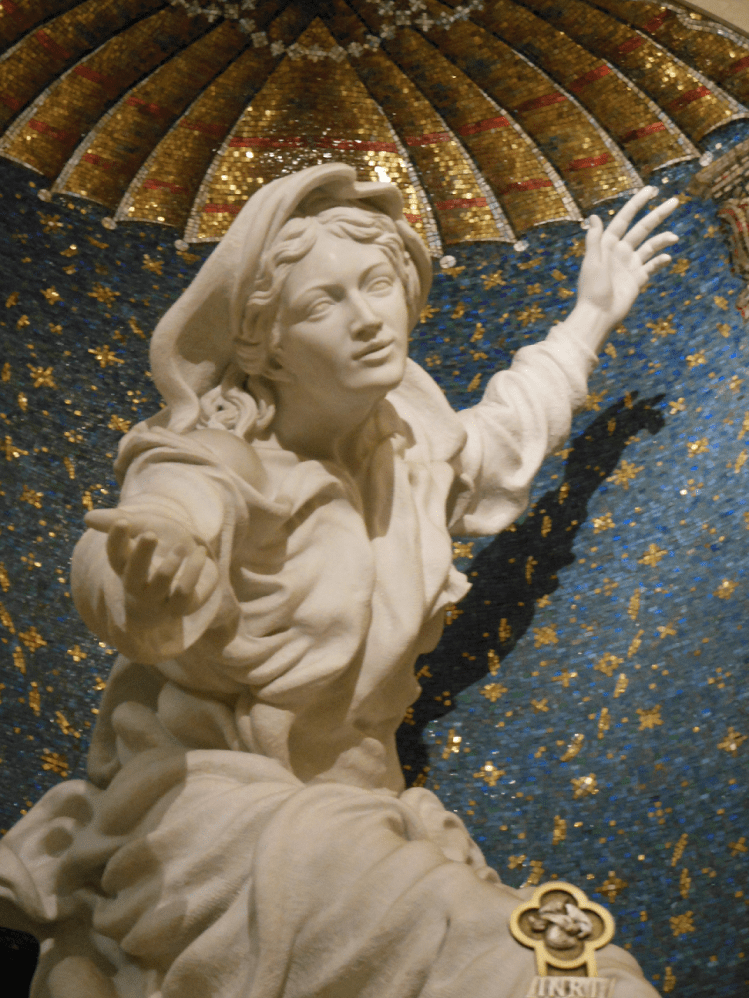
Mary at the Cathedral of St. Matthew the Apostle, Washington DC

Mary our mentor

Recently I received an email from Ascension with a short video about the vocational callings of Fr. Mike Schmitz and Fr. Josh Johnson. While their ‘yes’ to God was not quite as straight-forward as the Blessed Mother Mary’s fiat, reflecting on their stories brought a new appreciation for Mary as well as for those who profess religious vows.

The comment that struck me the most was when Fr. Mike indicated that as a youngster, he thought priests were perfect. From the laity’s perspective, I can see how those in religious life appear to have a connection with the divine that ordinary people don’t. I think we hold them to a higher standard, expecting them to be beyond reproach.  That’s also why it can be devastating to us when their failings are revealed. Rather than putting them on this pedestal of perfection, we need to remember they made a choice, a commitment to say ‘Yes’ to God for their whole lives and in every part of their lives, including family and career choices. When we are struggling or having doubts about what God is calling us to do, we only need to reach out to our local parish priest for guidance. Priests and religious that minister within communities are wonderful resources for prayer and guidance. They are like us, part of our community, and they understand our struggles to follow the call of God.

Community is what God IS: Father, Son, and Holy Spirit. Community is also what God wants for us: to be in communion with Him, by being His Body for others and ministering to one another. Participation is what a community does, how it acts. God wanted us to participate in salvation history. He asked Mary to be the vessel in which His Son took flesh to walk among us. While Abraham may have been  first to say ‘Yes’ to God, Mary was the first to experience the full communion saying ‘Yes’ brings. 

Praying the rosary or just a simple Hail Mary, we invoke the spiritual assistance of a Mother who constantly pleads on our behalf to Her Divine Son. We rejoice in her agreement to participate in God’s will, not just for herself, but for all creation. She is a mentor for all of us, but most especially for priests and religious, who vow their lives in service to God in imitation of her. And for those times when we need to interact on a human level, we can look to those dedicated spiritual sons and daughters of Mary to provide guidance and support in our challenges and struggles. 

In thanksgiving to all priests and religious, let us say a Hail Mary or two, lifting them and their struggles up to the Mother who showers grace on all of us as her response. 

Catholic Girl Journey Logo

Resulting success

No one wants to fail. No one sets out with the intention of failing. We may lack confidence in our ability to succeed, but we all want to succeed in every aspect of life. Yet God does not ask us to be successful, rather He wants us to be faithful. 

As the Bible in a Year podcast transitioned into the successors of Kings David and Solomon, Father Mike Schmitz pointed out that all the wealth gained under David and Solomon was lost within the first generation that followed. But it wasn’t just gold that was lost, but also the unity. David gathered all of Israel under his kingship, yet Solomon’s sons divided it up so that 10 tribes became the kingdom of Israel, and 2 tribes were known as the kingdom of Judah. It is through the kingship line of Judah that Jesus comes. If you recall, Judah means “to praise.” It was the name of one of Jacob’s sons.  

The kingdom of Judah contained the city of Jerusalem where the temple was located.  Under David and Solomon, it  was recognized as the only location where the sacrifice to God could be offered. These sacrifices, described in the book of Leviticus, formed a calendar of worship to God. Without access to the temple, the 10 tribes that broke away lost the ability to adhere to the practices of the faith. This faithlessness resulted in a lack of success for the kingdom of Israel; they were the first to succumb to foreign invaders and soon lost their territory. Even with the ability to worship God as written by Moses, the kingdom of Judah struggled to remain faithful, but they were successful in keeping a remnant of the kingdom even through to the time of Jesus.

King David was not perfect. He failed to be faithful on a number of occasions as documented in the Scriptures. Yet when faced with his sins, he acknowledged his failings and sought reconciliation with God. God blessed David’s efforts to remain faithful to the Lord; it is through His blessings that David found success in spite of his weaknesses.  His son Solomon started out strongly in his kingship, seeking the guidance of God and asking for wisdom to govern the people rightly. God blessed Solomon’s initial humility and eventually his wealth surpassed that of his father David.  Solomon, however, became a victim of the pride that came with that success.  He had many wives and built temples to their gods, diverging from the right praise that David upheld.

There will always be trials and hardships, yet if we remain faithful to God, if we place ourselves into His hands, He will see us through. When we emerge from these trying times, we need to thank God for blessing us with success, rather than taking credit for it. God blesses us with talents and opportunities, so any success of ours is really from Him. When we reap the benefits He sows for us, we should seek to share them with others. When we fall, we can remember the example of David and ask God’s forgiveness. 

We can be only as successful as our faithfulness to God and His will for us. Our faithfulness is not just restricted to our worship of God, but permeates throughout our lives: into our families, relationships, professions, and communities. If we first seek the kingdom of God and His righteousness (i.e. being faithful to His will), He will shower us with blessings and success beyond measure. We need to be mindful not to get caught up in the blessings and successes, but keep aligned on God’s will for us. 

Catholic Girl Journey Logo

Word choice

According to a Google search, there are approximately 600,000 words in the English language. These words are the tools we use to communicate to one another, not only in the moment, but also into the future through written and digital form. How well do we use these tools?

The language at my new company is, indeed, different. Yes, I do expect differences in the normal business functions context.  I also expect all the acronyms companies love to generate or repurpose for their own use. Yet I noticed during orientation, one team member talking would thank another team member who was assisting in communicating links to various company websites being mentioned. The specific wording used was: “I appreciate you.” I was fascinated by this saying, especially since I heard it several times during orientation, as well as a few times by my own team members to one another. Reflecting on my own speech, I would normally say, “I appreciate that,” meaning the action that a person did for me. By saying “I appreciate you,” the acknowledgement is on the person, not the action. Wow! How powerful is that?

Another unique phrase I’ve come across in my new company is “cordially required.” The word cordial has its root in Latin word for heart. Originally the word conveyed heartfelt or deep sincerity. The word is used now to convey warmth and welcome. Usually, one is cordially invited to an event. While these company invitations are not to be declined, its use does, however, still convey warmth and welcome. I don’t look at something I’m “cordially required” to attend with the same outlook as I would consider a “mandatory” meeting at my old company. Using the word cordially to explain the meeting type gives me the opportunity to review other meetings that may be scheduled at that time and make this one my priority. A mandatory meeting makes me feel I need to clear my calendar and indicates I will be instructed in that meeting and perhaps penalized if I don’t attend. I don’t even want to refer to something “cordially required” as a meeting, but rather as an event, one in which I am a participant. 

If these two instances of word usage have made an impact on me in the few weeks I’ve been at the company, how much more can we do as Christians and as Catholics to convey to others that we see Christ in them? And it’s not only in speaking, but our writing, which includes our texting and posting to social media? Do we ever pause and think about the potential damage our words can do to others, or the effect our words can have on their perception of Christians if they know our religion? Jesus Christ is the Word of God made flesh and His words brought healing to many. Our words may not bring the healing that Jesus’ did, however, they can bring comfort, companionship, and counsel to those we encounter. 

Words are what we also use to communicate with God. We order our thoughts and petitions through the words we use. While it can be comforting to use memorized prayers like the Our Father, Hail Mary, and Glory Be, they do not provide us a pass to let our minds wander while reciting the words. Memorized prayers are meant to focus our concentration more deeply on God, allowing us to explore the mystery of God in ways we haven’t thought of previously. Praying is meant to open our spiritual ear to hear God speaking to us. We need to listen to what we say when we pray and mean what we say. If we pray for the right words to use in difficult situations, we then need to listen to hear what words we need to use. If we pray for the knowledge of how our words are perceived, let us also pray for the wisdom and grace to change how we speak so that we can be more Christ-like. 

We have over a half million words to choose from, let us choose wisely so that our words reflect the positive love of Christ to all who hear and read them.

Catholic Girl Journey Logo

Being remembered

How many generations can you go back in your family? Do you know their names off the top of your head or do you need to look them up? “Vanity of vanities! All things are vanity!” begins the book of Ecclesiastes. The use of vanity, according to the footnote in New American Bible translation, represents the Hebrew superlative expressing the supreme degree of futility and emptiness. For many, the fleetingness of life is being forgotten within our own family.

Listening to the Bible in a Year podcast as the first two chapters of Ecclesiastes were being read, I was hoping that as the book progressed, I would be able to understand what the author was saying. All I could glean from it was how depressing life is: it is worth nothing and no one is remembered. Yet Fr. Mike Schmitz’s comments that followed unpacked these chapters illustrating it is only in and through God that life makes sense. If life is only reduced to what we experience here and now and has no bearing after we complete our time on earth, then yes, life is nothing but vapor, fleeting and useless. However, if we live our life with the belief and guidance of God, then life does have a purpose and every choice has a meaning. Our ultimate end is whether we want to enjoy the after-life-on-earth within God’s presence or if we choose to turn our backs on Him. 

I really enjoy hearing so much of the Bible read by Fr. Mike. There have been so many names that I would usually glaze over because I did not know how to pronounce them. But hearing those names made me realize just how many people have come before me. I wonder how long they lived; what their favorite food was; what was their favorite story around the fire at night? I think of how the names mentioned carried significance, like Joshua, son of Nun. Who was Nun and why was it so important to identify Joshua as being his son? Were there numerous men named Joshua that they identified the father to tell them apart? Some may say it was the beginning of having a family name, but if that were the case, why aren’t all the names mentioned in conjunction with the paternal relation? While in some areas of scripture, a family line may be traced, Joshua is mentioned specifically as the son of Nun in Deuteronomy (1:38 and 34:9), as well as at the beginning and end of the book of Joshua (1:1 and 24:29). Perhaps Nun was an ordinary man, who lived a life of faith in God that was so strong, he imparted it on his son who was then able to lead the Israelites into the promised land. Nun may not have had the great actions of Moses or even his son, but his ordinary faithfulness was rewarded by God since he is never forgotten as long as the Bible is read. 

There is great power in naming things after people. I remember when I first moved to the suburbs of Philadelphia and kept hearing DeKalb mentioned. There were several renditions of DeKalb used in naming the area roads. It wasn’t until I visited a portrait gallery in the Independence Hall area of Philadelphia that I realized why that name was so important: he was an officer in the Continental Army of the American Revolutionary War. Just like Nun, we may not remember what DeKalb did in the fight for independence, but his name has lived on and used on a daily basis each time mail is delivered to a house on one of many streets that bear his name. 

I see the finger of God at hand through the ages that aligns the reading of Ecclesiastes with the celebration of the Memorial Day weekend in the United States. From the Revolutionary War to the present day conflicts in the Middle East and to all places where our troops are deployed, we take a moment to not only lift up to God those we know who give their life for their country, but also those whose names are known only in heaven. Life may be fleeting and we may be forgotten within a generation or two, yet if we live a God-centered life, we look forward to seeing God after we breathe our last. Perhaps we will spend all eternity meeting those who have preceded us — those within the family of God, and even those who come after us!