Catholic Girl Journey

The Rock

I remember in the parish where I grew up, there was one older priest whose homilies were captivating to me as a youngster. While I may not be able to recall the details, I remember the substance.  His homilies often included details about the Jewish culture, traditions, and environment and how they impacted the people of Jesus’ time. Even now, homilies with this sort of information help me appreciate the gospel message much more.

In Matthew 16:13-20, Caesarea Philippi is mentioned. I recall one homily when the priest explained the significance of that mention: the city is located beside a sheer rock wall. So when Jesus renames Simon to Peter, calling him the rock, it is in juxtaposition to the visible rock. If you dig deeper into this location, even more significance emerges. This location is one of the sources of the Jordan river. It is also home to pagan temples, which were in ruins at the time of Jesus.

“And Jesus answered him, ‘Blessed are you, Simon Bar-Jona! For flesh and blood has not revealed this to you, but my Father who is in heaven. And I tell you, you are Peter, and on this rock I will build my Church, and the powers of death shall not prevail against it. I will give you the keys of the kingdom of heaven, and whatever you bind on earth shall be bound in heaven, and whatever you loose on earth shall be loosed in heaven.’” (Mt 16: 17-19)

In declaring Simon the rock and that the gates of hell would not prevail, Jesus promises the Church will last longer than the pagan temples that had fallen into ruin. While there have been times of uncertainty, He has kept His promise to this day. I have been blessed to see three men in the office of Pope illustrate different ways to be humble servants of God. Saint John Paul II struggled gracefully with his declining health. Benedict XVI, like my early parish priest, illuminates us with his teaching. Francis both advocates and illustrates how to put the gospel into action. These men have been and are the rock of the Church. If we can strive to practice even just a little from each, we will be grounded in the faith and able to stand tall in the face of difficulties. And learning a little bit more about the context of the gospel stories gives a richness that can increase our faith in God’s plan for salvation.
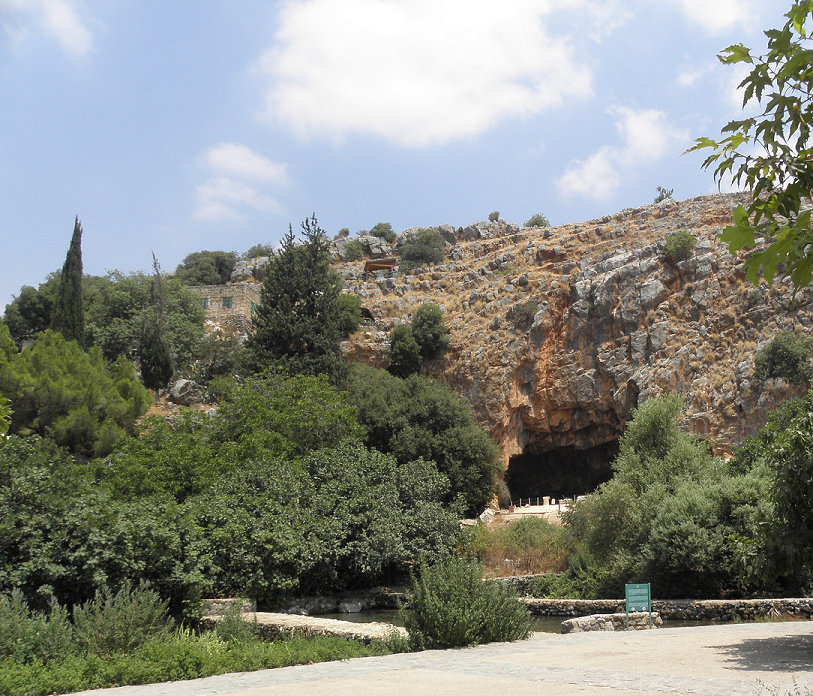
The rock wall at Caesarea Philippi
The rock wall at Caesarea Philippi

Catholic Girl Journey

The Same but Different

It was the same order of Mass, the Eucharist was consecrated and distributed, yet it was different. While in Washington DC, I attended Saint Luke’s at the Immaculate Conception. It is a parish of Personal Ordinariate of the Chair of Saint Peter. Basically it is an Anglican parish that has been received into the Catholic Church, but it retains elements of the Anglican heritage. It was a beautiful Mass and I was very glad to be part of the congregation, since it was my first Catholic Mass that was not of the Roman rite.

The first thing I noticed was that five deacons were assisting the priest and the priest was wearing a hat as he processed to the altar. The hat may have a special name and have Anglican roots. I believe in previous years priests of the Roman rite may have also worn one, but that was a bit before my time (or memory). The priest faced the altar for many of the prayers. While for some that may hearken back to the Latin Mass, again for me, this was new since I am only familiar with the Mass as it is today.

After  the procession, everyone kneels. I was glad they had booklets for me to follow that included the required postures, as this was a new one for me. We knelt from the sign of the cross until the Gloria. The penitential rite began with a set of responses between the priest and the people from Psalm 43. The priest then said the prayer “I confess to Almighty God…” by himself, which was a twist for me. The people responded to that prayer with, “May Almighty God have mercy on thee, forgive thee thy sins, and bring thee to everlasting life.” What an incredible moment to pray for the priest before he consecrates the sacrament! All too often we forget that the priests are human too, and need our prayers just as much as we need his. The people then said the “I confess to Almighty God…” prayer and then stood for the Gloria.

The liturgy of the Word was very similar to the Roman rite, as was the liturgy of the Eucharist, with the exception of some different prayers and definitely more singing by the choir (which alone would have made my attendance there a joy!). There was one prayer in particular that  was recited by all after the Lamb of God/Agnus Dei, but before Communion:

“We do not presume to come to this thy Table, O merciful Lord, trusting in our own righteousness, but in thy manifold and great mercies. We are not worthy so much as to gather up the crumbs under thy Table. But thou art the same Lord whose property is always to have mercy. Grant us therefore, gracious Lord, so to eat the flesh of thy dear Son Jesus Christ, and to drink his blood, that our sinful bodies may be made clean by his body and our souls washed through his most precious blood, and that we may evermore dwell in him, and he in us. Amen.”

I found it such a beautiful prayer to say before receiving Communion, that I took a picture of it so as to remember the words. One of the added blessings in attending this Mass, is that it increased my awareness of the routines of our own Mass.  We sometimes  lack the appreciation and attention this special encounter with our Lord deserves. This particular prayer really focused my attention on the gift I was about to receive.

Another first for me was receiving Communion at the altar rail. After Communion the priest and people all recited a prayer of thanksgiving for receiving the sacrament. Although I don’t include the words here, it  was of equal beauty to the one before Communion. While the concluding rite seemed to be the same, the curve ball came when the last Gospel was read, after the sign of the cross. The passage is the beginning of John’s Gospel. How appropriate now that we had received Communion to be reminded before we left that the Word became flesh and dwelt among us. It was truly a blessing to receive the same Jesus and participate in a Sunday worship just a bit different from what is familiar to me.

Catholic Girl Journey

Learning to Love God

When I first heard the Jars of Clay song, Love Song for a Savior, I was confused. The refrain contains the line, “I want to fall in love with You.” My confusion came from listening to that song with a secular ear. How can a person fall in love with God? There is no courtship, no dating, no hanging out with God the Father, Jesus or the Holy Spirit. I liked the song and it’s an easy, catchy tune that I found myself singing.

The Catechism of the Catholic Church states in the very first paragraph, “He [God] calls man to seek him, to know him, to love him with all of his strength.” We are called to love God, and I thought I did love Him until I heard that song. I realized that to me, God was like another member of the family; I had to love Him, because that’s what I was supposed to do. I didn’t necessarily choose to do so, but just expected that of myself. Hearing the lyrics of the song made me start to wonder how a person could fall in love with God.

During my searching for an answer, I came across the definition of love described by Fr. (now bishop-elect) Robert Barron: “Love is willing the good of the other.” If God is all-good and all-loving how can I will the good of Him? Precisely because He is all-good and all-loving, God only wants the best for us. He knows that left to our own devices, we would fall into chaos. He gave us His commandments, not because He wants to be mean and limiting, but for our benefit. For example, “Remember to keep holy the Sabbath day.” (Exodus 20:8), is not meant for God’s benefit, but that we as humans interacting in the physical world, take the time to seek a spiritual relationship with God, whom we know in a spiritual world. Even Jesus says, “If you love me, you will keep my commandments.” (John 14:15).

So how can we fall in love with God by keeping His commandments? In some respects, it’s not thinking of command as being an order or demand, but rather something that is a choice happily made. As an example I’ll go back to the third commandment. Rather than considering it a burden, or trying to “schedule” Mass so that it’s convenient for us on Sunday, how about planning nothing but going to Mass as the first thing in the day? Let the Spirit move you through the rest of the day. It may be a great exercise even if it’s not realistic in the long run. Try it, for a few weeks.  Perhaps it will be the jumpstart needed to learn to love the commandments. This sort of openness to the Spirit calls for a change of attitude, a change that we have to be willing to make. But even though it is our free will to make the change, we can always ask God to help and support us in our efforts. And someday we may find ourselves saying, “I want to fall in love with You.”

Catholic Girl Journey

The Essence of Mary

In a trip down to Washington, DC, I attended Mass at the Cathedral of St. Matthew the Apostle. The cathedral design is on par with many of those in Europe in its grandness and decor. As the seat of the Archbishop of Washington, it may be familiar to some because Saint Pope John Paul II celebrated Mass there in 1979. Others may know it as the location of President John F. Kennedy’s funeral Mass in 1963. For me, what makes it special is the discovery of the unique statue of Mary that I don’t think I will ever forget.

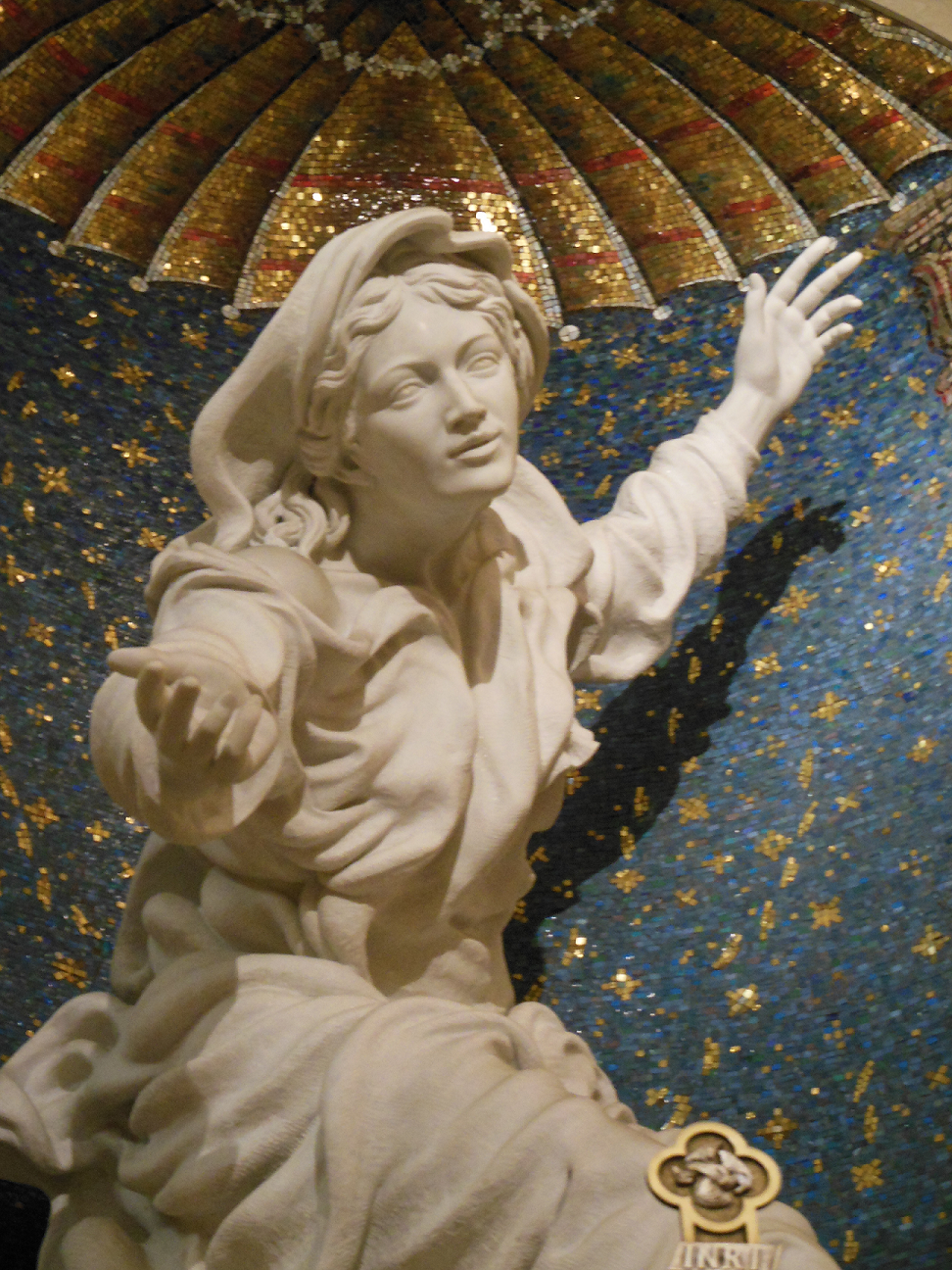
I have seen many statues of Mary in numerous chapels, churches, cathedrals and basilicas during my travels. Most portray her as serene and prayerful. Others show her maternity by including Jesus in her arms or lap.  Each are beautiful in their own way, although some stir my soul more than others if I think they capture Mary’s essence of prayer and motherhood. However, in the Cathedral of St. Matthew, sculptor Gordon S. Kray portrays Mary “reaching down to fallen humanity and pointing to her ascended Son.” It is so beautifully touching, I could not help the tears that streamed down my face.

Mary at the Cathedral of St. Matthew the Apostle, Washington DC

Mary at the Cathedral of St. Matthew the Apostle, Washington DC

As I knelt before the statue, I felt the urge to reach my hand out to hers. I wanted to say, “take me with you to heaven.” This pure statue of white needs no paint to illustrate Mary alive and still helping man at a personal level. While she may be calling all to her Son, her gaze from the statue is on YOU. It’s like she is saying, “Come, child, take my hand and I will help you. Let us go together to my Son, Jesus.” To me, this is the essence of Mary in her role in the Church today.

Preparing for the Journey

Do you use a checklist when you pack your overnight bag? Making sure you have the essentials like toothpaste, toothbrush, contact lens solution, and daily medications is the easy part. Do you check the forecast for the weather of the destination to see if it will be hot/cold/wet during your stay so you know what kind of clothing to take? I remember being in Italy in April at a location more suited for summer getaways. There was so much marble in the place, it was rather chilly.  It didn’t help that the heat is shut off in Italy in March, no matter what weather is expected. Toward the end of the trip, my clothing choices were limited!

Now, what if you didn’t know where you were going? How would you prepare for the journey? Bring a little of this and a little of that? How would you know when you arrived? What if it is a place that no one has been there and back from? I have admiration for the early explorers like Columbus, who took to the sea in search of a better way to the Indies not knowing what they would find. They were tested daily and  probably had days of doubt. Even the first astronauts making their trip to the moon had at least some idea of journey, but not all the trials and successes along the way.

If faith is a journey, is it possible to “prepare” for the journey? Actually, I think the journey IS the preparation. The faith journey prepares us to spend eternity with God. Since God is Love, we need to spend the time practicing how to love everyone, as we are called to do as Catholics. The journey also gives us practice forgiving those we perceive wrong us, and helping others without begrudging the personal cost or expecting repayment. It is practicing true selflessness. I’m specifically calling it practice, as we all have times of success and times when we fall short. Each day gives us countless opportunities to practice and to prepare for our destination: Heaven.

Catholic Girl Journey

Seek Him First

Priorities. We all have a way of putting things in a particular order, from the way we get up in the morning, to the way we schedule our days, to the way we determine the activities we can and will do. We can say we make God a priority, and sometimes we do, by going to Mass at an extra early hour or by finding a Church when on vacation. But what about seeking God first?

In Matthew 6:25-34, Jesus gives us the directive not to be anxious, ending in the familiar “Seek first the kingdom of God and His righteousness, and all of these things shall be yours as well.”  These things refer to food and clothing in the passage, but perhaps there are other necessities that fill up our to do lists.  I’ve been thinking about what it really means to seek God first, since I do think I make Him a priority. And over many months of small observations (this is definitely a journey), it has occurred to me that it’s in the way we approach choices at a very basic level. I listened to my parents ask my niece who was a senior in high school, “what do you want to do after college?” I felt like asking her “what does God want you to do after college?”

In my own life I’ve been wondering about my job and whether or not I should be looking for a new position. Given the length of service with the company, it makes it easy to be lazy and stay. Looking for something new means I need to know what I want and that presents a question. What am I looking for? Even in my prayers I found myself asking God what I should do. I knew I needed His help to make a good decision. But I began to realize I was only looking from my perspective, it was all about what I wanted, what I’m interested in, me-me-me. So I had to ask the question differently: what does God want me to do? I have also observed from learning about the lives of various saints, that you don’t ask that question lightly, you need to be truly open to the response. It really takes your relationship with God to a different level, making Him more than just number one in a list of priorities.

To many this may seem like a no-brainer, but to others this is totally overwhelming. The journey of faith is as unique as each individual. While God has given us all special talents and abilities, offering them back to Him to use as He pleases is one way of seeking the kingdom of God first.

Catholic Girl Journey

Walking on Water

St. Peter has become an important role model for me. You can see his journey of faith through the Gospels and Acts: from a sinner fisherman to the bold leader of the apostles.

My favorite passage is the one where Peter tries to walk to Jesus on the water (Matthew 14:22-33). So many focus on the fact that Peter had to cry out for Jesus when he began to sink.  “You of little faith,” Jesus said,” why did you doubt?” I’m not one to argue with God, but I like to look at the boldness of Peter. He asked Jesus to command him to walk on the water, then Peter actually got out of the boat! So let’s just stop a minute and think about this. The wind is blowing strongly, the water is thrashing about and the boat is rocking enough to make seasoned fishermen fear for their lives. Would YOU step out on the water?

Peter not only stepped out of the boat, but he started to walk to Jesus. Walking on water! How fantastic and frightening that must have been. But Peter starts to sink. Why? Did he realize what he was doing? Did his focus shift from walking to Jesus to realizing that this was a miracle? Did he recognize his sinfulness in the midst of what Jesus was allowing him to do?  Did he focus on the storm instead of on Jesus?There can be a lot of suppositions about this, but the most important thing was that he called out for help, not to the others in the boat where there were probably ropes and oars that could help in a material sense. He called out to Jesus – not just for help but to be saved.

I’ve walked on water twice, but it was frozen–once on the frozen Arctic Ocean and once on a glacier during a helicopter excursion. The experience is very surreal in a world of white ice and snow. But the water was firm and solid, nothing that would make me think there would be any movement. If I were in the same situation as Peter, I think my reaction might be to cling to whatever piece of wood that I could, craving that stability of earth. But Jesus does not want us to cling to what we know, he calls us to walk to Him, to walk on the water to Him. Our daily lives might not require walking on actual water, but sometimes it can be a metaphor for the challenges in our lives. How many times do we step out of the boat in faith? How many times do we have the courage to walk on the water toward Jesus? How many times do we call out for Him to save us? Andt how many times do we doubt that He can? Jesus, I believe in You; help my unbelief!

Catholic Girl Journey

What Faith Can Do

Life, just like faith, is a journey. It will always have challenges that we will need to deal with and once one is “solved” there will be another just around the corner. Leaning on faith during these challenges does not automatically fix them, but rather provides a sense of peace to get through them if we allow it.

One of the most wonderful experiences for me is praying in front of the Blessed Sacrament in the Adoration chapel. I can have tears running down my face with all of my struggles and anxieties, and yet I am overcome with a sense of peace. It hasn’t fixed the issues, but rather given me the strength to continue with them. Sometimes I may even get a different perspective on how to address one of the struggles.

Faith experiences are not limited to just holy places. They can happen anywhere: the gym, the grocery store and even stopped at a red light. Often when I’m running late (or think I won’t arrive on time), a red light seems like an obstacle. But it gives me a few precious moments to realize why I am so anxious about where I’m going. And in that recognition, I can turn my fears over to God to work out. I still may arrive late, but at least I’ll be a little less stressed when I get there.

Sometimes within the life journey is mini-journey of faith. I was in the hospital overnight and in the wee hours, I was wide awake since I could not get comfortable and I was fretting about the next steps. I was totally not thinking about God, yet He was thinking of me, as the thought came into my head that there were angels all around me. I could not see them, but my faith allowed me to believe it. I didn’t immediately fall asleep, but I felt a sense of calm that allowed me to rest. The rest I received that night was the building block that allowed me to move forward with the next step of my treatment. What looked like a medical mountain with fears of “what am I going to do” and “how am I going to get through this” was moved in faith one stone at time, one step at a time. In order to recover, I only could do what was in my power: to take care of myself and follow the doctor’s orders. Focusing on those directions and doing them to the best of my ability was the step by step journey to conquer that medical mountain with the faith that God would see me through.

Allowing faith into your life’s journey puts you on a journey of faith. With each new experience and event, you change and grow as a person and you have the opportunity to grow in faith.

Catholic Girl Journey

Daily Joy

“Smile, look like you’re having fun.”  When I first started in the world of work, I used to say this to my co-workers.  They were not thrilled to hear it, although after grousing about it, sometimes the corners of the mouth would start to curl upwards. At the time, I was working in a card and gift shop, and except for the day after Christmas when everything was 50% off and the crowd was uncontainable, it was actually a nice place to be. Why not smile and be happy that the little bit of money we were making would help to offset the cost of college fees?

People communicate mostly through nonverbal means, like tone of voice and facial expressions. I admit, when I’m deep in thought mulling over a challenge, I may have more of a scowl than a smile. But when you’re dealing with other people, a smile goes a long way. It may even be the only bright spot in a day filled with challenges and disappointments. Recently while I was dealing with some health issues and was working from home, it was all too easy for me to express my crankiness at not being well. Since it’s just me at home, who am I hurting if I’m cranky, right? I received a mailing from the Society of the Little Flower, which had the following printed on the envelope, “Even when alone be cheerful, remembering always that you are in the sight of the Angels.” – St. Therese of Lisieux. OUCH! It felt like a finger pointing directly at me. It also made me realize that if I don’t try to be cheerful and smile at home, how can I ever expect to have it come naturally when I’m around others?

At the birth of Jesus, the angel proclaimed to the shepherds, “Do not be afraid; for behold, I proclaim to you good news of great JOY that will be for all the peoples.” (Luke 2:10, emphasis added) Are we afraid to live a life of joy and spread it generously? We often get so encumbered in our daily challenges that we forget the joy that living a life in Christ has brought us. We miss out at enjoying the blessings we have: life and breath, hope and love. The joy of Christmas is not meant for one day, but everyday. We especially celebrate it once a year to remember that most special day and re-energize our joy to spread through the upcoming year.

My trademark now is wishing people a happy <whatever> day, and yes, I do wish folks a Happy Monday. I have had the response of, “It’s Monday, how can it be happy?” However at the end of the work week, most people don’t mind when I wish them a Happy Friday. It’s not so much that the day itself is happy, but that I’m wishing folks happiness throughout the day, whatever it brings: a little happiness or much happiness. I am wishing them well in their day. Sometimes I’ll hear someone at work wish another a “Happy Tuesday.” I don’t know if they are picking it up from me or elsewhere, but it makes me smile to hear it.

Smiles, cheerfulness, joy and happy wishes, are all part of spreading the love of God to our neighbor. And since this is posted on Wednesday, dear reader, I wish you a Happy Wednesday.

Catholic Girl Journey

A Story in a Story

“So what’s the game plan?” I’ve heard (and said) on many occasions, but it was never anything regarding a sporting event.  People who have never been professional racers use, “I need to make a pit stop” when they have an errand to complete during their travel from point A to point B. How many of us play “Monday morning quarterback” when we offer our thoughts on how we would have done something differently?

These analogies are familiar to us, yet most of us do not play the sport referenced in our saying.  We may not even follow that sport. I have never watched a racing event, yet I know what a pit stop is, and I’ve used that saying. I may not understand the specific dynamics of the offense versus the defense in football, but I can generally understand the analogies when they are mentioned because the sport is part of our culture. We use these sayings all the time, and as long as people understand the culture, they can understand what we mean. I’m sure in other foreign countries, there are also unique sayings that although composed of familiar words, may not make any sense to us.

Jesus understood this and used parables to teach about the kingdom of God. Our human limitations allow us to only partially begin to understand the divine kingdom. To help us comprehend, Jesus compared it to things we know and understand. Sheep and shepherding were common in His time, and even if the people themselves were not raising sheep, they either knew someone who did, or had enough dealings with sheep that they could understand the references He was making. I have occasionally attended the Maryland Sheep and Wool Festival to purchase fiber, tools, and wheels for spinning yarn. While at the Festival, I have had plenty of time to observe sheep. I’ve seen a sheep crane her neck out of a pen to munch a particular flower – even though the pen was set up over many of the same flowers. My first inclination was to smile and think, “what a silly sheep,” but after hearing the various parables about sheep, I’ve started to see how my actions are similar to those of that sheep: not happy with what I have and straining elsewhere to try and get it.

We hear parables often during the Gospel at Mass, but because times have changed since then, some of those stories can be hard for us to fully appreciate. It’s all too easy to say “I don’t understand therefore it’s not important to me.” I’ve often wondered what sort of sport Jesus would use in telling his parables today and if I would be able to understand them better? Maybe the parables are given to us to make us think a bit more about the story and to remember the point more easily.  When you encounter a difficult parable, it helps to ask Jesus in prayer what He meant. Perhaps these stories are to instigate a deeper relationship with God by drawing the listener in little by little as the story is pondered and prayed about, calling us to use the experiences in our daily lives to go deeper the next time we hear that story. And maybe someday we will see the story of the kingdom of God unfolding  from the everyday because of the framework provided by Jesus’ parable.