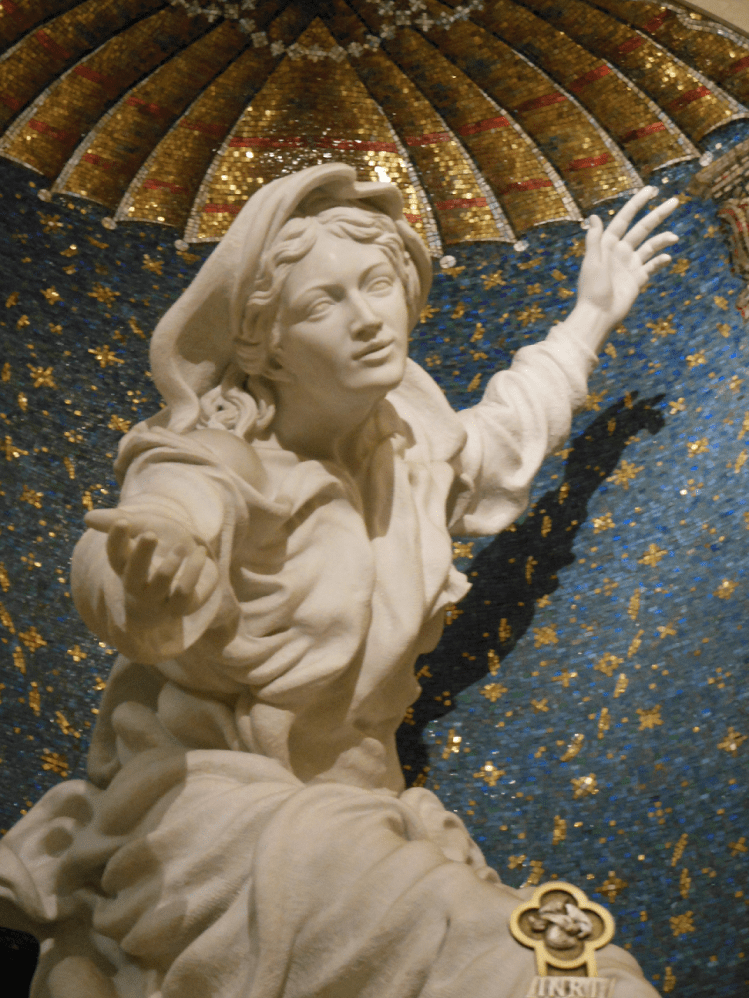
Mary at the Cathedral of St. Matthew the Apostle, Washington DC

No singular purpose

This week the Church celebrates the Assumption of Mary into heaven. It’s a perfectly placed holy day to remind us of who we are and where we are going.

August means summer is just about over and, for those who have children, another school year is about to start. All too soon we will be replacing shorts and t-shirts with long pants and cozy sweaters as well as finishing another calendar year. The older I get the faster time seems to pass. The culture that surrounds us seems to live on emotions alone which can change faster than the wind, and produce just as much chaos and turmoil as any windstorm or tornado. While there is value in living in the moment, we also should not be hyper focused on solely how we feel as the barometer of our life. One can’t seem to escape the headlines or sound bites indicating an epidemic of depression. Too many see their value based on fleeting ideals of their career, their bank account, their status in society, or even their popularity on social media. Yet the Church reminds us Catholics to stop and remember the Blessed Virgin Mary.

Our baptism welcomed us into the family of God. Our purpose is not a secular one based on what we can measure here on earth, but rather how we reflect and imitate the love of God to each other. From the first chapter in Luke’s Gospel, Mary sings God’s praise to Elizabeth. Instead of reflecting on the message she received about her own miracle, she rushed to assist her kinswoman Elizabeth. One could argue that Mary’s purpose was to be the Mother of Jesus during His time on earth. But her motherhood didn’t end when Jesus died on the cross because He gave her a new role as Mother of the Church. 

Parenthood is not just a title, but a multi-faceted job that takes one’s whole self, requires sacrifice, can be painful and yet produces a joy that can only be experienced and not explained. Aspects of Mary’s spiritual motherhood can be found in praying the Litany of Loreto, which has over 50 titles for her. There are 15 titles that include the word “Mother,” 7 titles containing “Virgin,” and 13 titles with “Queen.” Some titles describe how she intercedes on our behalf and others are comparisons that paint a more tangible perspective of a mirror, a tower or a vessel. Praying and reflecting on the litany reminds us that God has not placed us here for a single moment in time, but rather at a particular period of time to accomplish His will in many different ways. While we can evaluate how we respond to God’s will and how much we have pursued a relationship with Him, we cannot be the final judge of how much we accomplished as that is in the hands of God.

The feast of the Assumption reminds us that there is more to life than the daily grind. Eternal life with God is possible if we have a relationship with Him now and seek to do His will as Mary did. God brought Mary full circle at the end of her life by bringing her, body and soul, into heaven. This is not something she could achieve as a mere creature created by God. This is a supreme gift from Almighty God as a blessing to Mary for fulfilling His will on earth. At the moment of her conception, she was preserved from original sin and at the hour of her death her body was spared any decay or corruption by being assumed into heaven. Mary is enjoying now what we hope to, God willing, after our resurrection from the dead. 

The summer draws to a conclusion and the daylight hours grow fewer. Another year ends and our time on earth is shortened. Yet our hope is in the Lord as our source of light and life. Our journey is not through this time but towards God as we seek to know Him as our Father and love Him by choosing His will over ours. May the Blessed Mother of God, Mary Most Holy, intercede for us with her motherly wisdom. 

Who is stealing from whom?

I’m not sure what’s going on in Christian music today, but on my journey to visit my Mom on Sunday, I heard two very different songs about thieves. As catchy as both the tunes are, both are poor theology. 

I’ve heard these songs for awhile now and every time I’d hear either one, something just didn’t seem to make sense in my brain. Usually I listen to Christian radio when I’m driving, so I’m not fully concentrating on the lyrics, as there are too many other drivers around me that I need to pay more attention. The first song, by Tauren Wells, is Take It All Back. The refrain sounds quite powerful, both in the music as well as the lyrics:

I’m calling the angels down
I’m storming the gates of hell
Tell the devil he don’t own my soul
I’m taking back what the enemy stole
I’m raising the battle cry
I’m holding the banner high
With the power of the Holy Ghost
I’m taking back what the enemy stole

The song evokes the age-old battle with Satan that is a result of our sin, which is often portrayed as chains or shackles that bind us. And in many spiritual ways that is true. But it’s also a choice. Can the opportunities to sin appear to be something good rather than evil? Absolutely! However, it is still a choice that we make and we are responsible for our words, actions, or the lack thereof. The lyrics of the song imply that the Devil has stolen the person’s soul, basically taking what did not belong to the Devil and certainly without the consent of the person. Sin separates us from God. It’s only when we turn back to Him, when we repent and lean on His mercy that we can receive the grace God wants to shower on us. The Devil cannot hold our souls unless we give him permission to do so. Satan will try and trick us and think that we can’t escape, but we can call on the Triune God for help — Father, Son, and Holy Spirit. We can call on our guardian angel or even St. Michael, the Archangel, in our battles with the tempter. I know the song wouldn’t pack the same punch if the lyrics were, “I’m taking back what I gave up.”

The other song is equally catchy, but has even worse theology! The song by Crowder is Grave Robber and the refrain for this one is: 

I got stolen by the grave robber
Picked me up from that rock bottom
Washed my soul in that Holy water
Brought me back to life 
One more stone rolled away
One more sinner been saved by grace
This dead man, he ain’t dead no longer
All because of that grave robber 

In the first song we had the Devil stealing a person’s soul. In this song, we have Jesus stealing a person from themself! What?! Jesus is not going to force you to choose Him, and He certainly will not take you against your free will. He wants a relationship with you. Jesus will give us life in abundance, and He rejoices when a hardened sinner repents and turns to Him. Jesus gave us the parable of the Prodigal Son, so that we can know that God is constantly seeking for us and at the first sign of our return, He is there to bless and celebrate us. This song, however, makes it seem like Jesus is just snatching up unsuspecting people and forcing them to believe in Him. While it’s true that we cannot save ourselves, our salvation does rely on our participation with God. If we turn away from God and want nothing to do with Him, He will continue to love us and seek a relationship at any small, micro possibility that can open us up to Him. A thief or robber takes what is not His and without permission. Since God created us, technically we are His. But God has also given us free will and will never force us to turn to Him. We may be required to make a choice for His will or our will (sin), but we always have a choice. 

Just because a song is on Christian radio does not make it a good song, no matter how much the tune sticks in your head. Neither the Devil nor Jesus is a thief. We have free will to choose. It’s up to us to choose a relationship with God and to do His will. 

Catholic Girl Journey Logo

Wheat and weeds

A daily Mass Gospel reading last week was that of the wheat and the weeds, Mt 13:24-30. As I thought about the reading, the oddest juxtaposition came to mind: Peter and Judas. 

Peter is mentioned many times in the Gospels, sometimes not in the best way, but always very loyal to Jesus. He is quoted many times throughout the passages, and I would suspect many could at least paraphrase something Peter said. But what about Judas? Besides his treachery that led to Jesus’ crucifixion, the only other recorded moment of him is his objection when perfumed oil was used to bathe Jesus’ feet. He thought it should be sold and the money donated to their cause. The commentary indicates that as the money keeper, he was thought to be pilfering from the donations that came their way. Yet, Jesus called Judas to be one of His intimate set of followers. Judas heard all the parables and teaching opportunities that Jesus presided over. He saw most of the miracles that Peter saw. And Judas had a personal relationship with Jesus while He was in the flesh. Have we ever had a moment of weakness when we thought that if we could just see and talk to Jesus in His human form, it would make believing easier? Well, Judas spent three years traveling with Him and despite all he observed, he still allowed greed and pride to rule his actions and ultimately betrayed Him. 

In the parable, the farmer instructs his farmhands to not pull up the weeds, lest they disturb the roots of the wheat and bring that up with the weeds. Instead the two are allowed to be cultivated together and the care that is given to wheat — water and fertilizer — is also being utilized by the weeds. Likewise, God does not just bless good people who “deserve” it, as if anyone is good enough to deserve God’s blessing, God blesses those who seek a relationship with Him as well as those who run the other way. “That’s not fair!,” may be your reaction! Yet, if the weeds do not receive the same care that the wheat gets, the consequences could be worse than the two growing together. Perhaps the weeds would start feeding off of the wheat? Or in trying to obtain the water and nutrients that the wheat received, the amount would not be sufficient enough for both and neither the wheat nor the weeds would ever mature for a harvest. And worse yet, in the competition for the food, with neither having a sufficient quantity, both would perish. During His earthly ministry, Jesus gave all 12 Apostles and many other followers opportunities to know God in a way they never thought possible. It wasn’t only being instructed by Him, but they talked with Him, ate with Him, laughed with Him, and cried with Him. Peter and Judas were both wheat and weeds growing up in the presence of Jesus.

While parables are a helpful tool in teaching spiritual concepts in a more concrete manner, they are imperfect. Weeds cannot change what they are, however, as humans we can change the kind of person we are. We can turn away from what separates us from a relationship with God and seek to do His will. Our sinful nature makes us weeds that should be tossed into the furnace. But through God’s mercy and Jesus’ sacrifice, we are able to become wheat that can be received into the heavenly barn at the final judgment. The choice is ours to make, as God gives us free will to choose for Him or for ourselves. 

Both Judas and Peter betrayed Jesus that last night; one by selling their location to the Pharisees and the other by denying he knew Jesus. Both regretted their actions. Judas’ despair drove him to hang himself. Peter’s sorrow was forgiven in his encounter with the resurrected Jesus. Peter had faith in God and Jesus. And it is our faith and the actions that flow from our beliefs that make us wheat instead of weeds. 

Catholic Girl Journey Logo

Temptation everywhere

I have resisted writing a blog post about this, I prefer to focus on a relationship with God and ways we can look to improve it. However, I feel like I need to examine how the other one can tempt us in such small and innocent ways that can add up and be damaging to our relationship with God. 

Recently as I was reviewing my life, my attitude, and my choices in everyday living, it felt like there was a disconnect. When I tried to figure out why I was making the choices I was, it was like there wasn’t a good answer. For example, I would tell myself I was tired and put a chore off for another day only to stay up past midnight watching TV. Even as I saw the time getting later and later I would tell myself that I should be getting to bed soon, but would promptly put it off for just a little bit longer. It’s not a sin for me to stay up late, but if it impacts my work and attitude, maybe it’s a lack of taking care of the body God gave me. It may not be as dangerous as taking drugs or drinking to excess, but it’s still less than what God wants for me. Even though it was my choice, I really couldn’t figure out why I was making these types of choices. I began to wonder if this is how Satan tries to get a hold into our life and disrupt our connection with God.

I believe that God made all things good. I also believe that God gives us all the choice to either love Him or our own egos. Lucifer, the angel bearer of light, decided he was going to love his own ego over the God that created him. But that makes him miserable and he wants all of God’s creation to choose against God, not necessarily for him, Lucifer — aka Satan or the Devil, but as long as it’s against a relationship with God. If Satan tried to tempt me with drinking alcohol in excess, it would be a losing battle, as I fall asleep after a small glass of wine. However, Satan seems to look at our weaknesses to figure out how best to tempt us, especially when it doesn’t seem like a temptation.

Oddly enough in this past Sunday’s homily, Fr. Armando commented that we are “born into a battle.” The reference of a battle between good and evil is appropriate, since Satan often operates in ambush tactics. When we are worried or frustrated, those are soft spots for his attacks. If we struggle with health issues, financial issues, or relationship troubles with those around us, watch out as we can easily be led astray and make poor choices that affect not only ourselves and those in our families, but can hamper God’s efforts in walking these difficulties with us. Let’s be clear: God does not tempt us, ever. God allows us to be tempted because we have free will, the option to choose Him and His will over ourselves and our egos.

What makes Satan’s tactics so effective in such miniscule ways, is the secular culture that promotes a victim mentality (i.e. it’s someone else’s fault and not ours) as well as being led by how we feel. Feelings and emotions can change minute by minute, depending on what our circumstances are. It can be challenging to make solid decisions when we are polarized in either happiness or sadness. Society seems to expect us to be ecstatically happy all the time, and if we’re not we need to do whatever we can to be that way and to look at whatever is impeding that feeling as the enemy to be conquered. The irony is that it is often our own choices that have created the circumstances and our ego is the enemy. We can claim that “the Devil made me do it,” however, it was only a whispered suggestion that feeds our egos, similar to the one Adam and Eve heard in the garden, of how they can become god-like, that they can be in total control. We each make the decision to eat the forbidden fruit in our lives, and we need to take responsibility for that. However, we can ask God to help us when we are challenged or tempted. He may not remove the temptation, but He can help us walk through the challenge we are experiencing. 

Temptations are everywhere, but if we are mindful about how Satan operates, we can seek God’s protection and guidance. There will be battles that we fall as a result, but there is always God’s mercy to help us stand up to fight another day. Our focus should always be on God as the center of our lives, but awareness of how Satan operates to disrupt our focus can be a weapon in our daily battles.

Catholic Girl Journey Logo

Why do good?

There is an old idiom that says, “You reap what you sow.” Even Jesus remarked, “Any sound tree bears good fruit, while a decayed tree bears bad fruit.” (Matt 7:18) However, when you look around society today, we  struggle to see where that natural justice is taking place. It can be very discouraging and make us wonder why we should try and do good in our lives.

Psalm 73 shows us that even in ancient times, there was a similar feeling:  

When we see those openly mocking God and living in ways that go against His teachings being acclaimed and considered social heroes, it can cause us to doubt ourselves and our beliefs. Then if we speak out against their words and actions, we quickly become the target of viciousness and spite! It’s like the tables are turned and we are the transgressors, because we speak contrary to their words and deeds. When the world seems to be upside down and the opposite of what it should be, it can be very easy to slip and lose our footing! 

The analogy of plants and trees may have a deeper meaning than just the surface of the words. It takes time for seeds to grow into plants. And it takes time for a tree to produce the blossom before it becomes a fruit. We can’t expect immediate repercussions to occur each time a person says or does something evil that is celebrated in our secular society. And likewise, we can’t expect to be showered with blessings just because we do a singlar good deed. For most plants and all fruit trees, they don’t produce a single item, but rather many. When we reap what we sow, it is not just a single instant of our lives that determines what we reap, but rather the whole of it. If our entire life parallels a single growing season of a tree, how much fruit would be on it?

Another consideration we need to keep in mind is that our world is very materialistic and repeatedly glorifies what is objectionable to God. Jesus tells us we need to pick up our cross and follow Him, not pick up our bouquet of roses and dance happily down the yellow brick road. It may appear that the wicked are prospering, but that is the image they hope to portray. They may even be deceiving themselves by focusing on the accolades they receive. We are called to live in this world, but not to be OF this world; which is to say that we do not look at our time on earth as the only existence we have. As Catholic Christians, we believe in heaven and the resurrection of the dead, and the consequences of our actions during our lives will impact more than just however many years we live on earth. We also recognize that our actions also impact the lives of those with whom we live, work, and interface.

Lastly, we are all sinners in some way and we will need to atone for those sins either here and now or in purgatory. When we practice doing good, we learn how to be aware of those around us. Sometimes good is actually doing something or helping another. Other times, it can be in not doing something, like repeating a piece of gossip that we’ve heard. When we follow Jesus’ example, we are training ourselves to be the bearer of good fruits. We may stumble from time to time, but we can, through the mercy of God, repent and do penance for our faults to lessen the impact of our sins. By having a relationship with God, He can prune away the dead, sinful branches within us, so that only the healthy, life-giving plant remains.

It’s very tempting to compare our situations with others who seemingly have it easy, even though they rail against the will of God. However, if we strive to always have a relationship with God, repenting when we falter, He will prosper us, if not in this time and place, then surely in heaven where we will see Him face to face. 

Catholic Girl Journey Logo

Rebellious house

This past weekend the new parochial vicar, Father Armando,  started his assignment at our parish. Looking at the Sunday readings, I hope they are not a sign of his time here! We hear from Ezekiel about a rebellious people, then Paul talks about a thorn in the flesh he suffers with, and the Gospel talks about the lack of belief from Jesus’ home place preventing Him from working miracles. I’m not sure what that means for Fr. Armando, but what does all this mean for us?

What struck me most of these readings was the one from Ezekiel. The Old Testament is a foreshadow of the New Testament, however, sometimes the parallels can be so nuanced, we only read what occurred to the Israelites and forget to apply it to ourselves. The Old Testament is all about God teaching His people how to have a relationship with Him. As He slowly reveals Himself in the first books of the Bible, it becomes a journey home. Isn’t that what we are on now, a journey home to heaven? If we consider the land of Israel as a parallel to heaven, how does that change the impact of the reading? The stiff-necked people are refusing to listen to God’s word. God warns them they will not be able to stay in the land if they keep ignoring His word. God does not want them to lose their relationship with Him, so He sends prophets to make His will known to them.

We are children of the New Testament. Thanks to Jesus, we have a bit of heaven on earth with the Eucharist. However, we are just as much in danger of losing heaven as the Israelites did in being exiled from Israel. When we pick and choose what we want to believe of the dogmas of the Catholic Church, when we ignore God’s revelations, and when we make choices that divide, hurt, and encourage sin, we are being just as obstinate and rebellious as the Israelites. We hear God speak to us weekly at Mass, or maybe more if we attend weekday Mass or read Scripture, but if we do not take the time to examine how God may be speaking to us in these words, we are as deaf as the Israelites were to the prophets.

The second reading from Paul’s letter to the Corinthians illustrates that we do not need to be perfect to get to heaven. While the first reading seems all doom and gloom, the second reading shows that everyone experiences times of weakness and sin. The difference is the attitude towards it. Do we excuse our sins because we are fallen humans? Or do we seek God’s assistance with the very sins that can keep us from being with Him in heaven? We don’t celebrate the sin, but that God can do wonders for us despite our sin.

The Gospel then ties the first and second readings with what glues everything together: faith in God. We need to not just petition God for His help, but to be open to the methods He chooses to help us. When we put our faith and trust in Him, our cooperation can lead to many miracles. And when we doubt His abilities, we close ourselves off to a relationship with God and His ability to work within our lives. This affects not only ourselves, but potentially all those who cross our path in need of an experience with Jesus. We could be the hands, feet, ears, smile, and love of Jesus on earth, but if we don’t have a relationship with Him, He cannot shine through us and we cannot bring a bit of heaven to the world around us.

We are sinners and we have the sacrament of Reconciliation to restore our relationship with God. Let us strive not to be a rebellious house, but to use Paul’s example of accepting whatever thorns we receive in life, allowing God’s love and mercy shine through our imperfections, and keeping faith in God.

Catholic Girl Journey Logo

God’s place

Bishop Robert Barron has a saying that has become so popular, the Word on Fire organization sells t-shirts emblazoned on them: Your life is not about you. I would take it one step farther and add: Neither is heaven.

In many of the books and videos that Bishop Barron has participated in, he has consistently taught that we need to have a Christ-centered life. Until we order our lives around Jesus, we will never be able to have full peace and joy. This means giving up what we want, stop feeding our own egos, and instead, follow God’s will for us. That is what the saints have illustrated with their lives, so it is possible. In our secular-oriented age, which seeks only to soothe our own egos and appease our own feelings, it can seem like an impossible task. WIth God’s help, nothing is impossible.

As humans, we live in time and space and our language reflects that. We can talk about things that we will do in the future, things we are presently doing, or things we have done in the past. God is the creator of time and space, and thus exists beyond it. Trying to describe heaven in our language is difficult because our knowledge and language lacks the ability to adequately convey the spiritual realm. We say we want, or expect to, “go” to heaven when we die. But what is heaven and why do we want to go there? The Catechism of the Catholic Church tries to define its essence in three ways: God’s own “place,” eschatological glory or beatific vision, and the saints and the “place” of the spiritual creatures, the angels, who surround God. (CCC 326) The word place is used in quotes because in our time-and-space language, it’s the best word choice to use, even though heaven is outside of those constraints.

If we try using our language to describe going to heaven, it would be like getting on a plane with a one-way ticket and flying to another country on the other side of the world without any preparation and taking nothing with us. In most cases we would need at least a passport and perhaps a visa to enter that country. For some countries, certain vaccines or shots are recommended so that we don’t become ill with disease that is common in that area. Communicating with the local people may also prove difficult if we don’t know the language; we can’t expect everyone to speak like we do. If we traveled with some of our currency, we cannot expect it to be accepted in every place we visit there. Yet far too many people assume that because God loves them, they will be welcomed into heaven, God’s place, on their own terms. 

Heaven will be everything we want and hope for only when we want what God wills for us and hope in Him. We are given this time on earth to cultivate a relationship with Him. While we can never truly comprehend what is infinite, we can get to know aspects of God that He reveals to us through the Church, the sacraments, and our interactions with one another. When we live with Jesus at the center of who we are during our earthly journey, we are preparing ourselves to enter heaven. When our lives mirror the commandments, the beatitudes, and the works of mercy, it’s like we are learning the language of heaven and storing up foreign currency. When we participate in Mass and the sacraments, it’s like we are preparing our passports, visas and medicinal needs to travel to heaven.

If we aren’t interested in having a relationship with God while we are on earth, why would we want to go to heaven? If our lives are all about fulfilling our wants and catering to our feelings, going to a place that is God-centered would not be desirable. It’s not like we can try out heaven and see if we like it; if we go there, it will be for eternity. 

God created each of us with gifts and talents. He allowed whatever flaws we have, as we live in a fallen and corrupt world. He has given us the freedom to choose to have a relationship with Him. The more we want, desire, and pursue that relationship, the more we reflect what He has given and taught through the Church. When our lives are centered around God, then heaven will be a most welcome place. And when we go there, we will be able to call God’s place our home. 

More than food

It all started with an apple. It ends with bread and wine. Why is our salvation centered around food? What significance does it have on our spiritual lives?

The apple has been the iconic symbol of the fall of man for many centuries, yet in reality, Genesis never mentions what it was that Adam and Eve ate, only that it was the “fruit of the tree.” There are many trees that provide produce, like oranges, lemons, almonds, walnuts, and coconuts. Early scholars suggested that the fruit was a fig or an olive, which was common in ancient times. However, if there was only one tree in the garden that they could not eat, perhaps whatever fruit it was is no longer in existence? It could explain why there is no special identifier for that fruit beyond the fact that it was produced by the tree. Does it matter what type of fruit it was that was consumed? Curious human brains want to have these details, but sometimes in wanting details, we miss the bigger picture. What is it about eating the fruit of a tree that we need to pay attention to? Perhaps it’s more about the tree producing the fruit, something that, ultimately, rests in the hands of God. As humans, we can plant seeds and trees and care for them to the best of our ability, but we cannot force the fruit to come. An apple is actually a good example of the fruit of the tree as a source of nutrition from God. We need to do absolutely nothing to prepare an apple to be eaten; we don’t have to peel it, we don’t have to cook it. We can just take a bite and enjoy!

God uses patterns throughout salvation history to effect change. One example is when the Israelites were wandering in the desert complaining and they were struck by seraph serpents. God had Moses fashion a bronze serpent on a staff and raise it up and anyone who looked at it would survive their bite. (Num 21:4-9) This is considered a precursor to Jesus on the cross. We could also say that the fruit of the tree eaten by Adam and Eve is the precursor to the bread and wine we use for communion. If it was with food that we sinned, then it is through food that we are saved. However, there are two large differences between the fruit of the tree and the Eucharist.

While bread and wine are both food, they don’t come ready made for us to eat. We humans have to put time and effort into making each. This doesn’t mean that we are in control of our salvation, rather, that we need to participate with God to achieve salvation. We work with the fruit of the earth that He provides, and apply the knowledge and experience we have gained in order to make the bread and wine. Ironically, each of these food items are on the opposite ends of the shelf life spectrum. Bread, unless it is made with lots of preservatives,  really only lasts one day. Wine, on the other hand, takes time to produce and gets better with age. We can interpret these polar opposites to understand that God will give us what we need today and will also provide for our future. 

It’s not just any bread and wine that has salvific properties, but rather those that are consecrated during Mass. While humans have transformed wheat and grapes into bread and wine, Jesus transforms them into His Body and Blood, leaving only the properties of bread and wine to observe. In the Eucharistic miracle accounts I’ve read, any microscopic testing of the consecrated host structure was found to be consistent with muscle tissue from the human heart. Jesus loves to feed us with Himself, to have a relationship with us. In receiving Jesus in the Holy Sacrament, we welcome Him into our bodies and into our lives. The desire to become better that caused Adam and Eve to sin becomes the basis of Holy Communion. Thus, food continues to play an important role in salvation history. By partaking in the communal celebration of Mass, we look to strengthen our relationship with God and with one another.

Balance of life

This past week was filled with both highs and lows for me. Yet in both there were celebrations of life. It is the gift of faith that lets me see God in both and to thank Him for all that He provides.

On June 10, my cat, Vera, turned ten years old. It is a milestone for her, as she was diagnosed with a cancer that she shouldn’t have survived the year, let alone the past seven. The vet staff that takes care of her now think she was misdiagnosed, and whatever she does have, we have been able to keep it from impacting her life too much. I celebrated the day by taking off from work and spending it with her. My family came over for dinner and it was a lovely visit. Later that night as I checked my phone, I saw a message from my neighbor that his wife had passed away a few days earlier. As I read her obituary, I realized she was just a few months younger than me. She had been battling cancer for the past three years and while the initial treatment went well, it did end up spreading and cut her life short. What a rollercoaster of emotions, from being so happy to feeling so sad for my neighbors.

I am not sure how long I will have Vera in my life, so even when she wakes me up extra early or is interrupting my work asking to be fed, I try to appreciate even these moments that bring frustration because I know our time is limited. I do see her as a blessing and I’ve mentioned in several previous blogs how in caring for her, I can get a glimpse of the love God has for me. All this time I’ve focused on Vera’s limited time, but with my neighbors’ passing, I realized it could just as easily be me that goes before her. We don’t know how long we have on this earth. It’s so easy to get caught up in the day-to-day as well as planning special events or vacations, that we lose sight of what’s really important: our relationship with God. At any time, we need to be ready to stand before Him, no matter what our age or the vitality of our health. However, we can’t live every day expecting it to be our last either.

Psalm 23 is the one most people associate with comforting the family and friends who have just lost a loved one. I suspect that’s due to the final line, “And I shall dwell in the house of the Lord for years to come.” (Ps 23:6) However, I often say the first line, more as a motto when I feel like I’m being too materialistic: “The Lord is my shepherd; there is nothing I shall want.” (Ps 23:1) I have quite a bucket list of house projects as well as travel ideas and crafting projects, that even if I lived healthy to 100, I don’t think I would be able to accomplish it all. I’m slowly learning that when I do encounter too many “wants” at a time, I turn them over to God, letting Him know of my desires but putting the fruition of those items in His hands and timing. 

Psalm 23 is a very short one, yet it packs a powerful punch. One of the main concepts it reminds us of, is the sheer abundance of God’s blessings. When we look at someone who passes in their early 50’s, to those half that age, it may seem that they lived a long time, however, for those around that age or older, it seems their life was too short. No matter which perspective we have, we need to realize how many blessings were given in that lifetime. We have memories to reflect upon, to bring both a smile to our face as well as a tear to our eye. It is with gratitude that we thank God for the gift of shared friendship for whatever the length of time. 

Long and short, happy and sad, life is a combination of all these, and the balance of which is in the hands of God. With a faith-filled relationship, we can trust that no matter what occurs in our life, God will accompany us through it all and bring us to dwell with Him always.

Catholic Girl Journey Logo

Faith as a skill

Many people talk about having faith, as if it was something that belonged to them or was a characteristic of their natural being like brown hair or green eyes. Perhaps faith should be looked at as more of a skill, than an attribute.

I’ve challenged myself this year to practice weaving, so that I can both learn and produce more quality products. My goal is to complete at least one project a month and I have a number of kits that will see me through most of the year. As it is already June one would think that measuring out the warp would be something that I would have no trouble with, since I need to do that for every project. I had trouble with my May project, and started making the same mistake again this month. I was happy that I caught it in time, but was really flustered that I almost made the same mistake. However, it does underscore that my goal of practicing to complete a project monthly will be beneficial as I can continue learning, and noticing when I am about to make an error. Similarly when I was finishing a project on a sewing machine, I had to look at the instructions again to remember how to set it all up. It was only the second time I used the machine, but that, too, has a little learning curve to it. Not all my weaving projects will require machine stitching, so I’ll need to do even more projects before I feel sufficient in my machine sewing skills. 

As I was refreshing my memory of how the sewing machine works, it reminded me that it was like practicing patience: you need to have opportunities presented in order to actually practice patience. But it doesn’t just stop with patience, or even the virtues; it’s really faith itself that needs to be practiced so that we can build up our skill set that include the virtues, and the beatitudes, and the sacraments, and whatever other religious practices that we are called to. I don’t think one can ever plumb the depths of the knowledge of the faith. We can spend a whole lifetime and never learn it all, but that doesn’t mean we give up and don’t try. Rather we learn and practice. If we want to develop our skill in scripture, perhaps we read the Sunday readings in advance and ponder them before Mass. Or one could take time to read and reflect on the Mass readings daily. Maybe it’s expanding your reading to other books about the faith like the Catechism or biographies of the saints.

No matter what we choose to practice, we need to make sure we allow ourselves to make mistakes. Continuing with the reading of sacred writings, the error we may encounter may be more of a time issue. We may not achieve the goal we set out, or we may have mistakes or errors in what we do. That’s the whole reason for practice. Even professional athletes practice regularly so that they can perform to the best of their ability during the game, and they don’t always win. Life is much more precious than a game, and while some errors we can just acknowledge and move on from, others may benefit from confessing it in the sacrament of reconciliation. The sacrament isn’t just for mortal sins, but also for the pesky venial sins that continually seem to trip us up.

Being a Catholic Christian doesn’t mean that we are perfect. It means we strive to be as perfect as our heavenly Father, but know that we can return to a relationship with Him when we fall. God has a unique plan for each of us, but that doesn’t mean we can’t have a plan to deepen our knowledge, and to practice a Christ-centered life.