Doubting everyone

Poor Thomas usually gets the nickname, Doubting Thomas, however, a closer inspection of the last chapter of each Gospel should prompt the question, Who doesn’t doubt?

“When they saw him, they worshiped, but they doubted.” (Mt 28:17) One of the last lines in Matthew’s Gospel is at the point Jesus gives the Apostles the mission to proclaim Him to the world. It seems a bit odd to see that the Apostles doubted the risen Jesus! From Matthew’s perspective, his message seems a little unfinished if the Apostles were still doubting. Perhaps it’s because the Gospels are written several decades after this time. In addition, Jesus’ ascension and Pentecost, the coming of the Holy Spirit, boosted their faith, which in turn prompted the Gospels to be written. Perhaps it’s a subtle acknowledgement that this can be a difficult teaching and it’s okay to question it. 

“When they heard that he was alive and had been seen by her, they did not believe.” (Mk 16: 11) “After this he appeared in another form to two of them walking along on their way to the country.  They returned and told the others; but they did not believe them either.” (Mk 16: 12-13) Mark’s Gospel account relates that the Apostles did not believe Mary Magdalene nor the two disciples who had returned to Jerusalem, most likely the two who were walking to Emmaus. Twice! How can the Apostles not believe two separate accounts? Did they believe all were imagining a ghost? 

“The women were Mary Magdalene, Joanna, and Mary the mother of James; the others who accompanied them also told this to the apostles, but their story seemed like nonsense and they did not believe them.” (Lk 24: 10-11) In Luke’s account, it is the women’s story that is received with disbelief. Later on in the chapter is the story of the disciples on the way to Emmaus as well as Jesus appearing to the Apostles. At that time period, women did not have legal status and could not be an eye witness in court. Thinking with that mindset, it seems plausible that the men would discount what the women said. However, these were women who most likely traveled with the itinerant band. They would have been familiar with the women and know they would not tell lies or make up stories. Perhaps because the subject matter was unthinkable, they couldn’t understand the resurrection?

“Then the other disciple also went in, the one who had arrived at the tomb first, and he saw and believed. For they did not yet understand the scripture that he had to rise from the dead.”  (Jn 20:8-9) John’s Gospel is almost the reverse of the others. While it doesn’t come out that Peter didn’t believe, it implies such because the other apostle stated his belief in the risen Lord. John’s Gospel also includes the story of Thomas as well as an epitaph remarking on why the Gospel was written so that people could come to believe in Jesus. 

It’s comforting to see that even those closest to Jesus struggled to comprehend the entirety of His mission. I do believe in all the aspects of Jesus’ birth, death, and resurrection, however, I cannot explain how Jesus did all of this. I believe these are all miracles that God can do, the God of all creation — from the smallest atom and particle to the largest planet and galaxy — He can do anything. What I struggle with is how God is working in my life. In the good times and in the troublesome times, God is always there with us, just like He was with all the Apostles as they came to the realization of Jesus and His mission, which became their own.

Everyone doubts something at some point. It’s more about what we do when we are in doubt that will determine how doubt affects us. We can either turn away from God, letting doubt be greater than God. Or we can turn it over to God and lean into Him to help us through it, in which case our doubt strengthens our faith. In these times, we can reach out to the Apostles for support as well, since they understand doubt and how it can transform us into messengers of the Gospel.

Where to look

Easter is about seeking and finding. However, it entirely depends on what you’re looking for. And during this season, why do we search for something that’s empty?

One of the optional Gospel readings for Easter is Luke’s account of the women who visit Jesus’ tomb. They meet up with angels who ask them, “Why do you seek the living one among the dead?” (Lk 24:5) It’s a fascinating question to ponder because it challenges us to reflect upon our faith. While it makes sense for the women to look for Jesus at the tomb, as they expected Him to remain buried. For us, living 2,000 years later, with scores of commentary, sermons, and prayers written about Jesus’ resurrection, we have to ask ourselves: where do we look for Jesus? Do we go to “dead” places to find Him? Are we surprised when our half-hearted attempts result in emptiness?

Ironically, many participate in seeking another type of emptiness: plastic Easter eggs. These colorful symbols of the season seem to contrast the empty tomb. While they may be a symbol of the holiday, they are not true correlations of the faith, rather they are merely a hollow imitation of the real symbol. Tradition teaches that an egg is a symbol of the resurrection when it is cracked open, not when it is whole, intact, and painted a pastel color. A plastic egg pales in comparison to a real egg. It is hollow inside, and, frankly, it’s fake. Yet we joyfully go after them on Easter to see how many we can find. Or for those who are hiding the frauds, to see how many others will find without hints. Do we chase after Jesus with the same mirth and excitement? Do our actions lead others to Jesus or drive them farther away?

It is an interesting juxtaposition: a plastic Easter egg and Jeus’ tomb; both are empty. Yet the tomb is responsible for more joy over the centuries than any single plastic Easter egg ever could. Our human nature makes us susceptible to hunt for these colorful but meaningless toys, which can correlate to our earthly desires and passions. It may make us happy in the moment, especially when we find one, but that moment is fleeting. When we dig down in our faith and seek Jesus, the empty tomb becomes our promise of hope in what’s to come for us. We, too, someday will be resurrected like Jesus; reunited body and soul. The empty tomb is not just some cave far, far away. It is theological proof that Jesus IS God in the second person of the Trinity, for only God can raise the dead and bring new life back to what is no longer. Jesus died for us, going to the farthest reaches any human can go, and came back again. He freed us from sin’s dark hold and put an end to the fear of death. 

God is not the God of the dead, but of the living. Like a real egg cracking to release the newly hatched chick, the tomb cracks open new life in Jesus Christ. Through our faith in Him, Jesus fills us with grace and the gifts of the Holy Spirit. Anything else is a cheap thrill that will only leave us empty inside.

Without a doubt

During this Holy Week, we conclude our reflection on the Stations of the Cross. These two may seem to be superfluous after the events leading up to the crucifixion and death of Jesus. However, they underscore the finality of death in order that Jesus’ resurrection should be that much more extraordinary.

The thirteenth station: Jesus’ body is taken down from the cross

While this action seems to be rather mundane, in actuality, it was rather surprising. Crucifixion was not only meant to be a punishment, but also a deterrent. If the crucified bodies were removed immediately after they died, the threat of the punishment would lose much of its power. The executed bodies would remain for all those who passed by, to remind them of the penalty in going against Rome. Perhaps due to the solemnity of the Passover that was celebrated at that time, Pilate allowed the quick removal of Jesus’ body and those crucified with Him. 

It is this station that evokes the image of Michelangelo’s Pietà, of Mary holding the body of her Son one last time. Jesus came down from heaven to be born of Mary, and she held Him in her arms at Bethlehem. Now His mission from His earthly body’s standpoint is complete and she holds His remains lovingly in her arms. While Jesus understands all emotions, Mary is one to seek during times of sorrow and grief. She allowed God’s will to unfold and supported it to the best of her ability. She trusted in God to get her through this, the most painful sorrow she had encountered as the Mother of Jesus. Simeon’s prophecy at His presentation in the Temple must have been ringing through her thoughts. A lance penetrated Jesus’ side and heart, but a spiritual and emotional sword pierced Mary’s motherly heart at what seemed like the end.

The fourteenth station: Jesus’ body is placed in the tomb

In a dark cave, hewed out of a rock, Jesus’ body is wrapped and placed for burial. A large stone is rolled to seal the entrance, the ancient equivalent to nailing a coffin shut. At the time, it seemed to all the world that the promised Anointed one was no longer. With His demise, the Apostles are left without a leader, without direction, and wholly uncertain of what to do next. 

The Church equates the time after the Liturgy of the Passion and through Holy Saturday in reflection of this station. We ponder the depths that God, via Jesus, would go to, in order to restore a relationship with us. Not just did Jesus die for us, but He also went to the depths of spiritual darkness, where all the souls who had perished previously were awaiting Him. Those souls went from no ability to be with God to the possibility of cleansing any remaining attachments and beholding the beatific vision. Jesus loves us that much, that He fulfilled the Will of the Father to redeem mankind throughout time.

These two stations set the foundation for the spectacular resurrection of Jesus. His death was verified by many people as He was removed from the cross and His lifeless body was placed in the tomb. When he rose from death on that first Easter morning, it was beyond belief. For us today, we still don’t understand it fully, even though we believe it as one of the main tenets of our faith. There is no doubt that Jesus died. And for Christians, there is no doubt that Jesus rose from the dead. 

In these last days of leading up to the most holiest day of the year, let us ponder our doubts and place them before the cross and before the tomb. Let us open our hearts to God to illuminate the way to trust in His Will for us. That’s what our faith journey on earth is all about; giving our whole selves, doubts and fears as well as love and sacrifices, to God so that our lives may be a song of praise to Him.

Not the end

This is not the end. While this week’s stations seem like they should be, they are not. They are, perhaps, the most difficult stations to meditate on.

The eleventh station: Jesus is nailed to the cross

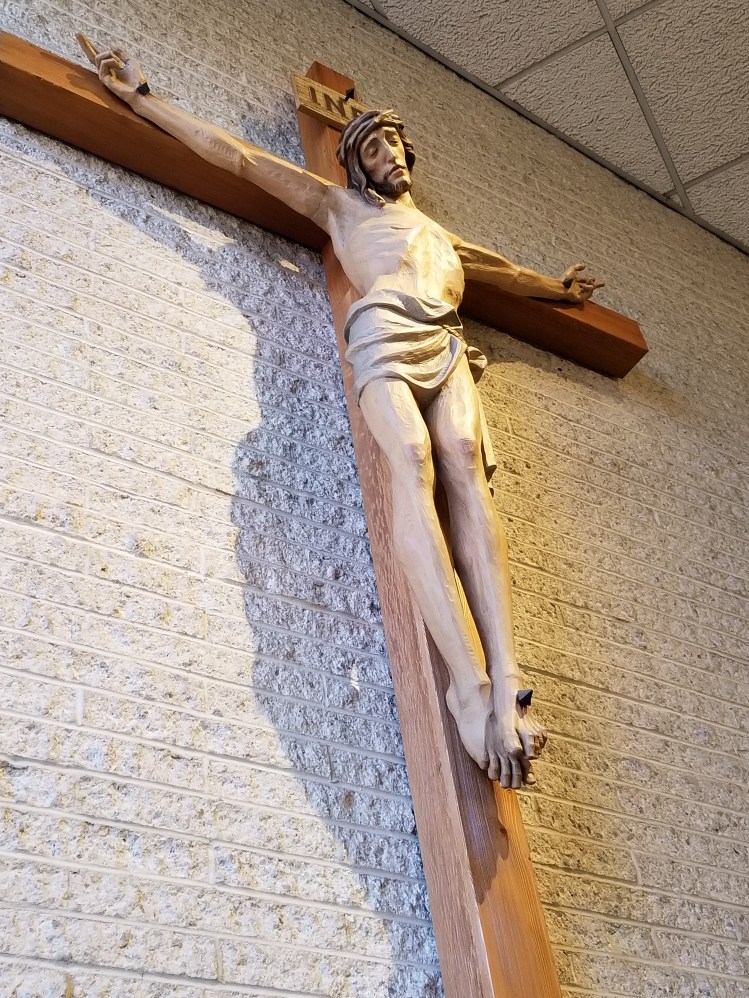
The Romans soldiers seemed to have perfected brutality. While scholars may quibble about where the nail was placed, in the palm or in the wrist, Jesus was nailed to the cross. Ironically, all four Gospels only report that Jesus was crucified, but do not explain what that entails. It’s in John’s Gospel after Jesus’ resurrection when Thomas doubts that the nail marks are mentioned.

Perhaps it’s just me, but whenever I’m praying the stations of the cross and this station is prayed, I feel like I want to protect my hands and wrists. Just thinking about having nails hammered through makes me cringe. After all the pain and suffering Jesus had to go through, from the mock trial and abuse from the Sanhedrin, to the scourging by the Roman soldiers, to the forced walk to Golgotha for His crucifixion, this last detail humbles me. While being affixed to the cross in any manner may be part of the whole crucifixion method, metal nails that pierce sensitive tissue and nerves must have been excruciating. And Jesus allowed Himself to be thus treated. For me and my sins. He did it so that I can have a relationship with God. He did it because He loves me. 

The twelfth station: Jesus dies on the cross

This is only the culmination of all Jesus’ suffering. It is not the end of Jesus or of salvation history. Rather it is the turning point. We have confirmation of Jesus’ death with the Roman soldier who pierced Him with a lance, to make sure He was dead. There is no mistake. Jesus just didn’t faint from being hung on the cross. He died. His body ceased all function. Jesus is fully human and fully divine, so while His human body died, His soul, both human and divine, lives on after the crucifixion. His soul descended down to the dead, to those souls who perished before Him, all the way back to Adam and Eve. But to those who walked with Him in His earthly life, all they know is that Jesus is dead. 

We have the luxury of knowing what happened next, but to those at that time, it must have been absolutely heartbreaking. From Blessed Mother Mary, to the Apostles, to all those who followed or who were somehow touched by Jesus during His ministry, the loss of Jesus must have been felt down to their soul. Praying the stations of the cross is walking with Jesus and His companions through this difficult time. We may not have been there at that time in history, but praying these events takes us back and opens our eyes to all that Jesus endured. Too often we sum it up by referencing Jesus’ Passion and Death, like it is two checkmarks on a list of what Jesus did in salvation history. 

It can be hard to pray the stations of the cross, and we’re not even done reviewing them all yet! It’s easy to become overwhelmed at all the pain and suffering in each detail. However, without being there, this may be only part of the full story of what happened. We can find ourselves wondering why Jesus allowed all this to be done to Him. Why didn’t He say enough is enough? But that is our human perspective reflecting on these events. These details are meant to be a method of reflection for us, to recognize when we choose our way or a perceived “easy” way of sin. Sin is when we reject God and His will for us. Sin is actually worse than all that Jesus suffered. And yet even after contemplating all that Jesus has done to repair our relationship with God, we choose to sin, again and again.

During Lent, we practice prayer, fasting, and almsgiving in a focused manner to align our minds and hearts with Jesus’ Passion and Death. In this time leading up to the most Holiest celebration of the Liturgical Year, let us recognize the depth of Jesus’ love for us, and humbly offer our Lenten practices in thanksgiving to Jesus. 

Fallen and stripped

As we continue our journey through the Stations of the Cross, the next two are ones that we may not think as important as others. However, these two are still worth contemplation and reflection, every bit as the ones that seem even more important, especially as we get closer to the final stations.

The ninth station: Jesus falls for the third time

When we reach this station, it can be easily glossed over, as we have already reflected on the first two falls of Jesus. What more can be said? But that is way too much of a human perspective. We can get frustrated by repetition, especially when it comes to our sins. Sometimes when we realize just how often we sin in the same way, we can shrug it off and say that we can’t help it or that it’s just the way we are. What we are doing is giving up. Other times we may be so frustrated with ourselves that we think that God cannot forgive us yet again. Both attitudes are incorrect. 

The way of the cross only identifies three times that Jesus fell. But was that really the total amount? He was weak from the beatings, the loss of blood, the crown of thorns, walking to the crucifixion site while carrying the wooden beam or cross that He was to be nailed to. The road, even if it was paved in stones, may not have been very smooth, and certainly was not flat. Jesus definitely stumbled many times, and fell at least three times and perhaps more. His mission at this point is to become our Savior by dying and rising again. He fell, but He didn’t give up on us. Neither should we give up on His mercy, no matter how many times we fall into the same sin. That’s what confession is for; so that we can stand up again and learn to be mindful of what leads us into the same sin and try to avoid it. 

This third fall is a call to penetrate deep into our hearts and souls and to examine what separates us from a full relationship with God. What are the sins, even those that are minor, that have become habitual? It is these that we take to the third fall of Jesus and ask for forgiveness and mercy to help us do better in the future.

The tenth station: Jesus is stripped of His clothes

While the Gospels mention the soldiers casting lots for his garments, it skips over the obvious. Jesus is stripped of the last of His human dignity: His clothing. It may not seem like much, but it, too, is torturous for Jesus. Anyone who has had a bandage stuck to an open wound knows that it hurts when pulled off. After the severe beating Jesus had at the hands of the professional Roman soldiers, Jesus’ body would have been full of open and still bleeding wounds. Ones that His garments would stick to because they acted as bandages for Him. 

Since Jesus was going to die soon anyway the soldiers would have no incentive to remove His clothing gently. Yes, they were going to gamble for it, but that doesn’t mean having a full garment intact would be worth more. Perhaps garments won by the soldiers were considered their trophies and the competition was for who had the most. The soldiers didn’t care how Jesus felt when they removed His clothes. Perhaps in removing them quickly it was a mercy to Jesus. Or did the executioners know the pain in removing the clothes and did it slowly to cause more agony?

While depictions of Jesus on the cross always include a loin cloth for decency, the prevailing thought is that Jesus was naked on the cross. When we go to confession, do we bare our souls naked to Jesus? Do we confess all our sins, even those we would prefer not to admit or that have become a habit? 

Jesus willingly gave up His life, and in doing so, allowed Himself to the indignities of being treated as a criminal. He did that so that we could be forgiven and return to a relationship with God. There is no detail in Jesus’ passion, death, and resurrection that does not have meaning. Jesus willingly accepted it all for the love of us. Let us return the love by contemplating on the details of cross, even those that can seem repetitive and minor.

No halftime show

We are about at the halfway mark through Lent, but there is no celebratory “half-time” show. There is no song and dance, no feast of food. Rather, we see both the humanity and divinity of Jesus in the next two stations of the cross.

The seventh station: Jesus falls for the second time 

Jesus falls, again. He falls despite receiving help from Simon to carry the cross. He is weak from the loss of blood, the torture, as well as having to walk to His own death. This is what He came for, to go to the farthest reaches that man can go, in order to build a bridge back to God. Death is scary for all creation. And Jesus would not just have to face death and experience it, but an agonizing death designed to be the most cruel and inflict the most suffering. Knowing there is still quite a distance to travel, Jesus succumbs to the fatigue in His body and falls. 

Yet there is no stopping to rest. The soldiers have a job to do and in order to do it, Jesus needs to get to Calvary. While they won’t help Jesus, they don’t want Him to expire on the way. We don’t have an exact account of what happened, however, we can use what we know of the times to analyze what could have happened. The soldiers could have started beating Jesus to get Him to get up off the street. They could have beat Simon to carry more of the burden. Perhaps they readjusted how Simon was helping so that he could support both Jesus and the cross. 

If we look back at our Lenten journey so far, how have we fared? Have we kept up our prayers, fasting, and almsgiving? Have we embraced the special practice we resolved to do for our Lenten observance and continued with it? Or have we fallen? While we don’t have Roman soldiers beating us back into practice, we can pick up our Lenten practices again. Jesus understands our struggles more than we do. 

The eighth station: Jesus comforts the women of Jerusalem 

In Luke’s gospel (Lk 23:27-31), Jesus addresses the women mourning His death while He is still on the way to Calvary. He knows how difficult the next few hours will be from a human perspective, but He also knows the divine plan will be worth the pain and suffering He has to endure. The women, however, only see that Jesus will die a criminal. For them, death is the end and so they mourn and lament His torture and death. 

Jesus does not let this opportunity pass by. He corrects their sorrowful attention to be on the people of Jerusalem and the descendants rather than on Him. Here Jesus is showing His divinity with His prophetic utterance, one that seems particularly meaningful in our modern times. Jesus knows He will rise again, He will continue to have life. However, He also knows that societal changes will bring about an aversion for motherhood and childbearing. He warns us all — but especially the women — to be on guard for the time when participating in God’s creation by bringing new life is cursed rather than praised. 

Jesus is ever mindful of the healing that will result from His actions. Where He finds a willing soul, like those women of Jerusalem, He continues with His mission of preaching the Kingdom of God. Our Lenten practices are meant to soften our souls to be open to Jesus and God’s will for us. Let us seek the wisdom of Jesus as we journey through the second half of Lent. 

Remembering compassion

As we continue to reflect on the stations of the cross, the next two stations name a person who brought aid to Jesus on His way to Calvary. Including their names helps us to connect with them so that we can follow their example.

The fifth station: Simon of Cyrene helps Jesus carry His cross

The three synoptic Gospels all mention Simon helping Jesus to carry the cross. However, each also indicates that the Roman soldiers pressed Simon into helping Jesus. We can deduce a few things about the situation. First, Jesus must have been so weak that the soldiers were concerned Jesus wouldn’t make it all the way to Calvary. If Jesus had died on the way, it would have been not only tragic, but also not the result that would have pleased the Jewish leaders and crowd who had called for His death. Nor could it have been used as a deterrent of criminal behavior for those entering Jerusalem. Another point we can glean is Jesus’ acceptance of the assistance. While it was only His death that could have and does restore our relationship with God, nevertheless, Jesus was in need of assistance, and He received it by what seemed to be an unwilling person.

If you attempt to look at the circumstances from Simon’s perspective, the Roman soldiers were singling him out of the crowd. I would expect one of his reactions to be, “Why me?” Secondly, only criminals were executed on the cross. They were expecting Simon to aid a criminal and, in some respects, to potentially be mistaken as a criminal. Simon considered himself an innocent man, so why should he help anyone in those circumstances? What we don’t know is how Simon felt when he reached Calvary. Did Simon continue to begrudge the aid to a condemned criminal? Or did he realize the unique opportunity he was given in the salvation of the world? A hint that everything changed for him is in the Gospel of Mark, when the author references the names of Simon’s sons. It’s almost as if Mark is saying to those at that time that they can confirm what took place by consulting the source’s family. (Mk 15:21)

The sixth station: Veronica wipes the face of Jesus

It is more from tradition than scripture reference that we know Veronica’s name. While Simon had to be coerced by the Roman soldiers to help Jesus carry the cross, Veronica’s actions were the opposite. She defied the Roman soldiers, making them stop or at least slow down for a brief few seconds, in order to be able to wipe the face of Jesus. She saw a need and willingly reached out to bring a moment of respite to Jesus. The action may not seem like much, and may appear rather pointless, since He was being led to His death, but Veronica still risked her life to recognize the dignity Jesus had as a man. 

At that time, a respectable woman wore a veil. The tradition that Veronica wiped the face of Jesus with her veil gives the indication that this was totally spontaneous and outside the social norm. It was probably the only thing she had to use, that she could use, to effect this small act of kindness. Did she think about how those around her would be shocked to see her without her veil? Which was the greater scandal: using her veil or cleaning the face of a condemned criminal? Neither way would make her popular amongst the people and yet she did it anyway. In a way, Veronica gave up a piece of herself; her aid was a sacrifice. 

Simon and Veronica each rendered help to Jesus during His way to Calvary. Each approached the effort from different perspectives, yet both are remembered each time the Stations of the Cross are prayed. Let their assistance be a model for us to follow in this Lenten season. 

Human family

As we continue our Lenten journey through the stations of the cross, today’s two stations emphasize the humanity of Jesus.

The third station: Jesus falls the first time

Jesus is a young man of about 33 years old. To hear that He falls as he carries the cross seems a surprise, especially knowing that His full humanity contains an equal amount of His full divinity. How can God fall? And from the name of the station, it didn’t happen only once. After being beaten and crowned with thorns by the soldiers, who excelled at pain and torture, Jesus’ body was weak. And yet He gets up and continues on. His destiny is not to die on the road, but on the cross at Calvary. 

There have been heresies over the centuries that denied the humanity of Jesus, but this station underscores just how human He really was. Jesus understands our human nature because He has lived it. He knows, not just from a divine understanding, which penetrates much deeper that even we can understand ourselves, and brings that wisdom in practice. How many times do we use our fallen humanity as an excuse to do what we want to do, as we try to act as a god ourselves? We argue with God that He doesn’t understand our circumstances, but these defenses fall flat with Jesus’ first fall carrying the cross. He does understand how easy it is to fall under the weight the world puts on us. While Jesus can sympathize with our plight, can we understand the love He has for us to accept the cross and all it brought with it? Love is not just a nice feeling, but a choice that requires sacrifice. Do we die to our wants in order to choose a relationship with Jesus?

The fourth station: Jesus meets His mother

If you try to imagine a scourged and bleeding Jesus, carrying a cross on the way to His death, meeting up with His mother, the woman who has trusted God in all circumstances of life, the encounter is nothing short of painful. Jesus wants to comfort His mother, but words are hard and time is short. Mary wants to comfort and aid Jesus, but she can only pray that God’s will be done through all of this. He is her baby boy, but she also knows He has a mission too. She has to let Him go amidst the pain and suffering she feels. She lets Him go, but never too far away; she will be at the foot of the cross as He takes His last breath. 

This station reminds us of the great miracle of the incarnation of our Lord. He didn’t just pop into existence, but with the consent of Mary, started His life like we all do, in the womb of His mother. The bond between mother and child lasts far beyond the umbilical cord and early childhood dependence. While on the cross, Jesus will speak to Mary and give her motherly protection to John and the Church. Through our baptism we become adopted children of God and we receive Mary as our mother, to help support us and point us in the direction of her Son. She has experienced both true miracles and the worst of horrors during her earthly life. Now, in heaven, she seeks the well-being of all her children throughout the world and across the millennia. When we fail, let us never be afraid to seek her guidance and protection to help steer us back to the path God has for us. 

Jesus shared our humanity, and therefore is a part of our human family. As Christians we partake in His divine family, and are able to call God our Father and Mary our mother. 

Condemned to the cross

As we begin the Lenten season, one practice that is typically offered by churches on Fridays is the Stations of the Cross. This year, I’d like to reflect on each of these stations, two at a time. 

The first station: Jesus is condemned to death.

Each of the four Gospels are clear, Jesus’ death was sanctioned by Pilate. All four also indicate that Pilate questioned the need for a death penalty, trying to have Jesus released by comparing Him to another prisoner, Barabbas. Can you imagine what an intoxicating sound it must have been for Barabbas to hear his name being shouted by all the people? How many in the crowd had recently sung the praises of Jesus? How many had been healed or knew someone who was, and now they are calling for the release of a murderer rather than a healer?

In the end, “So Pilate, wishing to satisfy the crowd, released Barabbas to them and, after he had Jesus scourged, handed him over to be crucified.” (Mk 15:15, emphasis added) The Pharisees, the crowd, the soldiers, and Pilate all played a part in the condemnation of Jesus at that historic moment. Over 2,000 years later, we’d like to say we wouldn’t have participated or that we would have stood up for Jesus, but even His Apostles, the tight-knit circle of disciples, had mostly run away. While John was at the foot of the cross, where was he in this judgement? Was he one of the lone voices speaking out against this injustice? Or were his cries useless against the roar of the crowd? 

The phrase used in this passage in Mark can serve as a beacon for us. While God does not want us to be miserable, He also doesn’t want us to seek out satisfaction on our own. Rather than searching to find something or someone who can satisfy us, we need to learn how to be satisfied with what we receive. When we allow the blessings and graces God gives us to fill us up, there is less room for the devil to tempt us into seeking things and persons who turn us away from God.

The second station: Jesus takes up His cross

Condemned to death meant one thing: crucifixion. This begins Jesus’ last journey, but it is the one that He was born to make. He has been brutally beaten by the soldiers, mocked with a crown of thorns, and weakened from the loss of blood. Yet, He picks up the cross, bearing the weight of it on His shoulder. The burden of the cross equates to the weight of our sins. When we seek to reconcile ourselves to God, we seek His mercy in the sacrament, but do we realize that Jesus has already carried the weight of our offensive words, actions, or inactions when He picked up that cross? We may receive a penance of a few prayers or passages in scripture to read, but we need to remember that Jesus has already paid the price for us, and there is nothing we can say or do to compensate Him.

We all have problems, pains, and struggles. We often referred to them as our crosses to bear. How many times do we ask God to remove them from our lives? Do we allow these crosses to be opportunities to learn how to trust God more, to become closer to Him? We may start out with the best intention to carry our crosses ourselves, but we are far weaker than we realize. Jesus understands all too well the weight of what we carry. While we must be willing to bear the burden in our cross, we also must make sure that we are not adding additional burdens and anxieties to it. 

We cannot go back in time to help Jesus during this most difficult journey. However, when we pray the Stations of the Cross, we remember not just the sacrifice of Jesus, but the details that made up the sacrifice. And when we receive the sacrament of reconciliation, we can be more grateful for all that Jesus did for us.

Catholic Girl Journey Logo

Eye splinter

Comparisons should come with warning labels and spiritual safety glasses. In a world where likes are tallied and people can be “cancelled,” comparing our lives to the lives of others can have drastic consequences.

I’ve been watching way too much YouTube recently and one line that is universal to every video is, “Hit the like button.” Indicating you like the video and, if you want to see more of the creator’s content, subscribing to the channel are inputs to the complex calculation that is supposed to spread the creator’s content and recommend it to others who have similar viewing habits. Yet it feels as if, no matter where you go in society, everyone has a similar mentality of getting likes or positive online reviews, no matter how small the interaction. Every time I use a service or order online, it seems like I receive a survey so that I can provide my judgement of the experience. While it’s good to seek out how to improve, oftentimes it seems like I’m being asked to participate in a marketing ploy so that the company can use those favorite advertising descriptions like most popular and best seller. These statements may seem harmless on the surface, but for those with a competitive nature, it’s a subtle cue that triggers a desire to want the item, just because the proverbial everyone has it. We don’t even realize that these statements are causing us to compare ourselves with others, about whom the only thing we know is their purchase of that item or service.

In the carefully curated world of social media, we can do physiological damage to ourselves if we compare our lives with the lives of others. Even for those who keep it “real,” we are only seeing a small sliver of their life. We all know that life is complicated and challenging to navigate, and each person faces their own unique trials and issues. Yet all too often we pass judgement, either on those we see or on ourselves for not achieving what the content creator did. In Luke’s Gospel, Jesus warns us, “Why do you notice the splinter in your brother’s eye, but do not perceive the wooden beam in your own?” (Lk 6:41) A splinter in the eye sounds painfully horrid, but the reason Jesus uses the eye is because it’s through our eyes that we see the world and make comparisons of ourselves and others. Our eyes are constantly taking in the world around us and making micro decisions about our environment, looking for potential dangers, as well as noticing delicious food or something that will help us in our life. When our sight is hindered or blocked, we cannot get a full understanding of our circumstances and certainly not that of anyone else. Most often we fail to recognize our faults and yet feel empowered to tell others about how they can correct theirs, regardless of whether or not they sought our input. 

Comparisons can be a tool, if we use them properly. If we look to another and notice their words and actions bring the love and peace of God to others, then we can look to them as a role model. Mary and all the saints are role models for us to follow. However, if a person seems to sow division and accusations, we want to be sure we don’t mimic their behavior. We should not judge them, only use that example to cleanse us of bad habits. If we see similar traits reflected in our own behavior, rather than condemning another, we should seek God’s mercy and grace, not just only for ourselves, but also the person that is suffering in a similar way. Even better is to ask God to help all those who are stuck in that same negative trait. 

Life is not a contest for the most number of likes; each of us suffers with eye splinters. Let us seek God’s grace and mercy to address our words and actions that don’t bring His love and light to those around us.