Catholic Girl Journey Logo

Unclean hands

How often do you eat with unclean hands? What about receiving the Eucharist? Do you wash not only your hands but also your soul?

As the Gospel was being proclaimed last Sunday, I got the sense of the Old Testament foreshadowing the New Testament and that I just needed to ponder it more to see the bigger picture. When we consider the rituals that the Pharisees referred to, the washing of hands before eating as well as “purifying” or cleaning specific items, they are good hygiene practices to follow. The people of that time were not aware of the microscopic bacteria and germs that could cause them to become sick, but God knew. In requiring them to purify, or wash, their hands before eating, He was creating a habit for them that would reduce or even prevent disease. This physical habit should have also had a parallel for the spiritual health of a person. As they were “purifying” their hands, they should have thought about how well they kept the Commandments. Humans, however, have a tendency to be shortsighted and only look at what is being asked, relegating a healthy physical habit into a spiritual ritual instead of a spiritual reflection. In addition, one gets the sense that the Pharisees were scandalized to see that not all of Jesus’ followers adhered to this requirement.

As the Eucharist is a meal, how do we come to the table, which is the altar, with clean hands? Here again, the parallel is not literally having washed our hands (although that is always a good practice!), but rather preparing ourselves to receive in a worthy manner. In a sense we need to “wash” our souls before we receive Holy Communion. The most obvious way we can purify ourselves is through the sacrament of reconciliation. This is imperative if we are in a state of mortal sin, however, regularly receiving this sacrament can keep some of the lesser sins from growing into greater ones. Reconciliation is such an amazing sacrament! When we take the time to prepare for it by reviewing our thoughts, actions, and omissions, as well as truly being contrite for how these offenses have separated us from God, we can receive His mercy and be “washed” with grace. After a good confession, our souls are like the day we were baptized! 

If we aren’t in a state of mortal sin, there are probably plenty of venial sins that are causing our relationship with God to be strained. During Mass there are two ways that we can “wash” our souls. The first is the Penitential Act, when the priest asks us to call to mind the sins we have committed since our last Mass. As a congregation, we admit that we have sinned and ask God’s mercy through a general prayer. The priest gives a general absolution for these minor sins before we proceed with the Gloria. The other way we take ownership of our sins against others is at the sign of peace. This is the closest way the Church can encourage us to forgive others. It recalls Jesus’ teaching, “Therefore, if you bring your gift to the altar, and there recall that your brother has anything against you, leave your gift there at the altar, go first and be reconciled with your brother, and then come and offer your gift.” (Matthew 5:23-24). At the sign of peace, here again is a physical action that has spiritual parallel. It may be impossible for us to actively forgive someone who is many miles away at that moment, but we can recall the hurt and ask God to help us forgive that person or to help that person forgive us. If the person is near us, we can take the first step at healing the relationship by offering them the sign of peace, that is to say, “I forgive you,” or “I seek your forgiveness.” These two times in the Mass allow us to recognize the effect of our daily actions towards God and those we interact with, and seek God’s mercy and grace.

It’s not just an Old Testament ritual that instructs us to prepare to receive the Eucharist, but even Paul in his first letter to the Corinthians boldly warned them about not purifying themselves before receiving Holy Communion. “Therefore whoever eats the bread or drinks the cup of the Lord unworthily will have to answer for the body and blood of the Lord. A person should examine himself, and so eat the bread and drink the cup. For anyone who eats and drinks without discerning the body, eats and drinks judgment on himself.” (1 Cor 11:27-29) What does unworthily mean? I believe the list of actions Jesus indicates from Sunday’s Gospel reading that defile a person are what makes a person unworthy to receive Holy Communion. (Mark 7:21-23)

We are a people of unclean hands, but God, through His Church, has provided us ways to wash ourselves and our souls clean. Let us use these opportunities to grow our relationship with God rather than just performing a spiritual ritual.

Catholic Girl Journey Logo

Say it again

Did Sunday’s Psalm sound familiar? I thought it sounded repetitive last weekend as well. Actually Psalm 34 has been used the past three Sundays and always with the same response. “Taste and see the goodness of the Lord.”

While the past four Sundays have been from the sixth chapter of John, commonly known as the Bread of Life discourse, the initial Sunday was the multiplication of the loaves. It was this miracle that John expands upon in the following three Sundays and the mirroring of Psalm 34 imitates the pattern. Some of the stanzas are different, but the response remains the same. If we just take it at face value, we may think that Psalm is used because it is talking about bread and one does taste bread. But we’re not talking about any old bread, we’re talking about a discussion in which Jesus indicated it was His own flesh. According to Bishop Barron, in the original text Jesus emphasized the eating of His flesh by using a verb that conveyed the gnawing eating method of an animal to illustrate the act of consuming. The Church in her wisdom uses Psalm 34 to mimic the emphasis for us today.

Have you ever eaten a meal so quickly that once it was over you realized you have no recollection of how it tasted? It can be disappointing to realize that we really didn’t enjoy eating that meal! So how do we taste the goodness of the Lord? Is it merely the flavor of the consecrated host before it dissolves in our mouth? Is there a way we can gnaw on Jesus? According to Merriam-Webster, there are nine definitions for taste as a verb. Some of them indicate eating in small quantities. Yet if Jesus overemphasized the act of eating, I don’t think the definitions that equate to nibbling would be applied. I think the most appropriate definition for taste is, “to become acquainted with by experience.” We need to experience God in order to appreciate His goodness to us. 

As Jesus bluntly reiterated eating His flesh, how could we deepen this experience of God as if we are gnawing on His goodness? I’m sure there are areas in all of our lives that we grumble and wish the situations were different — in our home, our family, or in our work, but what if instead of grumbling about why it isn’t meeting our standards, we appreciated what we do have within all aspects of our lives? “I will bless the LORD at all times; his praise shall be always in my mouth.” (Psalm 34:2) Before the psalm talks about petitioning God for assistance, it urges His praise and glory. When we turn away from our egos and wants, we can see better to thank God for all that He has provided to us already. We can then expand our vision to see the small blessings that come our way each and every day. Praising God for all sizes of blessings on a regular basis will grow our relationship with God so that we can truly share Him with others, “… let the poor hear and be glad. Magnify the Lord with me; and let us exalt his name together.” (Psalm 34:3-4) In sharing our experience with Jesus with others, we can help them to taste and see God’s goodness in their lives.

Just to be clear, experiencing God does not mean that we won’t have challenges and the psalm is very direct about that. “Many are the troubles of the righteous, but the Lord delivers him from them all. He watches over all his bones; not one of them shall be broken.” (Psalm 34:20-21) God does not prevent us from difficulties, but He does walk with us through them, providing the support we need to get us back to a place of peace. 

With 150 psalms, I’m sure there were others that the Church could have used to accompany the Gospel readings for the past three weeks. Yet it found using this short Psalm with its repetitive response as the perfect fit. We have already repeated it as the refrain several times during the last three Sundays. It’s now up to us to continue that refrain in our praise of God to others. 

Catholic Girl Journey Logo

Take versus receive

As Catholics, do we take Communion or do we receive Communion? Is there a difference? If there is one that is correct, which is it? 

A few weeks ago I was assisting in training a small youth class on the Eucharist and the leader used the phrase take Communion. It felt awkward and uncomfortable for me to hear that. As she is a convert to Catholicism, I thought perhaps it was her Baptist roots showing. I gently corrected her phrasing to use the word receive. However, I’ve been second guessing myself for the past three weekends at Sunday Mass. We have been hearing the Gospel from John chapter 6, known as the Bread of Life discourse. Each week the homilies have included reminders of how the Gospel ties into the Eurchastic prayer taken from the synoptic Gospels where Jesus says, “Take this, all of you, and eat of it: for this is My Body which will be given up for you.” Take?? I thought we received Communion? I feel like the only time I would use the word take in conjunction with Holy Communion is when a person is making a call to a homebound person or someone in the hospital. It’s like we’re taking Jesus to visit that person, just as you might do with a mutual friend.

I love exploring the meaning of words and their etymology, so I looked up both words in Merriam-Webster. If it was a matter of the number of meanings, take would win hands down with over 20 verb meanings! I think the most used definitions come first. My perception of the word take is one of aggression and the first meaning bears that out: to get into one’s hands or into one’s possession, power, or control: such as to seize or capture physically. The word receive, on the other hand, only has a mere five verb meanings, however they contain the concepts of welcome, greet, and believe. My perception of the word receive is more of opening oneself to what is being offered or given and has a sense of humility in the action. In regards to etymology, however, they both mean the same thing, although they come from different sources: Old Norse and Latin. 

I searched for videos about receiving Communion at a Catholic Church to see how different content authors gave instruction. Receive was used by all, not just in the title but also in discussing the etiquette and actions for the proper reception. In one video by Fr. William Nicholas, he describes several ways of what not to do! In one description he uses the term snatch, which for me would be akin to using the word take in reference to Holy Communion. His video starts out by reminding us the third precept of the Catholic Church is, “You shall receive the sacrament of the Eucharist at least during the Easter Season.” (Catechism of the Catholic Church, 2042)

So why does Jesus tell us to take while the Church teaches us to receive? In John 20:22, Jesus does use the verb receive with His Apostles, but in a totally different way, “He breathed on them and said to them, “Receive the holy Spirit.” Jesus commands us to take in regards to the Body as it is a physical thing that can be held and take is the proper action verb in the physical realm. However, when it comes to the Holy Spirit, which is in the spiritual realm, we cannot perform any action to acquire the Spirit, but rather we must be open to receive the Spirit. It is Jesus, Himself, who is in the consecrated host we receive at Holy Communion. If He is giving us a direction to take Himself within ourselves, it makes sense that He gives us the command in such an actionable way.

Lastly, I did a search to see if there were any commentaries about Catholics using take versus receive in regards to Holy Communion. Oddly enough, there wasn’t much out there, but I did find a response on the Catholic Answers website that indicates both terms are correct. However, “traditional Catholic piety has encouraged use of the word receive to emphasize that Communion is a gift from Christ to the individual Catholic.”

I think words do matter and we need to be careful how we present concepts to those receiving instruction in the faith. Even if both terms are correct, receive is the preferred choice of the Catholic Church. 

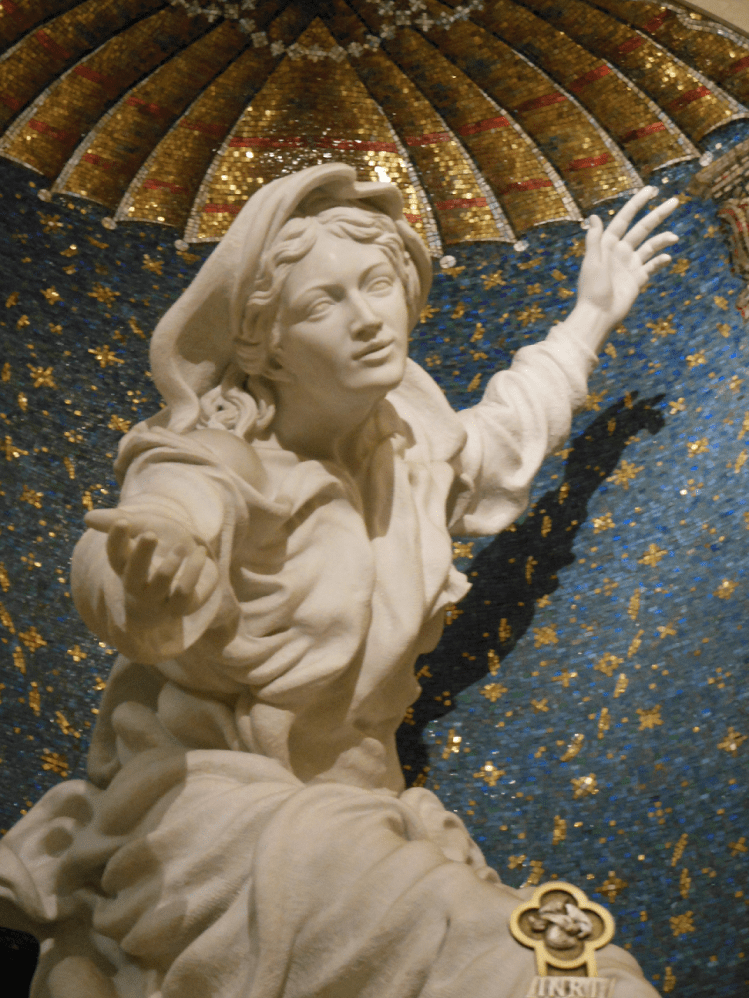
Mary at the Cathedral of St. Matthew the Apostle, Washington DC

No singular purpose

This week the Church celebrates the Assumption of Mary into heaven. It’s a perfectly placed holy day to remind us of who we are and where we are going.

August means summer is just about over and, for those who have children, another school year is about to start. All too soon we will be replacing shorts and t-shirts with long pants and cozy sweaters as well as finishing another calendar year. The older I get the faster time seems to pass. The culture that surrounds us seems to live on emotions alone which can change faster than the wind, and produce just as much chaos and turmoil as any windstorm or tornado. While there is value in living in the moment, we also should not be hyper focused on solely how we feel as the barometer of our life. One can’t seem to escape the headlines or sound bites indicating an epidemic of depression. Too many see their value based on fleeting ideals of their career, their bank account, their status in society, or even their popularity on social media. Yet the Church reminds us Catholics to stop and remember the Blessed Virgin Mary.

Our baptism welcomed us into the family of God. Our purpose is not a secular one based on what we can measure here on earth, but rather how we reflect and imitate the love of God to each other. From the first chapter in Luke’s Gospel, Mary sings God’s praise to Elizabeth. Instead of reflecting on the message she received about her own miracle, she rushed to assist her kinswoman Elizabeth. One could argue that Mary’s purpose was to be the Mother of Jesus during His time on earth. But her motherhood didn’t end when Jesus died on the cross because He gave her a new role as Mother of the Church. 

Parenthood is not just a title, but a multi-faceted job that takes one’s whole self, requires sacrifice, can be painful and yet produces a joy that can only be experienced and not explained. Aspects of Mary’s spiritual motherhood can be found in praying the Litany of Loreto, which has over 50 titles for her. There are 15 titles that include the word “Mother,” 7 titles containing “Virgin,” and 13 titles with “Queen.” Some titles describe how she intercedes on our behalf and others are comparisons that paint a more tangible perspective of a mirror, a tower or a vessel. Praying and reflecting on the litany reminds us that God has not placed us here for a single moment in time, but rather at a particular period of time to accomplish His will in many different ways. While we can evaluate how we respond to God’s will and how much we have pursued a relationship with Him, we cannot be the final judge of how much we accomplished as that is in the hands of God.

The feast of the Assumption reminds us that there is more to life than the daily grind. Eternal life with God is possible if we have a relationship with Him now and seek to do His will as Mary did. God brought Mary full circle at the end of her life by bringing her, body and soul, into heaven. This is not something she could achieve as a mere creature created by God. This is a supreme gift from Almighty God as a blessing to Mary for fulfilling His will on earth. At the moment of her conception, she was preserved from original sin and at the hour of her death her body was spared any decay or corruption by being assumed into heaven. Mary is enjoying now what we hope to, God willing, after our resurrection from the dead. 

The summer draws to a conclusion and the daylight hours grow fewer. Another year ends and our time on earth is shortened. Yet our hope is in the Lord as our source of light and life. Our journey is not through this time but towards God as we seek to know Him as our Father and love Him by choosing His will over ours. May the Blessed Mother of God, Mary Most Holy, intercede for us with her motherly wisdom. 

Who is stealing from whom?

I’m not sure what’s going on in Christian music today, but on my journey to visit my Mom on Sunday, I heard two very different songs about thieves. As catchy as both the tunes are, both are poor theology. 

I’ve heard these songs for awhile now and every time I’d hear either one, something just didn’t seem to make sense in my brain. Usually I listen to Christian radio when I’m driving, so I’m not fully concentrating on the lyrics, as there are too many other drivers around me that I need to pay more attention. The first song, by Tauren Wells, is Take It All Back. The refrain sounds quite powerful, both in the music as well as the lyrics:

I’m calling the angels down
I’m storming the gates of hell
Tell the devil he don’t own my soul
I’m taking back what the enemy stole
I’m raising the battle cry
I’m holding the banner high
With the power of the Holy Ghost
I’m taking back what the enemy stole

The song evokes the age-old battle with Satan that is a result of our sin, which is often portrayed as chains or shackles that bind us. And in many spiritual ways that is true. But it’s also a choice. Can the opportunities to sin appear to be something good rather than evil? Absolutely! However, it is still a choice that we make and we are responsible for our words, actions, or the lack thereof. The lyrics of the song imply that the Devil has stolen the person’s soul, basically taking what did not belong to the Devil and certainly without the consent of the person. Sin separates us from God. It’s only when we turn back to Him, when we repent and lean on His mercy that we can receive the grace God wants to shower on us. The Devil cannot hold our souls unless we give him permission to do so. Satan will try and trick us and think that we can’t escape, but we can call on the Triune God for help — Father, Son, and Holy Spirit. We can call on our guardian angel or even St. Michael, the Archangel, in our battles with the tempter. I know the song wouldn’t pack the same punch if the lyrics were, “I’m taking back what I gave up.”

The other song is equally catchy, but has even worse theology! The song by Crowder is Grave Robber and the refrain for this one is: 

I got stolen by the grave robber
Picked me up from that rock bottom
Washed my soul in that Holy water
Brought me back to life 
One more stone rolled away
One more sinner been saved by grace
This dead man, he ain’t dead no longer
All because of that grave robber 

In the first song we had the Devil stealing a person’s soul. In this song, we have Jesus stealing a person from themself! What?! Jesus is not going to force you to choose Him, and He certainly will not take you against your free will. He wants a relationship with you. Jesus will give us life in abundance, and He rejoices when a hardened sinner repents and turns to Him. Jesus gave us the parable of the Prodigal Son, so that we can know that God is constantly seeking for us and at the first sign of our return, He is there to bless and celebrate us. This song, however, makes it seem like Jesus is just snatching up unsuspecting people and forcing them to believe in Him. While it’s true that we cannot save ourselves, our salvation does rely on our participation with God. If we turn away from God and want nothing to do with Him, He will continue to love us and seek a relationship at any small, micro possibility that can open us up to Him. A thief or robber takes what is not His and without permission. Since God created us, technically we are His. But God has also given us free will and will never force us to turn to Him. We may be required to make a choice for His will or our will (sin), but we always have a choice. 

Just because a song is on Christian radio does not make it a good song, no matter how much the tune sticks in your head. Neither the Devil nor Jesus is a thief. We have free will to choose. It’s up to us to choose a relationship with God and to do His will. 

Catholic Girl Journey Logo

Wheat and weeds

A daily Mass Gospel reading last week was that of the wheat and the weeds, Mt 13:24-30. As I thought about the reading, the oddest juxtaposition came to mind: Peter and Judas. 

Peter is mentioned many times in the Gospels, sometimes not in the best way, but always very loyal to Jesus. He is quoted many times throughout the passages, and I would suspect many could at least paraphrase something Peter said. But what about Judas? Besides his treachery that led to Jesus’ crucifixion, the only other recorded moment of him is his objection when perfumed oil was used to bathe Jesus’ feet. He thought it should be sold and the money donated to their cause. The commentary indicates that as the money keeper, he was thought to be pilfering from the donations that came their way. Yet, Jesus called Judas to be one of His intimate set of followers. Judas heard all the parables and teaching opportunities that Jesus presided over. He saw most of the miracles that Peter saw. And Judas had a personal relationship with Jesus while He was in the flesh. Have we ever had a moment of weakness when we thought that if we could just see and talk to Jesus in His human form, it would make believing easier? Well, Judas spent three years traveling with Him and despite all he observed, he still allowed greed and pride to rule his actions and ultimately betrayed Him. 

In the parable, the farmer instructs his farmhands to not pull up the weeds, lest they disturb the roots of the wheat and bring that up with the weeds. Instead the two are allowed to be cultivated together and the care that is given to wheat — water and fertilizer — is also being utilized by the weeds. Likewise, God does not just bless good people who “deserve” it, as if anyone is good enough to deserve God’s blessing, God blesses those who seek a relationship with Him as well as those who run the other way. “That’s not fair!,” may be your reaction! Yet, if the weeds do not receive the same care that the wheat gets, the consequences could be worse than the two growing together. Perhaps the weeds would start feeding off of the wheat? Or in trying to obtain the water and nutrients that the wheat received, the amount would not be sufficient enough for both and neither the wheat nor the weeds would ever mature for a harvest. And worse yet, in the competition for the food, with neither having a sufficient quantity, both would perish. During His earthly ministry, Jesus gave all 12 Apostles and many other followers opportunities to know God in a way they never thought possible. It wasn’t only being instructed by Him, but they talked with Him, ate with Him, laughed with Him, and cried with Him. Peter and Judas were both wheat and weeds growing up in the presence of Jesus.

While parables are a helpful tool in teaching spiritual concepts in a more concrete manner, they are imperfect. Weeds cannot change what they are, however, as humans we can change the kind of person we are. We can turn away from what separates us from a relationship with God and seek to do His will. Our sinful nature makes us weeds that should be tossed into the furnace. But through God’s mercy and Jesus’ sacrifice, we are able to become wheat that can be received into the heavenly barn at the final judgment. The choice is ours to make, as God gives us free will to choose for Him or for ourselves. 

Both Judas and Peter betrayed Jesus that last night; one by selling their location to the Pharisees and the other by denying he knew Jesus. Both regretted their actions. Judas’ despair drove him to hang himself. Peter’s sorrow was forgiven in his encounter with the resurrected Jesus. Peter had faith in God and Jesus. And it is our faith and the actions that flow from our beliefs that make us wheat instead of weeds. 

More than food

It all started with an apple. It ends with bread and wine. Why is our salvation centered around food? What significance does it have on our spiritual lives?

The apple has been the iconic symbol of the fall of man for many centuries, yet in reality, Genesis never mentions what it was that Adam and Eve ate, only that it was the “fruit of the tree.” There are many trees that provide produce, like oranges, lemons, almonds, walnuts, and coconuts. Early scholars suggested that the fruit was a fig or an olive, which was common in ancient times. However, if there was only one tree in the garden that they could not eat, perhaps whatever fruit it was is no longer in existence? It could explain why there is no special identifier for that fruit beyond the fact that it was produced by the tree. Does it matter what type of fruit it was that was consumed? Curious human brains want to have these details, but sometimes in wanting details, we miss the bigger picture. What is it about eating the fruit of a tree that we need to pay attention to? Perhaps it’s more about the tree producing the fruit, something that, ultimately, rests in the hands of God. As humans, we can plant seeds and trees and care for them to the best of our ability, but we cannot force the fruit to come. An apple is actually a good example of the fruit of the tree as a source of nutrition from God. We need to do absolutely nothing to prepare an apple to be eaten; we don’t have to peel it, we don’t have to cook it. We can just take a bite and enjoy!

God uses patterns throughout salvation history to effect change. One example is when the Israelites were wandering in the desert complaining and they were struck by seraph serpents. God had Moses fashion a bronze serpent on a staff and raise it up and anyone who looked at it would survive their bite. (Num 21:4-9) This is considered a precursor to Jesus on the cross. We could also say that the fruit of the tree eaten by Adam and Eve is the precursor to the bread and wine we use for communion. If it was with food that we sinned, then it is through food that we are saved. However, there are two large differences between the fruit of the tree and the Eucharist.

While bread and wine are both food, they don’t come ready made for us to eat. We humans have to put time and effort into making each. This doesn’t mean that we are in control of our salvation, rather, that we need to participate with God to achieve salvation. We work with the fruit of the earth that He provides, and apply the knowledge and experience we have gained in order to make the bread and wine. Ironically, each of these food items are on the opposite ends of the shelf life spectrum. Bread, unless it is made with lots of preservatives,  really only lasts one day. Wine, on the other hand, takes time to produce and gets better with age. We can interpret these polar opposites to understand that God will give us what we need today and will also provide for our future. 

It’s not just any bread and wine that has salvific properties, but rather those that are consecrated during Mass. While humans have transformed wheat and grapes into bread and wine, Jesus transforms them into His Body and Blood, leaving only the properties of bread and wine to observe. In the Eucharistic miracle accounts I’ve read, any microscopic testing of the consecrated host structure was found to be consistent with muscle tissue from the human heart. Jesus loves to feed us with Himself, to have a relationship with us. In receiving Jesus in the Holy Sacrament, we welcome Him into our bodies and into our lives. The desire to become better that caused Adam and Eve to sin becomes the basis of Holy Communion. Thus, food continues to play an important role in salvation history. By partaking in the communal celebration of Mass, we look to strengthen our relationship with God and with one another.

Mary at the Cathedral of St. Matthew the Apostle, Washington DC

A very human mother

Jesus gave his mother Mary to be our spiritual mother just before He died on the cross. However, I think it’s very easy to forget that Mary was a very human mother to Jesus. 

When Mary gave her consent to Gabriel to be the mother of the Savior, she was not just a mere host for a divine creature. Rather God was able to fertilize her egg so that Jesus would receive His human flesh from Mary. While the conception of Jesus had a supernatural component, God allowed the natural progression of human time to: form Jesus in Mary’s womb, have Mary give birth naturally to Jesus, have Mary and Joseph raise Jesus from a baby to a boy to a teenager until He became a man. Jesus was fully human (and fully divine), and experienced all the emotions a human being can. Mary was a witness to her Son’s humanity throughout His life, but most especially when He was a child. If Jesus fell carrying the cross, He certainly must have taken a tumble like all children do as they are learning to walk or during play with other children. And if these incidents resulted in skinned knees and bruises, Jesus probably cried a number of times, just as He would as an adult when He wept for His dead friend Lazarus. In the movie, The Passion of the Christ, there is one scene I remember when Jesus was washing up before a meal and playfully splashed His mother. While movies are afforded the ability to add scenes that may not be historically documented, I loved that this was included because it beautifully illustrated the bond between mother and Son and their shared humanity. While there may not be documentation for that incident, I’m sure there were plenty of that type while Jesus was growing up. 

While most of Jesus’ early years are undocumented in the Gospels, there is no doubt that Mary and Jesus shared an intense mother-son bond. While the best example of this is Mary at the foot of the cross, another example is at the wedding feast in Cana. It is at Mary’s prompting that Jesus performs His first public miracle. Reflections of this Gospel passage are mostly from a spiritual perspective, but what about from a purely human exchange? Mary knows Jesus and what He is capable of doing: working miracles. She does not ask Him to make more wine, rather she simply informs Him of the issue at hand: “They have no wine.” (John 2:3) Many commentaries have analyzed Jesus’ response, but since Jesus was at the beginning of His ministry, perhaps it was not yet time to have such a big public miracle, like the multiplication of the loaves and fishes. Yet Mary is keen to make sure that the wedding feast is not marred by the embarrassment of running out of wine. Perhaps her exchange with Jesus was a private conversation and only those in the most intimate circle of friends were aware. Mary does not know how Jesus will solve the issue, but directs the wait staff to follow Jesus’ directions, which end up sounding very ordinary until they are directed to draw some water and have the headwaiter taste it. In John’s Gospel, he conveys, “…and his disciples began to believe in Him.” (John 2:11). It seems as if only the disciples who accompanied Him at this point were aware of the miracle. The Gospel does not seem to indicate that anyone else from the wedding were aware of what happened; or maybe they were too busy enjoying the result of the miracle to comprehend what happened. 

As we celebrate Mother’s Day this coming weekend, let us remember the motherhood of Mary, in its very human aspects, for it is in the culmination of these human experiences that she becomes a spiritual mother to us all.

Ever present fear

It seems no matter how strong our faith is, fear is always present, waiting in the wings of our stage of life. Fear can be a good thing, as it makes us cautious and causes us to think before taking action. It can also be crippling and prevent the will of God in us. 

In reviewing the Mass readings for this past Sunday, I only got as far as the first line of the first reading in the Acts of the Apostles. I had to stop and read it several times over, almost marveling at what it conveyed. The books of the Bible convey the most important details of what is needed to deliver its message, but sometimes the smallest detail can slip by us and we miss the wisdom it brings. The reading is just after Saul is converted and, after spending time in Damascus, has returned to Jerusalem.  “…He tried to join the disciples, but they were all afraid of him, not believing he was a disciple.” (Acts 9:26) From a logic perspective, that makes sense; Saul left Jerusalem with approval letters that would allow him to round up those following The Way, as it was first called, and to bring them back to the city in chains for judgment. He may have returned without prisoners, but did that really mean he converted? 

It is only after one of the disciples, Barnabas, takes the responsibility of bringing him to the community that Saul is able to tell of his conversion experience and he is then welcomed and allowed to support the evangelistic efforts. Barnabas was not one of the original twelve, but rather is identified earlier in Acts as selling a piece of land and laying the profits at the feet of the Apostles. Did the Holy Spirit only prompt Barnabas to take on the role of sponsor to Saul? Or was it fear in the Apostles that hampered the Spirit’s promptings? Earlier parts of Acts record the bravery of Peter speaking out and rejoicing when they are censured by the Sanhedrin. If they are happy to experience physical punishment for speaking about Jesus in the Temple, why were they so afraid of Saul? With all the miracles they witnessed Jesus perform, why did they find it hard to believe that Jesus could convert Saul? 

Further in the book of Acts, Saul becomes Paul and the main evangelizer of the Gentile, or non-Jewish, communities. I feel like I need to ask the question, what if Saul was not accepted into the community of the disciples? Would we have all the letters he wrote that makes up a portion of the New Testament? Would he have been able to preach to the Gentiles? Paul’s conversion and writings are key, even now within the evangelization efforts of the Church. I can’t picture how different the Church would be without his impact. What would have happened if fear also prevented Barnabas from taking action? 

Between what is written in the book of Acts as well as his letters, Paul did not have an easy time in his preaching. He was shipwrecked, stoned and left for dead, and had a number of other escapes to save his life. Was Paul fearful about his life on these occasions? Yet in his second letter to Timothy, Paul seems to know his end is near and calmly says he is “being poured out like a libation, and the time of my departure is at hand.” (2 Tim. 4:6) Perhaps it is because of his difficult experiences that he is able to not to be afraid of death, but welcome it when it becomes imminent. 

Fear will be something that we will need to confront many times throughout our earthly life. Let us pray for open hearts to the Spirit’s promptings during these times, or for us to have a person like Barnabas to take charge and help us through our fear so that God’s will can be accomplished. 

Holy Tabernacle

Are you a holy tent? If you are a baptized Catholic who receives the Holy Eucharist, you certainly are! How can this be, if we are all sinners?

In reflecting on the Easter seasons and its readings, there are so many that point back to the Last Supper and the institution of the Eucharist. This gift of Jesus is celebrated and adored throughout the year, but we pay special attention to it in the Easter season. During Mass, the hosts are consecrated and then distributed with any remaining then reserved in a tabernacle. The etymology of tabernacle comes from the Latin word for tent or hut. This evokes back to Exodus and when the Israelites wandered through the desert and a special tent was pitched for God to dwell amongst the people. God gave Moses specific instructions for its construction, consecration, the worship conducted within it, and its maintenance. While most think of a tabernacle as an item within a church building, made of elaborate metalwork, we forget that we who receive Jesus in the Holy Sacrament then become, ourselves, living tabernacles of the Lord. Jesus is “pitching” His tent within us, each and every time we receive Him. Do we welcome His presence in this way? Or do we just acknowledge His closeness to give Him a list of our troubles that we need His help with? We all need God’s help in so many ways that it’s natural for us to unburden ourselves to Him. However, Easter is the perfect time to take a different perspective with our Eucharistic encounter at Mass. 

“Do you not know that your body is a temple of the holy Spirit within you, whom you have from God, and that you are not your own? For you have been purchased at a price. Therefore, glorify God in your body.” (1 Cor 6:19) The idea of a human person being a temple, tabernacle, or dwelling place of God, is acknowledged by Paul in his first letter to the Corinthians. So, it’s not just when we receive Jesus in Mass that God dwells within us, but we are claimed as temples of the Holy Spirit from the time of our baptism. This gift of God is further reinforced with the sacrament of Confirmation, as we are sealed with the Spirit by the laying of hands by the bishop (or priest) and the sacred chrism oil. It is also these three sacraments, Baptism, Confirmation, and Holy Eucharist, that are considered the sacraments of initiation to become a Christian, a follower and disciple of Christ Jesus. And it is these three sacraments that are celebrated at the Easter Vigil or throughout the Easter season, depending on the needs and schedule of the parish.

God wants a personal relationship with us. Not just a quick visit once a week to check off that obligation, but to truly dwell in us at every moment of our lives. He sent His Son to be our Savior, the one who heals the brokenness caused when humanity chose their own desires over trust in God. God the Father and God the Son send God the Holy Spirit into the world to sanctify it, to make it holy so that we can have a relationship with the Triune God, listening to Him and trusting His will for us. One way we respond is to have a consistent prayer life, for example morning and evening prayer, or a daily rosary. It’s setting time aside to be attentive to God. 

God is not surprised when our human nature gets in the way. It’s why Jesus gave us Himself at the Last Supper, and upon His resurrection, directed the Apostles to receive the ability to forgive sins, something that only God can truly do. By frequenting the sacraments of Holy Communion and Reconciliation, we can better maintain the dwelling place within ourselves for God. No one, even the saints, is worthy to be a dwelling for God by his or her own merit. It is only through our cooperation with His Will for us that we can be a tent for God to dwell. And if we are a dwelling for God, then we bring Him everywhere we go and to everyone we meet. Others can see this reflection of God by our actions and our words. We embody the Trinity, that is we give our body as a reflection of our relationship with God to those we encounter. That is the makings of a saint, who dwells with God after his or her earthly life is complete.

During this seasonal focus on the Eucharist, let us take the time to think of God as living within us every day. Let us strive to be a Holy Tabernacle that pleases Him, welcomes His presence, and remains attentive to His call.