Catholic Girl Journey Logo

Star sign

Pop quiz for you: who were the magi that came to visit Jesus and how many were there? Most people would answer they were “wise men” and there were three of them, but the Bible doesn’t mention how many there were, just that there was more than one. It’s from the number of gifts identified that we surmise the count, one person for each gift named. But who really were these men?

The Gospel of Matthew is the only one that mentions the visit, and the visitors are referred to as “magi,” which Merriam-Webster defines as the plural of magus, a member of a hereditary priestly class among the ancient Medes and Persians. The etymology of the word shares its root with the word magic. These were most definitely NOT descended from the Hebrews/Israelites. According to the Bible footnotes, while the origin indicates a member of the priestly caste, the word has expanded its meaning to a person who has more than human knowledge. In this circumstance, they were astrologers. So, how is it that these men came to visit Jesus, an unknown infant whose parents were poor and unremarkable to their fellow countrymen? 

Out of curiosity, I Googled how far Persia was from Bethlehem. Persia is considered to be Iran and the average distance for traveling between the two is about 1,000 miles which would have taken about three or four months. This is not a trip to be taken lightly or to make just to see what’s going on. This was a journey they prepared for, including provisioning gifts for the infant. Also according to the Bible footnotes, it was an ancient belief that a new star was an indicator of the birth of a new ruler. Was this their purpose in studying the stars? To find out what new rulers were born and visit them to maintain good relationships from a political perspective? It would explain why they visited the palace of Herod first, thinking that the newborn was located there. 

However, “They were overjoyed at seeing the star,” after their audience with Herod (Matt 2:10). This doesn’t sound like they were politically motivated, but rather by the star itself and the destination it heralded. Were they familiar with Israel and any prophecies regarding a rising star? They certainly had knowledge of Israel’s location in order to calculate the distance to where the star was rising over, as well as to calculate supplies for their journey. To gain that much knowledge and experience, they must have had great passion for the subject and much practice in its application. God blessed these men with skills to study and follow the stars so that they would take action when they saw this very special star. 

While in our earthly life, we will never know what it took for those men to make that journey, or even how many did. Was it 2, or 10, or 30? Did it take them 6 months, a year, or longer to complete the roundtrip journey? However, what is captured in the Bible is the importance of the results. The visit of the Magi has long been considered a reflection of the Word being accepted by the Gentile communities, those of non-Hebrew descent. God used what they knew to give them a sign, and they prepared themselves and took action. What does it take for us who are baptized in the Christian faith to see the signs God gives us in our daily lives? Do we seek Him out and take action to deepen our relationship with Him? 

As we  prepare to end our Christmas season celebration with the feast of the Epiphany of our Lord, let us pause and reflect on the “star” signs God has given us in the past, as well as  the wonder and awe in our relationship with the Lord. May we remain vigilant to the opportunities God will call us to in this new year.

Catholic Girl Journey Logo

Not just a manger

Merry Christmas! I saw a wonderful meme on Instagram recently that made me chuckle. The picture was of a manger and the caption said: The first king sized bed. Of course that got me pondering  the manger and what all it really is.

The definition of a manger, according to Merriam-Webster is, “a trough or open box in a stable designed to hold feed or fodder for livestock.” It could have been made out of rough timber or even stone back in Jesus’ day. Basically, it was a “table” where animals eat. Jesus came to be the bread of life to us and we come to the table of the Lord each week to consume the Eucharist. I don’t think that is a coincidence. 

Speaking of coming to the Lord’s table, the manger was the first altar, the first place where Jesus was worshiped as the Son of God by Mary, Joseph, the shepherds, and the wise men. What if a church replaced their altar with a manger, how would we react? Would we be indignant at being treated as if we were animals? Or would we see the depth of humility God illustrated in becoming Man to suffer, die, and be resurrected to bring us to salvation?

When the Ark of the Covenant was in the Temple in Jerusalem, it contained the Mercy seat, the place where God would appear to Moses. I think it could be considered a throne, as God gave lawful direction from there. However, I would say the manger is the first throne of God to have a visible Person on it. As an infant, I don’t think Jesus was sitting on it, but it was where he received the wise men who came to pay homage to the newborn king. The wise men logically first visited the palace, only to find out He was not there. When they came to the crude loggings, what must have been going through their minds? Or were they so awed by the site, that the beauty of God-becoming-Man overwhelmed them and was all their focus on the baby Jesus?

As the Instagram meme right labeled the manger, it was also a bed, or a crib if you want to be more specific. It was a safe place to lay the baby Jesus down, because of its container-like structure, He would not roll off and fall, nor would He roll around on the earth. It most likely was filled with hay, which if you ever felt it, would be one of the last materials you would want for bedding. Even the animals would get straw, which is not much better. It was probably rather prickly to the soft and sensitive newborn skin. It may have been tempered by a few layers of cloth to make it feel not quite so pinchy, but it would need quite a number of layers to make it truly comfortable. 

The manger is a table, an altar, a throne, and a bed. It’s one of the most memorable pieces of “furniture” (if you can call it that) in history. Yet it’s where the Son of God chose to rest His head for the first weeks or months of His life. In His first lesson to us, Jesus illustrates how God chooses the humble to teach the proud. We may all be sinners, but Jesus has a purpose for each one of us: no matter who we are, what we’ve done (or not done), or how far away we may think we are from Him…even the smallest, most seemingly inconsequential things, like a manger, are not beyond His gaze.

Let us spend some time this Christmas season to look upon the Christ child as He lay in the manger and ask Him to direct our thoughts, words, and actions to help others find their way to Him, as the angels did for the shepherds and the star for the wise men. 

Catholic Girl Journey Logo

Angels and dreams

God sees each person as an unique individual, and that is demonstrated by how He prepared Mary and Joseph to be the parents of Jesus. Each was visited by an angel, but their experiences, at least what we know of them, were vastly different.

Luke’s Gospel shares with us Mary’s encounter with the Archangel Gabriel. There is a conversational exchange that occurs between them. When the angel greets her,  Mary is “greatly troubled  at what was said and pondered what sort of greeting this might be.” (Lk 1:29) I’ve heard many interpretations that indicate Mary was afraid, but the text doesn’t seem to indicate that. She doesn’t seem to be disturbed that an angel is visiting her, it’s more his message that seems to concern her. But since she is “filled with grace,” has the awareness to ponder the words used by the angel, and, perhaps knowing of the long-awaited Messiah, she recognized the magnanimous and prophetic language that the angel used. Being such a humble young woman, Mary’s interaction does not seem to be fearful, but rather inquisitive and wanting to understand enough  that she acts in accordance with the will of God. The angel departs only after Mary provides her consent to be “the handmaid of the Lord.”

In contrast, it is Matthew’s Gospel that shares Joseph’s perspective (Matt 1:18-25). Matthew only mentions that Mary is found to be with child before they lived together. Joseph, being a righteous man, was going to quietly divorce Mary because he was unaware of how the conception took place. Joseph is then also visited by an angel; however, it is not  “in-person,” so to speak, but rather in a dream. And instead of seeking Joseph’s acceptance of the situation, he is given directions to follow: take Mary into his home and name the child Jesus. The angel does kindly give the how (conceived by the Holy Spirit) and why (to fulfill the prophets and save people from their sins) of Mary’s pregnancy. Upon awakening, Joseph follows the directions he was  given. God communicates twice more to Joseph using this dream method, helping him to protect and care for Jesus.

Why is there a difference between the two communication methods? Could it be that because Mary was immaculately conceived that she could be visited by an angel when awake? While that may have some merit, Luke’s Gospel also gives the account of Gabriel appearing to Zechariah, the husband of Elizabeth and the father of John the Baptist. Zechariah was a priest, and that may have been a factor for sending the angel during the time he was ministering in the temple. A modern perspective would be quick to judge that it was due to Joseph being a menial carpenter that he did not receive a visit by the angel while awake. But logic would refute that. Otherwise why, or how, could God trust Joseph with the Most Precious of all children if He didn’t find him worthy enough to receive an encounter with an angel? Maybe focusing on the angel visit as an indicator of the holiness of the individual is the wrong way to interpret the difference. It could be that the relationship between God and Joseph was so deep, that God trusted him immensely to the point that He knew Joseph only needed to be provided the necessary information in a dream in order for him to take action. (If an angel appeared in a dream to me and gave me instructions, I’m not sure I would be able to follow them upon awakening; I’d probably wonder what it was that I ate or drank that gave me such odd dreams!)

God prepares each of us for the challenges that lie ahead of us in whatever way that we can understand best. He gives us what we need at the time we need it. He knows our human nature too well, thinking we understand more than we do, as well as our propensity to worry and be anxious about things yet to come. We look to Mary and Joseph not to see how God communicates, but that He picks the method that is needed to achieve His purposes. 

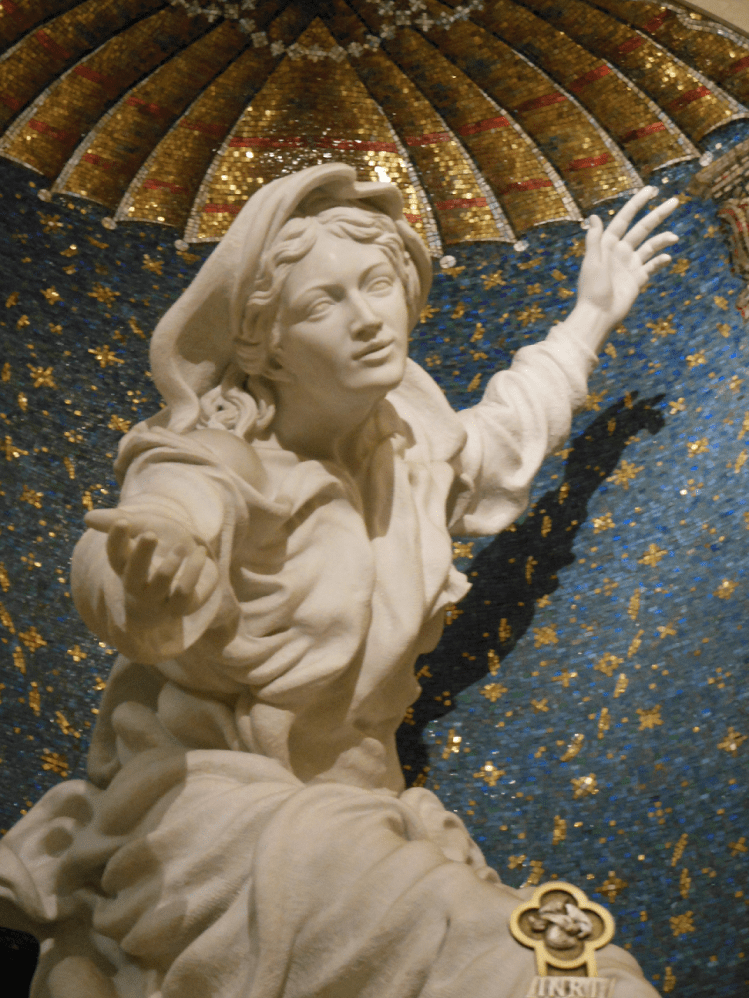
Mary at the Cathedral of St. Matthew the Apostle, Washington DC

Theotokos

Theotokos was once seen as a source of conflict. It means “Mother of God” or “or God-bearer.” In the early Church, there was debate over Mary being the Mother of God, since God is not a created being, yet she is the Mother of Jesus, who is the second person of the Triune God. The Council of Ephesus in the early 5th century confirmed this title on Mary, and the Eastern Church uses Theotokos as one of the titles for Mary.

No one questions that Mary did, indeed, give birth to Jesus. However, recently I was asked, if Mary was conceived without the stain of original sin, did she suffer in childbirth? My very first reaction was to shrug it off to say it doesn’t matter, it’s not a detail worth investigating. But as someone who has never given birth, that perspective could be rather myopic. Perhaps it’s better to take a step back and look at the whole picture of Mary and how God prepared her to be Christ’s mother. 

The fall of Eve produced the following two-fold curse: “I will intensify your toil in childbearing; in pain you shall bring forth children. Yet your urge shall be for your husband, and he shall rule over you.” (Gen 3:16) Eve’s curse is to desire her husband, and the fruit of that is a child. Thus while the desire is initially satisfied with pleasure, the pain of childbirth would be intensified or prolonged, seemingly to be a punishment for the initial desire. Yet, once the child comes, the desire does not go away, and the “curse” begins its cycle again. 

Because God intervened at Mary’s conception to keep her free from the taint of original sin, her desire was to please God. Mary was already betrothed to Joseph when Gabriel came to seek her consent. She was going to be a married woman. Perhaps if she did not give birth to the Son of God, she would have had a large family. Mary’s fiat to God’s plan turned her into a living tabernacle, a living ark of the covenant. What little of Joseph we do know, is that he understood the history of the Israelites and the covenant. He would be familiar with the ark, and that no one but the priests could touch it. He would have been familiar with the account of Uzzah, who reached out a hand to steady a tipping ark during its trip back to Jerusalem at the time of David, and was struck down because he was not worthy to do so. (2 Sam 6:6-9) Joseph realized just how special Mary and Jesus were, he would respect her and not seek to despoil her. From this viewpoint, the second portion of Eve’s curse is irrelevant. And for those who question when the various books in the New Testament refer to Jesus’ brothers, the Catechism of the Catholic Church explains the expression is used for those who have a close relationship in the Old Testament. (CCC 500)

Mary made many journeys as a pregnant woman: first to visit Elizabeth in the hill country of Judah (perhaps a “suburb” of Jerusalem?) and back north to Nazareth, and then back south beyond Jerusalem to Bethlehem to eventually give birth. Travel then was long and arduous, regardless of whether she traveled by foot, donkey or cart. After giving birth to Jesus, when she and Joseph took Jesus to the Temple, Simeon predicted a sword piercing her heart, which, while metaphoric, was a true suffering she experienced standing at the foot of the cross. The Church includes Simeon’s prophecy as the first of seven named sorrows that Mary endured. 

If we look again at Genesis, the translation uses the word “intensify,” which to me indicates that there would have been some duration of discomfort and/or pain associated with birth even before the fall of Eve. While the New Testament and Catechism is silent on the detail of how much pain Mary suffered during the birthing process, she would have had some level. But she certainly knows the pain when a child goes missing, is wrongfully accused, tortured, and put to death. Her solace in all of it was the grace of God. He prepared her to be the mother of His Son, and in doing so supported her during all her trials. 

After the visit of the shepherds, “Mary kept all these things, reflecting on them in her heart.” (Luke 2:19) The grace of God was alive in Mary, even before becoming Jesus’ mother, and intensified afterwards.  On the cross, Jesus gave Mary as mother to John, who represents the Church body throughout the ages. Mary had, and continues to have a relationship with God that is like no other. It is with confidence that we seek her intercession, aid, and assistance in praising God. And if God could prepare Mary so well to be Theotokos, how can we not think that He will prepare us for every blessing and trial in our life … if we let Him.

Catholic Girl Journey Logo

Every day should be Sunday

It started as an innocent remark by a colleague on a conference call. “Every day is Monday; until the afternoon on Friday.” Just hearing that sounded like a depressing outlook on life!

Working in an office setting, it’s not uncommon on a Tuesday to hear another mention that day being their “Monday,” when they had Monday off. Typically it’s used to explain why that person is just catching up after being out a day, and most Mondays seem to be a bit slow to get into the swing of office work. Likewise if time off is planned for a Friday, the person may express their jubilance on Thursday by remarking that the day is their “Friday,” indicating the end of their workweek. The general consensus is that Monday is a dreaded day while Friday signals that the two weekend days that can be spent in a manner of personal choosing are eight or less hours away. I know there are people who so look forward to the weekend, that the five days in between is a grind and an annoyance; something to be tolerated but never celebrated.

Growing up, I observed my father, after coming home from work, saying how much he was looking forward to retiring. I felt that if I was going to spend so much time doing something to make money in order to live, I wanted to want to do it. It was one of the big reasons I pursued a college education. While I can’t say that I have a dream job or that it doesn’t seem like work, I’m not totally miserable either. It challenges me and keeps me thinking, and there are many aspects that I do enjoy. Yes, there are times when I have a “case of the Mondays,” but most times I’m wishing folks a happy (whatever-day-it-is), even a “Happy Monday.”

Looking at the days of the week from a spiritual perspective, however, everyday should be like Sunday. As Catholics, we are a resurrection people; we believe that Jesus rose from the dead and He will raise us up at the end of time. To remember and celebrate, we keep Sunday as our day of worship. We are obligated to attend and participate at Mass; for without the resurrection, there would be no Mass. By receiving Jesus in the Holy Eucharist, we are partaking in time and space what we will fully experience once we are reunited with our bodies at the end of time. Sunday is not a day for us to do whatever we want, but rather a day designated to pursue a relationship with God, strengthen our relationships with each other and prepare ourselves for our spiritual future, not our earthly future, which is quickly fading away. 

While Mass attendance is required on Sundays and Holy Days of Obligation, many churches do offer weekday Masses, and some even offer Mass every day — that is truly making every day a Sunday! However, for those who would like to attend Mass and cannot because of schedule conflicts or lack of availability, taking the time to read the Mass readings of the day and praying a Spiritual Communion prayer is the next best thing. While this cannot fully replace Mass attendance, it is an opportunity to open yourself to God and His will. 

Any day can be filled with drudgery, work, and activities that we would rather not be doing. Labeling all those days “Monday” is setting oneself up for misery. But if we offer the work we are doing to God and spend time each day seeking a relationship with Him and to do His will, our weeks will be all full of “Sundays.”

Catholic Girl Journey Logo

Are you ready?

If Jesus’ second coming back to earth was tomorrow, would you be ready?

We don’t quite know what the second coming of Jesus will be like, nor what happens afterwards. What we anticipate is that at His coming, the dead will rise and all will be judged and then His kingdom will reign forever. For those of us who are still alive, if we still have faults that need to be purged, will there be some sort of purgatory for us? What will we do in eternity? Will we have jobs? Will we need to support ourselves? Jesus mentioned He will prepare a place for us, so if all our needs are taken care of, will we be forever contemplating God in all of His divinity? How can we prepare ourselves for something we don’t know — or perhaps more accurately — can’t understand with our finite and earth-bound mind? 

Each November the Church reminds us that the end is near. It’s a lot nearer than it was when Jesus first came. However, with two millennia passed, it’s hard to imagine the end of the world. Tumultuous activities, both natural and man-made, are supposed to herald the end, but that’s also been a constant since the beginning of civilization. Men have been predicting the end for the same amount of time, claiming secret knowledge has been revealed to indicate when it will come. Jesus dispelled that notion, indicating that only the Father alone has that knowledge (Matt 24:36).

It is an interesting juxtaposition, with the end of the liturgical year talking about the end of things, and the beginning of the liturgical year preparing for the coming of Christ. While we think more of a preparation for Christmas, the Church is gently reminding us that we need to prepare for both, the celebration of the historical time when Jesus was born as a man, as well as taking a look at what we could do better in preparing if He was to come back to earth for the final judgment. We know we’re to live our life trying to do God’s will and cultivating a relationship with Him. But to think about what will happen afterwards can be a bit scary and uncomfortable. It’s much easier, fun, and comfortable to think about preparations for Christmas: what presents to buy, how to decorate, what food to make, and with whom we will celebrate. 

It’s very easy for us to get lost in the daily aspects of living life on earth. The role models we are to emulate, the saints, are celebrated at the beginning of November. This isn’t mere coincidence; this is the Church giving us the opportunity to focus on the goal of our lives as well as to dive deeper into the lives of those we know are spiritually closest to God. If we haven’t done so during this month, Advent is also a good time to seek out some saints that we don’t know very well and learn about their lives. These last two months of the year can be a supercharging spiritual renewal, if we pursue it. It’s like the Church is saying: A) here’s the goal and examples of saints to follow, B) the end is near, but don’t be afraid because, C) the end is really a new beginning in the life of Christ when He comes. If the world does not end, we should still be preparing ourselves for it as well as the coming of Jesus in our daily lives (in the people we encounter as well as in receiving the Holy Eucharist), as well as preparing to celebrate His birth as it occurred in history. That’s a lot to think about for a mere human brain!

While it’s not just during the last two months of the year we’re to focus on the end that will bring a new beginning, setting aside the time to focus and take stock of our spiritual welfare is a worthy endeavor. The Church gives us the reminder and the resources, it’s up to us to acknowledge and pursue it or take our chances that we still have time to prepare the day after tomorrow. 

Catholic Girl Journey Logo

Prayer of roses

At the beginning of October, the Church celebrated the feast of Our Lady of the Rosary. It’s a prayer tool that has been around for about 800 years! Much has been said and written about it, as it seems like a topic that is inexhaustible. But is there a place for the rosary in our modern world?

In the 13th century, Our Lady appeared to St. Dominic with the option of praying the Marian Psalter. It combined the Angelic salutation with the life and works of Jesus, teaching the basics of the faith and combating the heresies at the time. It was a spiritual weapon that converted, or reconverted, many to the faith. In some ways, it mirrors the 150 Psalms, only instead of having to memorize all the different Psalms, it’s just a few prayers and the mysteries for meditation. A big part of the rosary is meditation, thinking about the specific mystery during the course of reciting an Our Father, ten Hail Marys, and a Glory Be. If all three sets of the original mysteries are prayed, then you would be reciting the Hail Mary 150 times. While memorization was important in the 13th century since that is how many things were taught to new generations, in today’s era of asking Google or Siri whatever is on your mind, memorization is not a skill that is actively pursued.

With the invention of the printing press in the 15th century, the ability to read and pray the Psalms from a book became possible to a greater number of people. However, praying all 150 of them does take quite a lot of time, since some of them are very long! The most I’ve done during Adoration is to pray the seven penitential Psalms: 6, 32, 38, 51, 102, 130, and 143. Praying from Scripture is always encouraged, and these seven are good to become familiar with, however, I think I’ve probably had deeper spiritual experiences when praying the Sorrowful mysteries than the penitential Psalms.

The majority of each mystery is meditated upon with the backdrop chant of the relatively short prayer of the Hail Mary. We repeat the words of the Angel Gabriel and the acknowledgement of Elizabeth, while seeking the intercession of Mary now and at the moment of our death. To some it may sound like we’re praising Mary, but in reality, we are praising God for His most perfect work of creation. In each mystery, God in one of the Trinitarian persons, is facilitating the event. Even those events that seem to be about Mary, like the Annunciation or the Assumption, are prompted by God with Mary as its recipient. It is truly a God-centric prayer and meditating on the mysteries can bring us closer to Him.

In our age of social media, it’s much easier to scroll endlessly through Facebook, Instagram, or any of the other platforms looking for something to catch our eye or entertain us. How can the rosary be a method of prayer embraced in today’s world? Perhaps because of its simplicity and non-technological requirements, it is the best method for people to get to know God. Whenever I read articles on reducing anxiety or managing stress, one of the suggestions is always learning and taking time to meditate. Usually the suggestions are to learn some Eastern form of meditation, and I wonder how many Catholics forego praying the rosary and embrace these other types of meditation thinking they are somehow better? Yet when one takes time to meditate on God, and especially the earthly life of His Son Jesus, the power of the prayer can calm our troubled hearts and minds as well as orient ourselves to God’s will.

The rosary is a timeless method of prayer designed to bring a person closer to God, provide mental exercise that can reduce stress and anxiety, and can be completed in about 20 minutes for one set of mysteries. It is the perfect prayer for those on the go as well as those who need to practice how to quiet their mind in order to better hear and see the impact of God in their lives. It is as if we are presenting a rose to Mary each time we pray the Hail Mary, who then presents them on our behalf to God as a beautiful and fragrant bouquet.

Catholic Girl Journey Logo

Desert of truth

I’ve been watching more YouTube than regular television lately and discovered that many of the songs from my youth can be found there. In Billy Joel’s River of Dreams, one phrase caught my attention: “Desert of truth.”

In the song Joel claims not to be a spiritual man, but to describe truth as a desert is amazingly perceptive as well as Biblical. Although, I must admit when I heard the phrase it seemed an horrid way to describe what truth is. I think of truth being rich and deep, whereas a desert is sparse and dull. Yet in a desert, there really is nowhere to hide. It is in a desert where we are removed from all distractions. When one is in the desert, it is living life at its most basic. 

Deserts play a prominent role in the Bible. It is in a desert that the Israelites first learn who God is. They learn to trust that he will provide food and water, in abundance, to meet all their needs. They spend a generation there to remove the influence of Egyptian life and to loosen the grip of a life familiar to them, as harsh as it was. 

John the Baptist chose to live out in a desert area, subsiding on the meagerest of food items. Yet he was a most excellent herald for the Messiah. By living away from cities and towns, those who came out to see and hear John had to make a special journey. This was not about stopping for a few minutes to listen to an itinerant preacher, but a journey to see the main attraction. He encouraged a literal turning away from the lure of secular life and turning toward God. He asked the people who came to see him to not just listen, but to take action, to make a commitment by being baptized. Baptism today calls us all to do the same, but instead of it being a singular action that one takes upon himself, baptism in the Catholic Church makes you a member of a family through Jesus Christ and an adopted child of God. 

Jesus, Truth itself, prepared for His ministry by spending 40 days in the desert. We’re familiar with the temptation that followed after that time, yet those days of preparation were not just for us to know that Jesus, too, was tempted. He spent His first 30 years living amongst men. Even though Jesus was fully divine, He was also fully human and needed the time in the desert to strengthen His connection with the Father and the Holy Spirit. Jesus also recognized that we need times of being in the desert to rest and recharge. In a similar way in Mark’s Gospel, Jesus invites His apostles to “Come away to a deserted place all by yourselves and rest a while.” (Mk 6:31) And this was in a time before all the modern conveniences and distractions that we have! How much more so should we be seeking out a desert place? 

Truth does have much in common with a desert. Both are stark, simple, yet beautiful. To describe truth as a desert means to not look for a truth that’s comfortable or that we can agree with, but to recognize that it can be sharp, stinging our fragile egos and wounding our pride. But only Truth can set us free and heal us from ourselves. 

Catholic Girl Journey Logo

Songs for the journey

My car radio is tuned to one of two Christian music stations: a local one in Virginia named The Journey, or the national one named KLove. It seems that no matter where I am in my spiritual journey, there is one song that really ends up matching how I’m feeling. 

A few months ago the song Build a Boat by Colton Dixon always seemed to come on whenever I was driving around. Since I work from home, there can be days where my car just stays stationary. I think that the more popular the song, the higher the probability that it will be played when I am driving. What captivated me about this song is the confidence in God that it encourages. Although in retrospect, it’s more of a preparation song. The basis of the song is building a boat in a desert with the expectation that the flood is coming and that God will see me through it. 

I will build a boat in the sand where they say it never rains
I will stand up in faith, I’ll do anything it takes
With Your wind in my sails, Your love never fails or fades
I’ll build a boat in the desert place

Chorus from Build a Boat

The chorus is quite catchy and when I sing along with it, I feel like I can do anything! It’s a wonderfully uplifting song. Yet there were times when I was singing along that I thought to myself, “what happens when the rains and the flood do come? Will I be able to handle it like this song says?”

Recently life has been rather bumpy, especially from a work perspective. The song I’m hearing as I drive around now is perfectly what I need. I’ve actually started singing it in the shower! It’s a collaborative song by two artists, Benjamin William Hastings and Blessing Offor, and is named That’s The Thing About Praise.

Sometimes the only way through it is a hallelujah
Sometimes the only thing to do is just to give it to You
And though my troubles shake me
I know they will never move You
That’s why I say hallelujah

Chorus from That’s the Thing About Praise

I think of this song as the “Hallelujah” song, but I know there is an older song with that title. The verses do talk about the general difficulties in life and that sometimes the waters are not parted or the mountain is not moved. It’s these times of struggle when we need to resist the urge to feel pity for our situation and thank God for where we are and what we have. Is it hard to do? Yes. However, when we turn our focus inward on ourselves, we are no longer leaning on God to help us through, we’re looking at what we can do and look to solve our difficulties from a human perspective. Yet when we turn to God and give Him praise for even the smallest of blessings (our next breath or heartbeat), the source of our strength shifts from ourselves to God. 

These particular two songs help us to remember who needs to be our focus: God. Christian radio is filled with songs like these that can speak to whatever you’re feeling in life, bringing God into all aspects of daily life. Your Hallelujah praise song may be playing now. 

Catholic Girl Journey Logo

Who is Jesus?

Who is Jesus to you? That question is one we will all be held accountable to answer. However, our answer is not just an intellectual one, but one that also needs to be reflected in who we are and how we live our lives. 

In last Sunday’s Gospel reading from Matthew (16:13-20), Jesus asks the disciples who they thought He was. Only Peter’s response is recorded, but it must have been rather startling for the other Apostles. “Simon Peter said in reply, ‘You are the Messiah, the Son of the living God.’” (Matt 16:16) In these ten short words, Peter summarizes the most important aspects of Jesus: His anointing and His Sonship. Only three types of men were anointed in ancient times: priests, prophets, and kings. Jesus is all of these. He is THE Anointed, the one everyone is waiting for (and whom they expect earthly deliverance from Roman occupation). The second part of Peter’s statement is the one that truly no human could have ever known without Divine revelation.

Jesus had been traveling with these men for the better part of three years. After this exchange, Jesus prepared the Apostles for His Passion, Death, and Resurrection. The only way these men could be able to get through this time is by understanding who Jesus is. Most of them will run away. And Peter, who so confidently provides the correct answer, ends up denying that he knows anything about Jesus. This question Jesus asks is to gauge the depth of their faith. 

Jesus acknowledges Peter’s answer as Divinely inspired. However, the only way Peter could have received this is by his close association with Jesus. He had spent years traveling with Jesus, hearing His word, and learning from it. In the beginning of the tenth chapter of Matthew’s Gospel, Peter is part of the group that is sent out by Jesus to preach and to heal. It’s almost a bit like an apprenticeship, where after observing Jesus, the Apostles are sent to neighboring towns to carry out what they saw Jesus do and what they heard Him say. It’s a bit of practice while the teacher is still around and before they spend the rest of their lives doing exactly this. 

How do we answer the question of who Jesus is? Do we demonstrate by word and deed who Jesus is? Do we order our lives around having a relationship with Him by daily prayers? Do we dive deeply by reading and meditating scripture? Do we pattern our actions after Jesus by being the loving servant to others?

In today’s landscape, many look at Jesus as a nice guy and boil down His teachings to be more of an intellectual theory than a call for action. The culture in Jesus’ day was very different from our own and Jesus’ actions were very radical, like talking to women, or correcting the Pharisees. The spread of Christianity changed society. While it didn’t happen overnight, the influence the Church had over the centuries reflects the person of Jesus. 

Each member within the Church needs to acknowledge Jesus the same way Peter did: by professing Jesus as Priest, Prophet, and King as well as His Divinity  in both word and deed. We pray for guidance to do God’s will in order for the Church to better reflect Jesus.