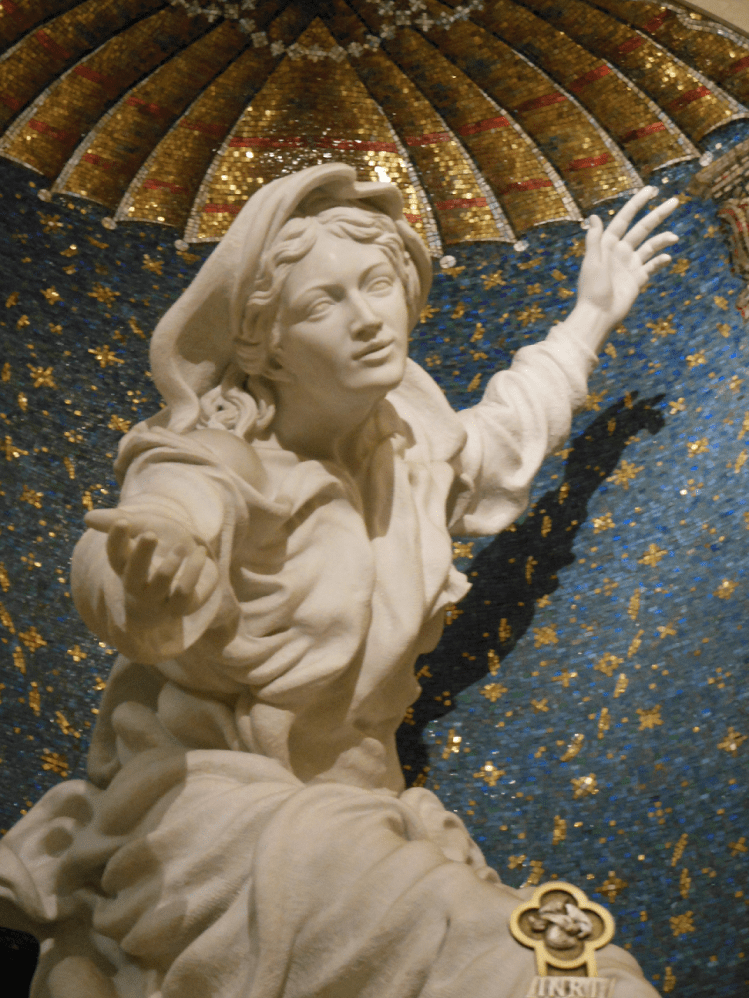
Mary at the Cathedral of St. Matthew the Apostle, Washington DC

Life on the run

So, to continue on from last week… the second sorrow of Mary is the flight into Egypt. While Matthew’s Gospel addresses it only in a few short lines, (Matt 2:13-21), there is much to ponder within the text provided.

Joseph was warned in a dream to take his family and depart to Egypt. Upon rising in the middle of the night, they left. Did Joseph need to awaken Mary or was she awake and tending to Jesus? Can you imagine having your sleep disturbed only to find out you need to leave on a long journey immediately? Even if she was awake, the dreadful news that the precious Child was in danger must have been disturbing to hear. With a destination of Egypt, a place where the Israelites had fled from slavery, Mary, and Joseph too, had to put all their trust in God. Just because they were caring for the Son of God, didn’t mean they would have an easy road. The detour to Egypt probably had a number of challenges, especially since they didn’t have the time to prepare for the journey. Yet, it was for the protection of Jesus, and so they made the trip.

Aliens. No, not the kind from outer space but rather those who travel from one country to seek asylum in another, safer country. That’s what the Holy Family were: aliens in Egypt. Moving to another country where you need to learn a new language, new customs, and a new way of life is challenging for anyone, but to do it with an infant surely poses many difficulties that most may not even be able to imagine. They had no friends or relatives that could help them get started, just the grace of God. If the reception at Bethlehem, among their kinfolk, left them out with the animals, what kind of welcome did they receive in Egypt? Were they looked upon with suspicion? Did the Egyptian people gossip about this strange family coming from a foreign land into theirs, wondering why they left their own homeland? Especially since Mary and Joseph were devout Jews, they must have been totally out-of-place there. Were there any synagogues there? Were they able to have a little taste of home and worship in the manner they did when living in Israel? 

News does travel fast, and I wouldn’t be surprised if they heard about the massacre of the infants in Bethlehem and realized that if they had stayed, Jesus would have been one of them. As a new mom, Mary must have been heartbroken to learn about all the needless killing; all the mothers who lost their sons while she still had Jesus. Relief and anguish all rolled up together, and she could do nothing to comfort those women. Nothing to let them know that the Child their sons died for was safe and why it was so important that He remain so. Jesus was safe for the moment, but the time would come when Mary would need to let Him go, watching as He suffered and died for us all.

As we journey through this Lent, let us keep in mind that there are those who don’t speak our language and are looking for a safer place to live. Let us remember that when we treat them with the dignity of being a child of God, we honor the sacrifice the Holy Family made in their time of exile into Egypt. Let us look at the excess we have in our closets and pantry and see how we can donate to others who need it more than we do, no matter what circumstances cause their need. Let us comfort those who have lost loved ones, especially their children, with our prayers, our friendship, and a shoulder to cry on. Lent is an opportunity to practice mercy towards others. Let us open our hearts and ask God what we can do to help those in need.

Mary at the Cathedral of St. Matthew the Apostle, Washington DC

Prophecy of the sword

As we begin our Lenten journey, I thought a good way to “travel” it this year would be to reflect on the seven sorrows of Mary. While I may have addressed or referenced these events in other posts, I’d like to concentrate on these as a guide within the Lenten season. 

The first sorrow of Mary’s is the Prophecy of Simeon (Lk 2:34-35). It is only 40 days after Jesus’ birth.

It all began with a visit from an angel, then Mary’s visit to Elizabeth, then for Mary to become part of Joseph’s household, and finally their journey to Bethlehem, where the birth took place. That’s quite a lot to happen in less than a year! Some of these things would be wonderful, like the visit with Elizabeth. Some may have been a bit more stressful like the relationship with Joseph and the travel to Bethlehem. Could Mary think of some of these events she’s already lived through as “sword-piercing?” Or did she think of all the hazards that parents encounter when raising a child, let alone the Son of God? 

Perhaps Mary thought about the various judges and prophets from the Old Testament. While some were looked upon favorably, all had warning messages to give to people who were less than willing to listen. Who wants to be told they are living their life incorrectly? Being a devout Jewish woman, Mary would have known all the stories very well, and probably understood them better than we do today. She was living in the land where they occurred, and would have understood the nuances within the text. The scriptures were written in her language, so there was nothing that could be “lost in translation.” 

At just 40 days old, Jesus had His whole life ahead of Him. There was no way that Mary could understand the gravity of the prophecy Simeon was making. But she didn’t let it stop her from raising Jesus. She had claimed herself as the Lord’s handmaid and she lived out that vow. Mary was also a very young woman at the time. While she may not have understood the prophecy, she probably remembered it as each trial event occurred. 

As we begin this Lent, we know that there will be trials to live out with whatever practice(s) we have identified for this season. The whole point of a Lenten practice is to challenge ourselves, to go deeper into our faith. No matter what avenue we choose — prayers, fasting, pennances, or almsgiving — it will bring an experience of suffering. However, if we seek Mary’s patronage this Lent, uniting our trials to her sorrows, we can receive the consolation that only a spiritual mother can impart upon us. No sword can piece us as strongly as the one Mary had to endure. Yet even now Mary does not rest in her heavenly home, but rather keeps watch on all her spiritual children visiting and intervening at times when circumstances will be most fruitful. 

While the sword of the prophecy is metaphorical, the damage is just as painful as from a physical sword. Let us call on Mary to lead us this Lenten journey, through whatever sorrow and pain there may be, into the arms of her beloved Son, Jesus. 

Catholic Girl Journey Logo

Random acts of prayer

We are just a week away from the beginning of Lent. And I’ve already begun to see Catholic blog headlines saying not to give up chocolate for the penitential season, but to add something to one’s prayer routine, like a seasonal meditation or scripture reading. However, I suggest adding something that you can continue well after the Lent is over: random acts of prayer.

Yes, you read that correctly. I said random acts of prayer and not random acts of kindness. What’s the difference? When we are kind to another, we make the choice of what and how to be kind. For example, holding open the door for someone who is behind us as we enter a building. Is it a nice thing to do? Surely! However, random acts of prayer are when we leave the kind action up to God. This is when we drive by a house, say a prayer and ask God to bless whomever lives there in what they need the most. There are so many times when we ask God for specific things, like a job for one person or healing for another. While those folks may need those things, it may not be their most pressing need. How awesome is it to let the God who created the entire universe with all its diversity,  decide how best to bless a person? 

In praying for another in the random way, we have no idea of the outcome. Perhaps when we go to heaven, we’ll find out the impact of all these random prayers. Even if we never know, it’s good for our soul to pray for others in this anonymous way. First, it makes us be aware of our surroundings — that there are children of God in a building, car, or park that need His blessings just as much as we do. Second, it reminds us that we don’t have control over everything. One aspect of original sin was that Adam and Eve were not just looking at tasty fruit, but to gain more knowledge and control. Third, it gives us the opportunity to “let go and let God” handle it, which requires regular practice. Lastly, it reminds us of all the ways God has blessed us in seemingly random ways. Some may refer to these circumstances as coincidence, but I see them as an opportunity God uses to get our attention. 

Usually my random acts of prayer have been made while driving. Whenever someone is kind and allows me to merge onto the highway or lets me go at a stop sign, I do try to say a Hail Mary or Glory Be and ask God to bless them in some way during the day. Sometimes I wonder what that blessing is: a close parking spot at their destination, or green traffic lights all the way. This is probably the easiest way to practice this type of prayer because we will never know the impact of our prayer said for that driver. But random acts of prayer can be practiced anywhere, in any circumstance. For instance, the next time you’re at the grocery store, you can silently say a prayer for another customer or the clerk while they ring up your order. But we don’t even need to leave the house to practice praying like this. Maybe we ask God to bless the person in the world who needs it the most at that moment of our prayer. The randomness of whom we choose is only limited to our imagination. 

I believe God answers all prayers. I trust that He knows better than I do what another needs. But by specifically praying for another in this random and anonymous way, I create a spiritual bond with someone I may not meet until we’re in heaven. And what a joyful day that will be!

Catholic Girl Journey Logo

Gift of presence

It goes back all the way to the beginning, just after Jesus’ resurrection. The disciples, who walked with Him all the way to Emmaus, only recognized Jesus when He blessed and broke the bread. Jesus is truly present at every Mass and in every consecrated host: Body, Blood, Soul, and Divinity.

It’s been many years since I first received Holy Communion, and I remember the songs that we were taught for that Mass, but I really don’t recall much of that day or the experience. However, I do recall the first time I chose to go to the adoration chapel at St. Isaac’s when I lived in Pennsylvania. It seemed like the longest 15 minutes of my life. I didn’t know what to do?! Sitting in silence with people I didn’t know felt very awkward to me. It’s different when one goes to Mass, as we can participate in the responses, so even if you don’t know anyone, you know what you are to say and when to say it. But at that first adoration visit, I really didn’t know or understand what adoration meant. 

Adoration of the Blessed Sacrament is when a consecrated host is reserved and displayed for prayer and worship. Usually this includes quiet time for individual reflection, but may also include community prayers and/or Scripture readings. The eucharistic host is displayed in a monstrance, usually a gilt-covered stand that resembles a sunburst, with the host being at the center. When the host is being placed in or removed from the vessel, the typical posture is to kneel. However, after reverencing the eucharist with a genuflect or deep bow, it is acceptable to sit, especially for those with medical conditions that prohibit their ability to kneel for any length of time. 

Like many things in life, the best way to learn what to do in adoration is to experience it and practice it. Attending to Jesus in adoration is answering the call He made to the Apostles in the garden of Gethsemane. And there are some people, who like those first Apostles, fall asleep in His presence. I’m not sure if they just feel so relaxed and at peace that they fall asleep or they are just not ready for the silence. I compare it to lifting weights; you can’t start out at 500 pounds, but rather with 5 pounds (or 5 minutes of adoration) until you feel stronger to take on more. Sometimes we do need to push our limits a bit and challenge ourselves to more, but always within reason and being aware of our limitations. The goal would be to work up to spend an hour in adoration.

Adoration is a time to talk to God, specifically Jesus — one to one — no matter how many people are there. Sometimes, and especially as we practice, praying a rosary, a litany, a chaplet, or some other set of prepared prayers is all that we can handle. These prayers are a great way to get the communication flowing, even for the most experienced attendees. There are so many prayers out there that if you wanted to pray them all, I’m not sure you would be able to pray them all in a day! Unless those in adoration are praying together in a community, all prayers should be said in silence. I remember feeling very embarrassed when I went to an adoration chapel in Italy because the door made such a horrendous noise when being open, especially in comparison to the silence in the chapel (you could hear a person turning a page to their prayer book!). I think the locals were used to it, as everyone was able to keep their focus on the eucharist. 

Jesus understands our human needs. By instituting the eucharist at the last supper, He left a way to nourish us spiritually, by receiving Him, but also to spend time with Him in adoration. He is physically there and we can see the host; our eyes have the ability to focus our attention on Him. And while it can be easier to say an Our Father or a Glory Be, we can also pour out our hearts to Jesus. As we become more comfortable in His presence, we can be open to how He chooses to speak to us, either at adoration, or any other moment of the day. Spending time in His presence is like spending time with family or friends; we share ourselves and are attentive to what they share with us. It’s also an opportunity for us to reflect, to think about the ways God works in our life, the blessings He brings, and where we need His aid. 

Jesus gives us the gift of Himself, present in the eucharist. Can you spare a few moments to spend time with Him?

Catholic Girl Journey Logo

Holiday versus holy day

As I sat in the salon chair getting my hair cut, I found myself looking at a red, winged cherub. Christmas just ended and here the Valentines decorations were already out. I corrected my thoughts: it’s St. Valentine’s Day.

According to Merriam-Webster, the first definition of the word holiday is holy day. The etymology makes it clear that holy day is the literal translation of the two words that make up this one. Yet over the years it has come to mean a day off from work and is now synonymous with the word vacation. As the meaning has evolved, so has the way many people celebrate these days. While it’s wonderful these holy days have been enthusiastically embraced by secular society, it seems as though the meaning of the holy day has been diluted.

While one may see a bumper sticker that says, “Keep Christ in Christmas,” the celebration of the Christmas holiday overlaps with the celebration of a saint’s feast day earlier in the month. Consider the legendary stories of Saint Nicholas, a bishop in the early church, who is the model for Santa Claus, the magical gift-bearer on December 25th. From a secular perspective, Christmas is about getting people the “right” gifts and attending parties. Christians who make an effort to celebrate Christmas in a meaningful way are able to, but their priorities may conflict with the expectations of those who do not. 

 In February, St. Valentine’s Day is another example of a noteworthy holiday that has been secularized. With such high expectations on romance, even those in a relationship struggle to celebrate the holiday. As a single person, I never feel lonely as much as I do around this day. While I do experience the cultural expectations that every person needs to be in a relationship throughout the year, especially when traveling, the marketing of romance is at its zenith in mid-February and can definitely make a person feel incomplete.  

A month later is the celebration of St. Patrick’s Day, where everyone claims to have some bit of Irish ancestry. Here again, another bishop’s memory has been skewed by the culture so that the focus of the day is a beer-drinking party. Some may wear something green, or eat particular Irish dishes, but the good deeds of St. Patrick are mostly forgotten. These holy days are no longer opportunities for us to praise God, but rather to please ourselves. While there is nothing wrong in having a party, drinking beer, buying chocolates and flowers for your spouse, or even gifts for all those you love, these actions should come from our love of God as a natural expression towards those in our life, rather than the focal point of each of these special days. If it weren’t for Christianity, none of these days would be of particular importance. 

We can’t stop the world from secularizing these saints’ days, but we can take steps to make them holy in our life. One way is to learn about the saints and seek their intercession. While Christmas is a holy day of obligation, attending Mass on these other holy days can also help focus our perspective and our celebration. When we  put God first on these holy days, we will receive His grace and blessings and more fully enjoy these holiday celebrations.  

Catholic Girl Journey Logo

Listen

Listen. I’ve heard this word several times in several different ways, many of which pertain to the spiritual life. This past Sunday’s first reading was yet again another example  which illustrates the need to listen to God. 

In preparing for Sunday Mass, I usually read the day’s readings to become familiar with them so that I can be open to any inspiration that comes to me when hearing it at Mass. However, this time, hearing the call of Samuel made me chuckle a bit. The reading is taken from the first book of Samuel (3:3-10,19), and to have two books of the Bible named after him, you know he plays an important role in salvation history. Some may not see the humor in the events, but if this was played out on television or in a movie, it would be a comedic scene. We find Samuel — whose mother Hannah prayed for him, weaned him, then dedicated him to the temple —  sleeping in the presence of God. When he hears his name, he immediately runs to Eli, the high priest. Eli, who was not the most faithful of priests, failed to recognize that it was God calling Samuel. It took three times before Eli realized that it could be God calling the youth. Three times the boy goes running to Eli saying, “Here I am, you called me.” Eli sends the boy back to bed twice before telling him how he should respond to God if he’s called again. 

Because Samuel was dedicated to the temple, he was raised there and Eli was responsible for his education. Samuel was a very willing child, jumping up from being awakened in a sound sleep to come to the aid of who he thought was calling him. Notice how respectful God is of Samuel (and of us). He doesn’t say to him, “Samuel, this is God, listen to what I have to say.” Rather He just calls him by name. It’s Samuel who needs to acknowledge the calling and invite God to speak to him. God wants a relationship with each of us; however, He will not force His way on us, we need to invite Him into our lives and be open to the gifts He bestows. Samuel grew up to become the last of the great judges of Israel. When the people ask for a king to rule over them, he is heartbroken on behalf of God, whom they are rejecting as their king. The Israelites want to be “just like everyone else” around them, with a king who leads them into battle. It is Samuel who would anoint the first King of Israel, Saul, as well as the great king who succeeds him, David. 

I firmly believe that God has a wonderful sense of humor, and this portrayal of a calling lessens my anxiety about not responding to God’s guidance immediately. We live in such a noisy world that I do have doubts that I can consistently hear and understand what God is calling me to do. This illustrates how patient God is with us, as well as persistent! He calls Samuel four times before he responds to Him. Are we that persistent with our prayers to God? His timing is certainly different from ours and we can be very quick to dismiss God’s help if it doesn’t come in the time and manner we wish. God is always listening to us, but are we paying attention to Him? 

We may not hear His voice calling us by name, but He does make His presence known to us in a manner that we can understand and accept. For some, hearing the voice of God would be terrifying and nullify our ability to freely choose to listen to Him. Perhaps it’s in our dreams that He makes His way known to us like He did for Joseph. Maybe it’s in the repetition of a word or topic that gets our attention. He created us and He knows the best way to communicate to us. We just need to still our minds and hearts and invite Him into our lives.

Getting unstuck

I’m still very new to weaving, as it’s almost been about 16 months since I took a 3-day weaving class and bought a used 4-harness floor loom. I’ve created some scarves from following a training video for new weavers and some hand towels from a kit I purchased while during my class. I have plenty of things I want to accomplish with it, but I seem to be stuck.

While I’m new to weaving, I’ve been a spinner for about 30 years. I may not have spun regularly throughout that timeframe, but I’ve amassed enough handspun (and more!) to knit a vest that I wore on a cruise to Alaska last year. Yet it’s only recently that I realized I’m doing the same thing in my approach to weaving as I did with spinning: letting the fear of ruining the fiber hold me back from trying. When I was first spinning, I bought lots of different fiber types, and some of the more luxury kinds like cashmere and qiviut, ones that need to be spun very finely, I put off to spin “when I was more comfortable with it.” The trouble with that mindset is that it’s very subjective, there is nothing that quantifies when I’ve reached the experience level needed to tackle those fibers. As I was preparing for my cruise last year, I realized that I had purchased qiviut (the down fiber of a musk ox which is only found above the Arctic Circle) on my first trip to Alaska over a decade ago, and had never spun it. I just couldn’t go on this cruise without doing something with it! While the consistency of the yarn could have been better, once I knit it into a headband to wear on the cruise, I achieved my goal of using the finished article. 

As we journey down life’s road, we can let similar fears make us stuck in our spiritual life. We get into a familiar routine and habits, and we coast along, not even realizing that we are stuck and our growth is stunted. There’s only 24 hours in a day, and most of that is taken up with work, chores, sleeping, and eating; how can we squeeze more time for spiritual devotions? If we attend more than just Mass on Sundays and perhaps pray morning and evening prayers along with a rosary, what more can we do? Some might take a Bible class or assist with a church ministry, doesn’t that “count?” Practicing our faith in prayers and works is always good, but perhaps we stick with these routines because they are comfortable. God may have introduced these practices, simply for that aspect: to learn to practice the faith. But we can’t learn anything new if we don’t try.

Learning can be painful; but some of the best lessons we learn is how not to do something. And whether it is fear or ruining fiber and yarn, or fear of what God is calling us to do next, opening up to new experiences can be scary and disappointing at times. However, the fruit of our labors will be sweet and delicious. I loved wearing my handknit headband and vest in Alaska. And I know pursuing a deeper relationship with God will not only bring me closer to Him in this life, but will help prepare me to spend eternity with Him. 

Sometimes we just need to get out of our own way in order to move forward. We read the parables Jesus taught about the shepherd leaving the 99 sheep to search for the lost one or about the prodigal son, and we think that’s for those who don’t believe. But would the God of Love not seek us out when we are stuck in the quicksand of our own fears? Just as Jesus reached out His hand to the fear-filled Peter as he began to sink in the waves, He will reach out to us to help get us unstuck. We need to be ready to ask and accept the help He gives us in whatever way He does, especially when that way is unexpected and surprising.

I have quite a supply of yarn. As I was planning on working a scarf kit on my loom, I realized that if I was so fearful of messing it up, I could try that same pattern with yarn that I was not as concerned about. The measurements may be a bit off, since the yarn for the kit is much finer, but I could at least practice before using the yarn from the kit. Plus I’m making fabric, does it really have to be a scarf or could I make it into something else if I really didn’t like it once it was off the loom? God has given my creativity a whack to unstick me from my fear of weaving. Now it’s my turn to be open to what He has planned next for my spiritual journey….

Catholic Girl Journey Logo

Star sign

Pop quiz for you: who were the magi that came to visit Jesus and how many were there? Most people would answer they were “wise men” and there were three of them, but the Bible doesn’t mention how many there were, just that there was more than one. It’s from the number of gifts identified that we surmise the count, one person for each gift named. But who really were these men?

The Gospel of Matthew is the only one that mentions the visit, and the visitors are referred to as “magi,” which Merriam-Webster defines as the plural of magus, a member of a hereditary priestly class among the ancient Medes and Persians. The etymology of the word shares its root with the word magic. These were most definitely NOT descended from the Hebrews/Israelites. According to the Bible footnotes, while the origin indicates a member of the priestly caste, the word has expanded its meaning to a person who has more than human knowledge. In this circumstance, they were astrologers. So, how is it that these men came to visit Jesus, an unknown infant whose parents were poor and unremarkable to their fellow countrymen? 

Out of curiosity, I Googled how far Persia was from Bethlehem. Persia is considered to be Iran and the average distance for traveling between the two is about 1,000 miles which would have taken about three or four months. This is not a trip to be taken lightly or to make just to see what’s going on. This was a journey they prepared for, including provisioning gifts for the infant. Also according to the Bible footnotes, it was an ancient belief that a new star was an indicator of the birth of a new ruler. Was this their purpose in studying the stars? To find out what new rulers were born and visit them to maintain good relationships from a political perspective? It would explain why they visited the palace of Herod first, thinking that the newborn was located there. 

However, “They were overjoyed at seeing the star,” after their audience with Herod (Matt 2:10). This doesn’t sound like they were politically motivated, but rather by the star itself and the destination it heralded. Were they familiar with Israel and any prophecies regarding a rising star? They certainly had knowledge of Israel’s location in order to calculate the distance to where the star was rising over, as well as to calculate supplies for their journey. To gain that much knowledge and experience, they must have had great passion for the subject and much practice in its application. God blessed these men with skills to study and follow the stars so that they would take action when they saw this very special star. 

While in our earthly life, we will never know what it took for those men to make that journey, or even how many did. Was it 2, or 10, or 30? Did it take them 6 months, a year, or longer to complete the roundtrip journey? However, what is captured in the Bible is the importance of the results. The visit of the Magi has long been considered a reflection of the Word being accepted by the Gentile communities, those of non-Hebrew descent. God used what they knew to give them a sign, and they prepared themselves and took action. What does it take for us who are baptized in the Christian faith to see the signs God gives us in our daily lives? Do we seek Him out and take action to deepen our relationship with Him? 

As we  prepare to end our Christmas season celebration with the feast of the Epiphany of our Lord, let us pause and reflect on the “star” signs God has given us in the past, as well as  the wonder and awe in our relationship with the Lord. May we remain vigilant to the opportunities God will call us to in this new year.

Catholic Girl Journey Logo

Not just a manger

Merry Christmas! I saw a wonderful meme on Instagram recently that made me chuckle. The picture was of a manger and the caption said: The first king sized bed. Of course that got me pondering  the manger and what all it really is.

The definition of a manger, according to Merriam-Webster is, “a trough or open box in a stable designed to hold feed or fodder for livestock.” It could have been made out of rough timber or even stone back in Jesus’ day. Basically, it was a “table” where animals eat. Jesus came to be the bread of life to us and we come to the table of the Lord each week to consume the Eucharist. I don’t think that is a coincidence. 

Speaking of coming to the Lord’s table, the manger was the first altar, the first place where Jesus was worshiped as the Son of God by Mary, Joseph, the shepherds, and the wise men. What if a church replaced their altar with a manger, how would we react? Would we be indignant at being treated as if we were animals? Or would we see the depth of humility God illustrated in becoming Man to suffer, die, and be resurrected to bring us to salvation?

When the Ark of the Covenant was in the Temple in Jerusalem, it contained the Mercy seat, the place where God would appear to Moses. I think it could be considered a throne, as God gave lawful direction from there. However, I would say the manger is the first throne of God to have a visible Person on it. As an infant, I don’t think Jesus was sitting on it, but it was where he received the wise men who came to pay homage to the newborn king. The wise men logically first visited the palace, only to find out He was not there. When they came to the crude loggings, what must have been going through their minds? Or were they so awed by the site, that the beauty of God-becoming-Man overwhelmed them and was all their focus on the baby Jesus?

As the Instagram meme right labeled the manger, it was also a bed, or a crib if you want to be more specific. It was a safe place to lay the baby Jesus down, because of its container-like structure, He would not roll off and fall, nor would He roll around on the earth. It most likely was filled with hay, which if you ever felt it, would be one of the last materials you would want for bedding. Even the animals would get straw, which is not much better. It was probably rather prickly to the soft and sensitive newborn skin. It may have been tempered by a few layers of cloth to make it feel not quite so pinchy, but it would need quite a number of layers to make it truly comfortable. 

The manger is a table, an altar, a throne, and a bed. It’s one of the most memorable pieces of “furniture” (if you can call it that) in history. Yet it’s where the Son of God chose to rest His head for the first weeks or months of His life. In His first lesson to us, Jesus illustrates how God chooses the humble to teach the proud. We may all be sinners, but Jesus has a purpose for each one of us: no matter who we are, what we’ve done (or not done), or how far away we may think we are from Him…even the smallest, most seemingly inconsequential things, like a manger, are not beyond His gaze.

Let us spend some time this Christmas season to look upon the Christ child as He lay in the manger and ask Him to direct our thoughts, words, and actions to help others find their way to Him, as the angels did for the shepherds and the star for the wise men. 

Catholic Girl Journey Logo

Always prepare, always rejoice

Even though we are in the third week of Advent, Christmas is only a handful of days away. No matter how much we’ve prepared, we are called to rejoice in the commemoration of God becoming Man.

Many of the ornaments on my Christmas tree have sentimental value and my mind goes down memory lane as I decorate. When you stop and ponder the twists and turns of life, sometimes you can see one experience or event that prepared you for another, and which in turn prepared you for another. It’s like we’re in a constant state of preparation, but we’re unaware of it. Or maybe it’s the thought that whatever challenge you’re going through at the moment is preparing you for something in the future; giving you the strength to see you through that difficulty. The same perspective could be used to describe salvation history. The whole purpose of the Old Testament was to prepare the people of one nation to be the bearers of salvation to all the world. Generation after generation, God instructed the Israelites about who He is through the various prophets and holy people of the Old Testament. 

When we think of the New Testament, we think of Jesus and consider all the preparation of the prophets were achieved. Even though John the Baptist is in the New Testament, he is still a prophet of God preparing the people for Jesus. Perhaps his intensive methods correspond to his knowledge that all the preparation was about to meet the expectation: the Messiah. We should take comfort that even up to when Jesus started the very beginning of his ministry, John was still calling people to repent and prepare. For us, God is asking us to prepare up to the final minutes to Christmas, as we celebrate the fourth Sunday in Advent on Christmas eve. In our modern age of instantaneous, our inclination may be to gloss over the fourth Sunday in Advent and go straight into the Christmas festivities. However we only do ourselves a disservice when we rush through the opportunities to practice patience and how to wait. 

When we take the time to prepare, our ability to rejoice seems to be directly affected. When we feel prepared for anything — an exam, an interview, or even Christmas — the more confident we are and the better outcome.  At the same time, our hope in our salvation causes us to rejoice in the preparation. We know God’s love and mercy through the sacraments of penance and Eucharist. By celebrating these sacraments during our preparation we deepen our relationship with God. Year after year, Advent after Advent, we become closer to God, which prepares us for our ultimate purpose: to live in God’s presence forever in heaven. 

In these final days of Advent, let us prepare and rejoice. Jesus, our Savior, was born so He could conquer death by rising from the grave. Even Jesus knows what it’s like to wait; He had to wait 30 years to begin His ministry and complete the purpose God gave HIm. The Advent and Christmas season is the perfect time to lean on God to help us practice waiting while rejoicing in the hope of our salvation.