Catholic Girl Journey Logo

Recognizing evil

What do black hats, dark clothes, and scars have in common? They are often used in movies and television shows to signal the villain of the story. An article entitled The Problem With Disfigured Villains in Pop Culture calls for Hollywood to stop relying on scars and disfigured people for villain identification. While disfigurement is an easy storytelling shortcut, seeing it so often and especially juxtaposed with the heroes who have a perfect body and totally symmetrical features, have taught our culture that anything that is not perfect is bad. 

As Catholic Christians, we are called to look beyond the surface of a person. Do we seek a deeper relationship with the people that cross our paths or has the influence of what we have seen in the media color our initial response? We connect more deeply with a movie or show when we find traits of ourselves within one of the characters. For those with visible differences, they are seeing an unbalanced representation that skews those with similar issues as evil villains. The use of disfigured villains goes beyond just the horror/thriller genre to include Disney movies like The Lion King and Star Wars. While movies based on books, like the Harry Potter series, may wish to point the accusation to the author, once a person sees what that villain looks like, the irregular features are no longer left to the person’s imagination and the portrayed disfigurement gets cataloged in the watcher’s brain.

The article uses Phantom of the Opera to illustrate that while the appearance of the main character was visibly unappealing, he had the ability to bring beauty into the world through his music and singing. By judging his outward appearance as evil and treating him as such, he succumbed to acting in the same way he was treated. When the novel Frankenstein came out, that too was a plea not to judge by what a creature looked like, but rather by his actions. I wouldn’t be surprised if the message of these two stories has been lost to the fantastic special effects that movie fans crave. If I asked you to draw a picture of Frankenstein’s monster, it would probably be a tall, green, human-like man with a flat head, bolts protruding from its neck, and perhaps some stitches or scars on its face. While shows like The Munsters and movies like Hotel Transylvania may soften us towards those who are visibly different, how much effort does it take for us to go beyond a person’s appearance? For individuals who lack symmetrical looks or who have scars, being rejected by others may result in a wall of protection when meeting new people. It may be more difficult to find a connection or common ground because of previously experienced hurts. 

In reality, we are all flawed and are affected not only by original sin, but also the sins we commit. We may not be able to recognize evil, since it’s not always obvious on the surface. While we need to leave all judgment up to God, especially their souls, we also need to remember all humans are children of God. They are neither good nor bad; rather it is all the actions of a person that must be considered. As we all fail to act as we should, we should not be judged on just one good deed or one bad act. Let us shower those whose appearance is less than perfect with all the love and mercy God has bestowed on us. Perhaps then we can be recognized, not by what we look like, but by the love we have for others and bring God’s kingdom to reign.  

Catholic Girl Journey Logo

Practicing charity in small matters

I was able to laugh at a video that came up on Facebook, but then again, as someone who always returns a shopping cart to the designated area, I may not have been the target for the video. Sponsored by BBC Scotland’s The Social, The Trolley Theory is a comedic illustration of doing the right thing for society.

In the United Kingdom, the term trolley is used for what Americans would call a shopping cart. In a very succinct presentation, The Trolley Theory uses the simple act of returning the trolley as a representation of what makes a good or bad member of society. It is “the apex example of what is right and what is so very wrong with free will.” This line got me thinking and I started to wonder about those who don’t return the trolley or cart to the corral. Would they find this video amusing as I did? Or would they be offended? Would they even care or would they shrug it off as some other person’s problem? 

What is wrong with free will, is that we are all free to make choices that affect others, while thinking that it has no effect on anyone but ourselves. Yet, it is in this “wrong” that others have the ability to step up and do more than what our “responsibility” is. Continuing with the example of a shopping cart, the store that I now frequent has two cart sizes. I love using the small one, as I don’t get much and it’s more easily maneuvered throughout the store. In the various parking lot corrals for the carts, there is supposed to be one lane for small carts and one for the big ones.  When the situation presents itself, I will align a cart or two in addition to the one I’m returning. It really doesn’t take much effort to do it, and I hope that by aligning the carts, others who are returning theirs will keep the alignment. I don’t have to do it, but then again — as the video points out — I don’t have to return the trolley either. 

The counterpoint to argue against the trolley theory is that returning the trolley is really a selfish act. What happens when no one returns the trolley/cart? The parking lot becomes a minefield of potentially moving self-autonomous weapons, ready to ding the side of your car or worse to roll into the path of your vehicle as you try to enter or leave the parking lot. During busy times at the grocery store, it’s hard enough to watch for pedestrians and other vehicles. Adding abandoned carts with the potential to move on their own from the slightest stirring of a breeze is a hazard that can be avoided by properly returning the cart. It may be selfish for me to want to reduce the number of moving possibilities as I navigate through the parking lot, but my selfish act is not just helping me, but others too. However, can an action be selfish if it benefits more than just the person committing it? 

You may be thinking, “A whole blog post about shopping carts? What does it all matter?” In Luke’s Gospel, Jesus says, “The person who is trustworthy in very small matters is also trustworthy in great ones; and the person who is dishonest in very small matters is also dishonest in great ones.” (Lk 16:10) It doesn’t matter if it’s money, time, speech, or shopping carts, little details matter. Even so, we shouldn’t use these items to be judgemental to others, but rather look and choose the opportunities that benefit others. If the circumstances allow your options to go beyond what you would normally do, then do it. These “small matters” give us the chance to practice charity towards others. And by practicing, we can increase the love we have for others and reflect the love that Jesus has for us.

“Wash the plate not because it is dirty nor because you are told to wash it, but because you love the person who will use it next.” 

Saint Teresa of Calcutta
Catholic Girl Journey Logo

Doubt strengthens faith

I’m sure it’s possible for someone to go through their faith journey without ever doubting anything of what they believe or what they are called to do. However, I think that those who do doubt can travel through that and come out with their faith strengthened. 

Last Sunday at Mass Fr. Goertz mentioned that July 3rd, when not on a Sunday, is the feast of St. Thomas the Apostle. What’s the first thing that comes to mind when you hear his name? Doubting Thomas. In our sound-byte world, poor Thomas will forever be known with that moniker. Father even pointed out that Thomas, because he was absent for Jesus’ first appearance, had left the Church even before there was a Church to leave. Yet it was through the brotherhood bonds of the Apostles, that they would not leave him to wander away. So the next time Jesus came into the presence of the Apostles, Thomas was able to see and believe. I find it interesting in the Gospel that Thomas, during his unbelief, says he won’t believe until he can probe the nail and lance marks, and while Jesus invites him to do so, the text doesn’t mention anything except Thomas proclaiming Jesus as “My Lord and my God.” (John 20:28) 

Doubt can have many levels. One level could be the entirety of the divine itself. Another could be a particular tenant of the faith. While another could be our response to either the faith or the practice of it. A Google search of “saints who doubted” comes back with about 72 million results, with that much commentary on the subject, we are in good company. According to Merriam-Webster, doubt is “to call into question the truth of ; to be uncertain.” When we dive deeper into understanding our faith and its practices, we do need to form questions and search for answers. If our hearts are open to the truth God reveals to us, we can emerge from our doubt strengthened and renewed in our faith. 

What causes doubt? Here again there are a multitude of possibilities. The divine is beyond our complete understanding, and we call some of the doctrines “mysteries” for good reason. For example the Trinity can only be explained by analogy, and since we are not divine, we cannot truly comprehend the relationship that makes up the Triune God. Another is the example of the culture that surrounds us. We see non-believers (or perhaps those that have fallen away) being successful and seemingly happy with their choices in life. We need to remember that since we do not know their faith journey, what looks like happiness to us, may be a mask of doubt or indifference. While most would like to pretend otherwise, another cause of doubt is Satan. He is the accuser, and he does a supernatural job against our mere mortal capabilities. There have been times when either in adoration or when receiving the Eucharist, it’s been hard for me to sense the presence of Jesus. During these moments, I need to lean on the faith that I have, my relationship with God, and make the choice to believe and ask God to help me in my doubt. 

Most of us have times when we want to probe the nail and lance marks of the risen Jesus. And there will be circumstances when we need to be okay with not being in control of what we can know and understand. If we genuinely seek to strengthen our relationship with God, let us offer our doubts up to Him with confidence that He will be as gentle with us as He was with Thomas.  

“Blessed are those who have not seen and have believed.”

John 20:29

Meaning of sacrifice

While anyone can look up a definition of the word ‘sacrifice,’ what does the word mean to you? How would you classify it; does it have a connotation that is positive, negative, or neutral? Have you ever given any thought to the word? 

In ancient times, sacrifice was a habitual act. Various religions used it as a way to communicate with their deity. For the Israelites, it was a sacrifice of grains, first fruits, and livestock. Other religions demanded infants and children. These were times when most struggled to get enough to keep them and their family going throughout the year. To give up any food, especially the best, took courage and faith. We will never be able to begin to understand what it took for parents to give up their children in the cultures that required it. In eras when children did not always survive into adulthood, was it considered a blessing that they were sacrificed for what the family believed to be a higher purpose? In ancient times, sacrifice hurt and most people, if not all, were affected by it in some way.

In modern times, if you mention the word sacrifice, someone may think you are talking about a particular play in baseball — the sacrifice fly ball. Another may think of it in terms of time; perhaps parents have to sacrifice their weekend to shuttle their kids to different activities. Others may think of it in terms of money or material things, but many times it’s more about sacrificing a luxury than something that is truly essential. (No, the cup of coffee from Starbucks is not essential; a habit perhaps, maybe an addiction, but it is not a requirement for life.) For people in lower economic brackets, they may need to make choices between modern day necessities like electricity, water, food, and medicine, but these choices are not necessarily sacrifices, as they are not freely choosing to give up any or all of those elements. Rather they are choosing what’s most important to their life, given the funds that they have. 

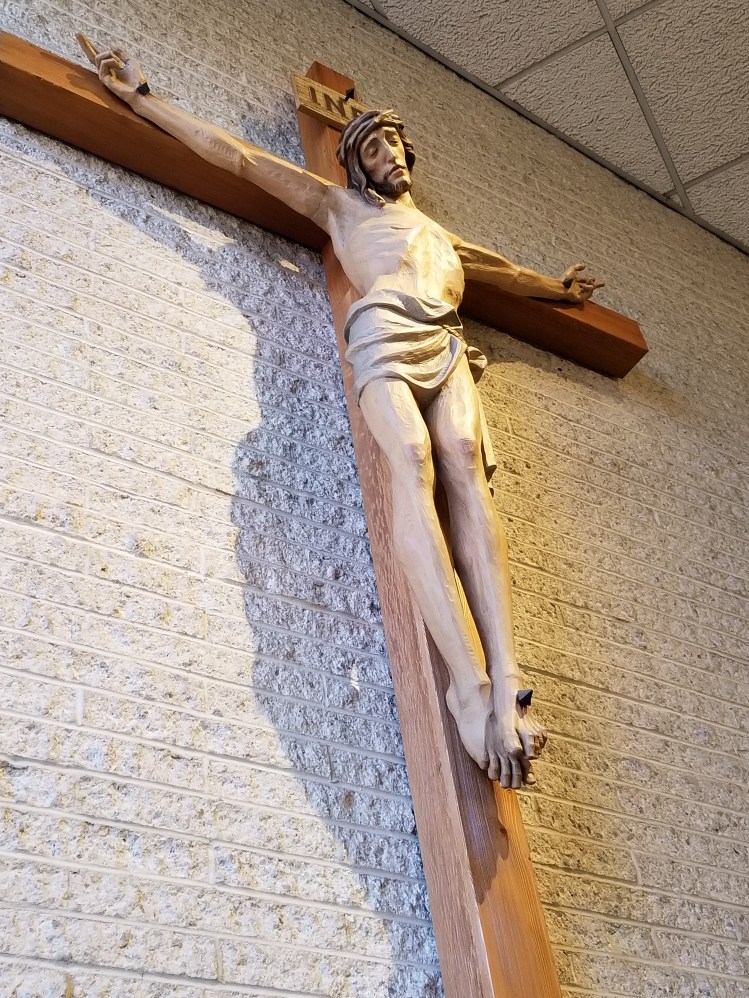
Sacrifice is a word that is used in our modern language. Sometimes it is confused with choice, or perhaps misused instead of it. In using it as such, the connotation softens the word, so that the harsh starkness of giving up something that is critical to life, or even life itself, no longer resonates. As Catholics, we hear about the ‘sacrifice of the Mass’ and perhaps we have even used that phrase ourselves. Yet each week we go to Mass, as the words of consecration are spoken, do we realize that what is taking place is Jesus giving Himself up on the cross on Calvary? While the Mass is the ‘unbloodied sacrifice’ it is nonetheless re-presenting the ultimate sacrifice of a life for a life – namely Jesus’ life for ours. Jesus freely gives His life to atone for what we never will be able to do: to make full reparation for the sins we commit. And He did it because He loves us. He did it even knowing that people turned away from Him. He did it so that we can hope in His mercy. He did it so that we can become the best version of ourselves in spite of our sinful predisposition. 

Jesus is both God and man, and so His death hurt. Not just His family and followers at the time, but for everyone who believes in Him. We should allow ourselves to feel hurt by His death. In participating in His death, we can better appreciate the resurrection, His ascension, and the descent of the Holy Spirit. Being affected by these events, we can immerse ourselves in the life of Jesus, sacrificing ourselves to become His representation in our little corner of the world. 

“…Yet I live, no longer I, but Christ lives in me; insofar as I now live in the flesh. I live by faith in the Son of God who has loved me and given Himself up for me.”

Gal 2:20
Catholic Girl Journey Logo

More than generous

 In Sunday’s Gospel from Luke, Jesus feeds the 5,000. I have heard suggestions that rather than feeding the people, Jesus encouraged them to share amongst themselves and that was the miracle. While I agree there is an element of sharing, I believe that God, who created all life out of nothing, can certainly multiply the loaves and fish presented to Him.

God is generous with us. He gives us what we truly need, when we need it, plus more. Perhaps in our plenty, we lose sight of just how blessed we really are. We look at what others have, what they can do, where they can go, and we want those blessings instead of thanking God for what He has given us and asking His help to use those gifts to the best of our ability. When Jesus fed the people, His generosity was recorded as having twelve baskets of leftovers that were gathered. I wonder how big these baskets were? Were they like the stone jars holding the water that Jesus turned into wine at the wedding feast of Cana? All totaled, those jars probably held over 100 gallons of water-turned-wine, another example of God’s generosity. If the baskets were comparable in size, then twelve baskets would have held much more than five loaves and two fish!

In Jesus’ last directive to the disciples at this event, He tells them to gather the remnants. Why? Couldn’t whatever is leftover be fed to the animals, or be used in compost to enrich the soil for new growth? Even though these two things are good deeds, they are not on the same level as feeding children who are made in the image and likeness of God. In gathering the extra bread and fish, our attention is called to God’s generosity, which should not be left to waste. When we receive from God, we are called to use His gifts well and then gather up what remains and share it with others. Not as a cast off of what we received, but in a selfless sharing of His blessings. We can often take this to a literal sense, and think that it’s only about money. But as the saying goes, “Time is money,” so how do you spend your time? Do you participate in volunteering your time to events that support the welfare of the community? How about the gifts of your talents? God has blessed us each with unique abilities, do we use them only for ourselves or do we share them with others? 

God showed the ultimate generosity by giving us His Beloved Son. We will never be able to exceed God’s generosity, and He has shown us that He gives more than we need. Let us be generous with others, with our time, our resources, and the Love that is God Himself. 

Catholic Girl Journey Logo

Listening for God

Elijah’s interactions with God showcase two very different ways He communicates with us. Which of the two do you most listen to?

On Mt. Carmel, Elijah issues a challenge to the people who have started worshiping Baal. The people, not sure of which god is more powerful, are afraid to respond to Elijah and he suggests a competition of sorts: which god could consume their sacrificial offering. When nothing happens to the offering prepared by the priest of Baal, Elijah raises the stakes and has a trench dug around the altar. The bull sacrifice and wood are drenched with so much water that the trench becomes a moat. It’s like Elijah is making it impossible for there to be any shadow of a doubt who the real God is. Elijah’s actions almost taunt the people with an attitude of, “You want to know who the real God is? Well, let me show you…” God does not disappoint. Not only is the bull sacrifice consumed in fire called down by Elijah, He also consumes the wood and all the water in the trench so that only the stone altar remains. Once the people saw for themselves, then they turned back to God. 

In another interaction with God, Elijah is hiding in a cave and is told that God would  be passing by. After several large, loud occurrences, Elijah realizes God is in a tiny, whispering sound. While the second way is much different, and the audience is exclusively Elijah, it may be a more widely shared story. The “message” for us is that God may not be in the loud events of our lives, but rather, He may communicate with us in the smallest, and most unexpected ways. In comparing these two accounts, it’s not just the grandness of the message, but rather how the message is delivered. On Mt. Carmel, the message is really an answer to the people’s skepticism. In the cave, Elijah is a man of faith and does not need the over-the-top display God provided to him at Mt. Carmel. Both accounts seem to address the lengths that God will go to communicate; based on the faith of a person or a people.

I’ve often said to God that if He wants something specific from me, He needs to bang me over the head until I understand. One of my greatest fears is to ignore God’s will for me, not because it was my choice, but because I didn’t understand it to be His will. Yet, I don’t believe in coincidence and am always looking at what I receive as a blessing or a challenge that He allows in my life. Perhaps I’m not as close in my relationship to God as Elijah was with the ability to hear God in a whispering sound. My faith, however, is a bit stronger than the Israelites in Elijah’s time, as I don’t need a water-logged sacrifice to be consumed before my eyes in order to believe in Him. 

In our journey of faith, we will have our times when we ask God to prove Himself. At other times, we are close enough to Him, that He can use the small, simple, everyday events in our lives to deepen our relationship with Him. Let us pray that when we listen to God, we listen as less of a skeptic and more as a prophet on fire for love of Him. 

Water and fire

Water and fire seem like polar opposites, but for the Catholic Church, they are complimentary.

Water is a necessity for life. Although the amount may change amongst creation, from plants and animals to birds and fish, everything requires water to survive. In our modern world, we have the luxury of having water at our command in many locations of our house: the laundry, the kitchen, the bathrooms, and even in our backyard gardens. Not only do we consume water for our own bodies to function, but we also routinely cleanse our bodies and clothes with it. Water now is a symbol of life and of renewing life. Yet for the ancient world it was a symbol of chaos. 

In the first book of Genesis, at the creation of earth, it “was void and empty, and darkness was upon the face of the deep; and the Spirit of God moved over the water.” (Gen 1:2) Before God brought the order of creation, there was chaos. Water is seen as a destructive force flooding the earth and killing anything that did not seek shelter in Noah’s ark. And for the Israelites, God parted the Red Sea, allowing them to walk dry shod through it, and allowed the Egyptians chasing them to be consumed by the mighty power of the waves. Each of these accounts illustrates that God is no match for nature. He created it, but is not subject to it like we are. In each of them there is a foreshadowing of the sacrament of Baptism.

Baptism is a call from God to join in a relationship with Him, and as part of that, the Body of Christ. We are called to leave chaos behind and welcome His grace into our lives, living and learning about the Triune God. Before Baptism we are void and empty and afterwards we are filled with the Holy Spirit and grace of God. He becomes our shelter in the storms and trials in our lives. He gives us a way out of temptation and sin if we follow where He leads us. Water is the most quintessential element and symbol of the sacrament of Baptism, however, its fulfillment is found, not in more water or other forms of water, but in fire.

Fire is another symbol of the Holy Spirit. From the “burning” hearts of the disciples on the way to Emmaus when they encountered Jesus, to the first Pentecost, when tongues of fire came to rest on the Apostles‘ heads. The sacrament of Confirmation completes what was initiated in Baptism. The bishop calls down the Holy Spirit by “sealing” or anointing the recipient with Sacred Chrism oil. They are anointed as soldiers for Christ, exemplifying Him in their daily lives, no matter who they are or what they do. 

Fire, too, can be considered a destructive force, yet who is not fascinated when they see the gentle flames in a fireplace and move closer to be warmed? No matter the size of the flame, fire is an action. It moves. Place a simple candle in front of you, and it may appear sometimes as if it’s standing still, but it shimmers, flickers, and makes the slightest of noises as the wick burns and is consumed by it. Place a cup of water in front of you and it is still and silent. We receive both sacraments and each exists in harmony within us. The still, quiet waters of Baptism cleanse us from original sin, open us to God’s grace and assistance, and puts us into a relationship with Him, allowing us to call Him “Father.” As we reflect the love and gifts God has poured out on us from these and all the sacraments, we too move to share with others from what we have received. We become the action of God: His hands, His feet, and His smile to everyone we encounter. 

God is not an either/or, He is a harmonious both/and. Through the sacraments of Baptism and Confirmation, we are called to follow in His footsteps to be both still and quiet like water and on fire in movement. We are called, by name, into relationship with each person of the Blessed Trinity: Father, Son, and Holy Spirit.   

Piety from the Spirit

One of the seven gifts of the Holy Spirit we receive at the sacrament of Confirmation is the gift of piety. But what is it and what do we do with it? 

At a basic level, piety is about respect for the sacred. We can start with God’s name. It’s not just about being sensitive when using the name Yaweh, it’s about respecting God’s name in all three persons: Father, Son, and Holy Spirit; and this includes the name of Jesus. If we throw around the name of Jesus like it’s any other word, we are not being respectful to God. If we would not substitute our own name, or the name of a loved one, then we shouldn’t use Jesus’ name in our responses. 

“Sacred items” are those items set apart from the every day and are for use during Mass, prayer, and sacraments. In addition, we should respect  churches and church spaces, especially when people are there to pray. This may mean avoiding unnecessary conversation or removing yourself to another location. From buildings to rosaries, and all things inbetween, piety is  acknowledging that these items are not meant for our pleasure, but as conduits in our relationship with the Lord. Even something like holy water, (which is blessed) is not something we would use to bathe in, but rather we use to bless ourselves, reminding ourselves of our baptism, and to call on the grace we received in that sacrament to help us in our current challenge. 

Sometimes distractions can cause us to lose focus and test our ability to be pious. For example, walking up to receive the Eucharist, we should be preparing ourselves for receiving the greatest gift of all: the Body, Blood, Soul, and Divinity of Jesus. Yet there is that cute baby peering over the shoulder of the parent in front of us. How could anyone not smile and give a little wave? And if we receive in the hand, do we present our hands like a throne for Jesus to be placed? And on our way back to our seats, do we take the time to welcome our Lord into our bodies or do we scan the crowd to see who’s there and acknowledge our friends? 

The gifts the Holy Spirit poured out on us at Confirmation may seem like that occurred a very long time ago. However, God is the master of all time, and His gifts do not have expiration dates. When we receive a gift from God, it’s not for us to keep and hold it. But rather, we are called to practice and share it. Piety is not for just “holy people” or saints, it’s for all of us. We are all called to be holy and practicing piety (with help from the Holy Spirit to lead us) will enable us to recognize the holy and sacredness of items and events in our lives. Our respect for sacred items is one way to love the God who wants nothing more than to shower us with even more gifts. We need to use and share what we have already received in order to receive more. Piety is not about perfection, it is a practice. Let us thank the Holy Spirit for this wonderful gift and ask His assistance as we put it into practice!

Free to serve

At the Last Supper, Jesus gives us the example of a servant by washing the feet of His  Apostles and telling them that they should follow the example and seek to serve others (John 13:12-16). Yet a bit later He remarks, “No longer do I call you servants, for a servant does not know what his master is doing; but I have called you friends, for all that I have heard from my Father I have made known to you.” (John 15:15) So, are we servants or not?

The word serve in the dictionary has many meanings. (38 nuanced definitions depending upon how it is used!) Some definitions that fit the purpose for my reflection include: to answer the needs of, to attend, to comply with the demands of, and to be of use. In the etymology of the word, it may be traced back to Latin, “to perform duties for (a master) in the capacity of a slave, act in subservience, to be at the service of.”  However, it is possible that the original sense was “watcher (of flocks), or guardian,” per Merriam-Webster. It should be of no surprise that the Good Shepherd would ask us to follow in His footsteps and serve, or watch over/guard others. Yet there seems to be a fine line between servant and slave. 

Baptism has freed us from original sin, and that means we have freedom of choice. Does that choice mean we can choose anything we want? Yes AND no! The “yes” answer is conditional in that we need to accept the responsibility and the consequences of our choices. The “no” answer is based on our understanding that we are just one tiny part of a bigger world (of nature, community, history, etc.) and our choices have impacts that can have a ripple effect that we may never realize. Our current self-indulgent culture has a great distaste for serving, unless it is in favor of the individual being served. Freedom and service seem to be at opposite ends of the spectrum; an either/or decision. Yet God calls us to both. We can be servants to others without losing our freedom. 

When we freely choose to serve another, to do a task at the request of another, we live out the example that Jesus gave His Apostles. We become not less of ourselves, but more fully ourselves by relating to that person and to Jesus in the same action. These experiences shape and develop us, opening us up to doing God’s will. If being of service to others means I am a slave, then by all means let me be a slave of Jesus — for He purchased me with His own Body and Blood on the cross. But Jesus has called us His friends, for we do not blindly take commands. Rather with the Love that is God, we perform acts of service. First, to acknowledge the love we have for each person made in the image and likeness of God; second, as an expression of praise and worship to God for bestowing his Love on us; and, third as an acceptance of the Love God gives to us.  

If we seek to be truly free, we should seek to serve God and do His will. 

Carrying your cross

How many crosses do you carry? And I am not  talking about the jewelry you wear, the rosary in your pocket, or possibly the tattoo on your body. I mean the spiritual, sacrificial hardships that are uniquely yours to bear. Is there more than one? Or does it change as your spirituality grows?

Luke’s gospel (9:23) records Jesus indicating the call of discipleship is for us to deny ourselves,  to take up our cross daily, and follow Him. While many, especially in our modern culture of “me,” would think that the cross Catholics are called to carry is the denial of putting ourselves first, in reality the crosses we are meant to carry can many times be categorized as a weakness towards sin. Even St. Paul in his second letter to the Corinthians acknowledges the thorn of the flesh he was given. (2 Cor 12:7). For some of us it may be an addictive pattern, for others it may gossip or judging others. Although we may share the same inclinations with another, how we handle ourselves and address our weakness is unique to each individual.

Life is ever changing. If we focus on one particular area in our life to improve, it often seems that we falter in other multiple areas. Then as we shift our focal point to those other problem areas, the original element of focus ends up back in the same way prior to trying to fix it. Some may call it an endless battle and eventually give up. Yet Jesus didn’t indicate that we only needed to pick up one cross (or needed to pick it up once) but rather daily; that thought alone can be overwhelming. When we notice ourselves falling back into a pattern of sinful behavior, it is a golden opportunity to lean on Jesus and also the saints and angels for assistance. Just like Simon the Cyrenian helped Jesus carry His cross, Jesus does not abandon us to our own devices unless we specifically push Him away. Some days the weight of our cross can feel like it’s about to crush us,  on other days it could simply be an annoying inconvenience. Our journey with our crosses span the length of our lives and it’s how we embrace certain moments of spiritual exercise overall that will determine our success.

Not all crosses we bear are a direct reflection of our actions. Illness, separation, or death can also be burdens that challenge our spiritual journey. Yet these, too, are temporary and do not define our spiritual lives. They can ultimately bring us closer to God and others as we navigate our way through these times. 

It can be easy to look at others and be thankful that we don’t have the crosses they bear. Comparing our crosses to theirs may not only minimize the severity of ours in our minds, but can also minimize the impact and effect of addressing the weaknesses we do have. But venial sins can stack up quickly. Minimizing the impact of our actions can lead us dangerously into the sin of pride, as evidenced by the parable of the Pharisee and the tax collector (Luke 18:9-14). We also need to be cautious not to “decorate” our crosses just so that others can see what we are dealing with. 

We can’t choose which cross we want to pick up, but we are asked to acknowledge our cross (or crosses) and daily pick them (all) up with the Lord’s assistance. Carrying this burden sensitizes us to have compassion for others. Yet we don’t just pick it up and hold it; we carry it and follow Jesus. He has shown us that even when we fall, we need to rise up again and continue in the path He has made with His cross – all the way through to the resurrection.