Catholic Girl Journey Logo

Glory and peace

In those two simple lines from Luke’s Gospel that the angels proclaim to the shepherds is the entire mission of Jesus: glory and peace. These two lines are very familiar. We basically say or sing them whenever the Gloria is used in Mass, which is most Sundays excluding Advent and Lent. They were even included in Linus’s scripture passage he quoted to Charlie Brown in the namesake’s animated Christmas special. Sometimes the passages that are very familiar are the least pondered. Have you ever thought what that proclamation by the entire heavenly host meant? In thinking about it, it seems so obvious that this is such an important message, since the whole choir of angels proclaims it. It’s like it has a heavenly set of exclamation marks at the end of it! 

Jesus’ whole life was lived with and for God the Father. His life on earth is the most perfect example of a life giving glory to God. “Jesus answered and said to them, ‘Amen, amen, I say to you, a son cannot do anything on his own, but only what he sees his father doing; for what he does, his son will do also.’” (John 5:19) Jesus, Himself, tells us that He is a reflection of God the Father and that all His works are works of the Father. As Jesus mirrors God, so we must strive to mirror Him as well. God has been very generous to us, so we, in turn, must share our blessings with others. Even if we lack material goods, our time, our energy, and even our very person can be used to show the love of God to others in need of it. The Blessed Mother did God’s will her whole life and that is why we show her the respect we do. When we pray a Hail Mary, we’re not praying to her, but rather through her and praising God for His most special creation that agreed to be the mother to His Son. When we praise God, we are giving Him the glory for His works. 

While our life objective is first and foremost to give glory to God, the angels’ proclamation assures us that we will be blessed with peace. If we look around the world today, one may begin to doubt, however, God’s peace surpasses any that can be achieved by man. God’s peace is gifted to us based on our response to Him. God would love to flood our souls with peace, but they need to be prepared. First, peace is brought through reconciliation with God. Jesus opened the door of peace through the forgiveness of sins when He was crucified, died, and rose again. He repaired the rift between heaven and earth and became our advocate to God the Father, since Jesus became like us in all ways but sin. 

When we acknowledge our sin — doing our will instead of God’s, we recognize we have a relationship with God. Another way God blesses us with peace is in our relationship to Him. When we seek Him out, return to Him through penance, and participate in the sacraments, we are cultivating a relationship with the Divine. A relationship with God does not demand special favors or only seeks to pray when one is in need. In both good times and troubles we seek to know God and to praise Him regardless of the circumstances. When we are able to rejoice in the moment we are at, we find the peace of God lifting us up. 

God is well aware of human limitations and frailties. He has given us the Commandments and the Beatitudes as the roadmap of how we should measure ourselves. Instead of looking to others and comparing our words, actions, and blessings, we need to weigh ourselves on how well we are living out the word of God. Here again we find the peace of God when our actions align with the instructions God has put forth. The more we act accordingly, the more we will be able to recognize the peace that comes from fulfilling God’s will for us. I sometimes think that when we are having particular trouble in making a decision, when we finally do choose God’s will instead of our own, there seems to be an extra blessing of peace bestowed on us that can almost seem tangible, and  at the very least, recognizable.

During this Christmastide, I do wish you joy as you glorify God for the blessing of His Son, and you are able to recognize the peace of God, which is truly beyond all understanding. (Phil 4:7)

Merry Christmas!

Catholic Girl Journey Logo

Gift of acceptance

As we head into week three of Advent, the week of joyful anticipation, let’s turn our focus on Mary and her gift of acceptance.

The second week of Advent held two great feasts for Mary: the Immaculate Conception and Our Lady of Guadalupe. Mary does hold a dear place in the hearts and spirituality of Catholics. We see her guiding presence within the Gospels and even in the Acts of the Apostles. Many times meditations on the Annunciation, when the angel Gabriel came to Mary asking her to be the mother of God, focus on the visit itself and what it must have been like for her. But what if we took another look at a different angle, specifically, her acceptance.

How many times have we had experiences that were drastically different from what we expected? At times like this my family will comment, “that’s not what I signed up for!” At the time of Jesus, the Jews were expecting a much different Messiah than Jesus. They expected Him to rid the land of the Romans and restore the earthly kingdom. If that’s what Mary was expecting, she was definitely mistaken. Perhaps throughout His life, Jesus prepared her for His eventual Passion and Death, but she could not have known what was going to happen when she said yes. Did she know He would be an itinerant preacher? As she is mentioned in the Gospel at the places where Jesus was teaching, perhaps she accompanied Him on His travels. If she was expecting a more militant savior, the travel probably didn’t surprise her, but perhaps the teachings did. 

If we put ourselves in Mary’s place at the time of the Annunciation, what we can expect is her assessing the risk she was taking by saying yes. As a woman who was only betrothed, she faced scandal by her family, her community, and even her future husband, Joseph. She could have been ostracized or worse, by law stoned to death. And she still said yes. While Mary was still quite young, thought to be a teenager, she was still of an age to marry and have children in those times. But even in her short life at the time, she trusted in God, no matter what consequences came from it.  

God asks us to trust Him like Mary did. While He probably won’t send an angel messenger to obtain our agreement, He still wants us to be open to His Will, even during trials and challenges. As the Church acknowledges Mary’s conception free from original sin, we see that God prepared Mary in a very special way for the special role she has in salvation history. God prepares us in a similar way, for each blessing and challenge is built upon our response to the previous opportunities in our lives. Each time we are free to accept God’s will or to choose our own way, and with each decision, we must also accept the consequences that come as a result of our choices. 

Mary’s gift of acceptance to God has become a role model for us all to follow, regardless of the risks or the consequences. When we accept God’s will, there will be many blessings but also many trials, however, He will always be there for us and help us through it. It may not be what we expect for our lives, but if we are truly doing His will, then our expectations are changed from secular, worldly matters, to the goal of reaching heaven and spending eternity with God and with Mary.

Catholic Girl Journey Logo

Saintly sufferings

Everyone suffers, even those who will eventually become saints. The life of a saint is often painted in broad brush stokes, and their struggles are often minimized. Yet if you dive deeply into their lives and ponder all the challenges they encountered, you realize their ability to be our mentors in the deepest of struggles.

Can a person become a saint if they have been excommunicated? Yes, and that was the case for Saint Mary MacKillop, the Australian nun. In 1871, the local church officials changed the constitution of her order and Sr. Mary did not comply with those changes. The bishop excommunicated her citing insubordination. Most of the schools she founded were closed and since she could not have any contact with the church, she lived with a Jewish family. About six months later, the bishop, on his deathbed, instructed the excommunication be lifted. She was later completely exonerated by a conference of local bishops. Sr. Mary went on to visit Rome and obtain approval for the order of nuns she founded and continued her work to found schools and teach the faith throughout Australia. 

For those six months that Sr. Mary was excommunicated from the church, she lived after losing everything: her mission, her fellow sisters, even the ability to worship God. We can look at that moment in history and say that it was only six months, but each day must have been mentally, emotionally, and spiritually excruciating. Did she doubt her calling during that time? Did she weep unceasingly over the rift that prevented her from receiving and being close to Jesus in the Eucharist? Did she think it was a ploy by Satan to prevent her ministry? Or did she put all her trust in God and let each day unfold? Perhaps it was a mixture of all of those thoughts and feelings. Yet for every bad day you have, you can be thankful that you are able to seek and receive Jesus in the sacraments.

I was shocked when I read the story about the apparitions at Fatima and learned the three children were arrested to prevent them from visiting the apparition site. The three children, Lucia and her cousins Francisco and Jacinta, began seeing Our Lady in May 1917 and were to return monthly on the 13th to visit her. In August, the children were incarcerated by the local mayor because he opposed the apparitions. He threatened them but ultimately released them when they continued to refuse to admit they were lying about the visions. However, Our Lady still appeared to them several days later instead. 

The children of Fatima were poor shepherds who had great faith. They accepted the grace the visits brought them and even at their tender, young ages, sought a life of holiness. I cannot imagine how horrible it must have been for them to be in prison — the darkest, direst place that is a punishment for sin. How much anguish they must have felt at the missed visit with the beautiful Lady from heaven. Even though the imprisonment could barely be measured in days, in that moment of time, what must they have been thinking and feeling? Were they scared to have so much attention on them that wicked people would try to prevent their visits? Were they thankful they were together and could lean on each other? Did they pray together and leave the outcome up to God? While the children didn’t know that Our Lady would still visit them at the time, we can all learn a lesson that even when dark forces try to prevent us from encountering God, He will make a way for us and give us the strength we need as long as we remain faithful to Him and desire to seek Him. 

St. Pio of Pietrelcina, also known as Padre Pio, was asked not to perform public ministry by church officials. St. Pio received the stigmata while hearing confessions, and the wounds remained with him. The church hierarchy was concerned with the growing interest by the public, who were drawn to the miraculous gift Padre Pio had been given. I wonder if the church was concerned that people would try to worship Padre Pio rather than God because they could see the miracle on him. St. Pio suffered from the stigmata itself, as well as the various doctors and investigators who confirmed that it was not being faked. Eventually the church leadership did allow Padre Pio to return to public ministry and Pope Pius XI even encouraged people to visit him. 

While I understand the church has to protect people from those who would seek fame by any means necessary, it must have been spiritually and mentally painful for Padre Pio, a very humble man, to be censored in such a way. He was known for hearing a great many confessions, spending 15 hours at a time in the confessional. Perhaps the break from public ministry allowed St. Pio the time to reflect and prepare for his ministry, rather than trying to learn how to deal with both the miraculous gift as well as the public exposure at the same time. But to a man who willingly listened and provided guidance in confession, a pause in the ability to administer the sacraments must have felt as if it went against his mission. 

Saints are our mediators and mentors during times of suffering. We can ask for their assistance during our earthly trials, and ask for the strength and grace to allow God’s will to unfold, no matter how long it takes. They are no strangers to the secular powers that seem to prevent us from doing God’s will. We must remember that if we are truly doing His will, we only need to participate as much as we can and let God do the rest, especially when our way seems blocked. 

Weapon of change

October is the month dedicated to the rosary. A whole month? Yes! The rosary has been touted as the most powerful prayer, especially when prayed daily. How can this prayer, that features the Blessed Virgin Mary, be so effective in our spiritual battles?

Living in a physical world, we often forget that there is also a spiritual realm active and all around us. Thankfully we each have a guardian angel to accompany us through life and assist us in our spiritual battles. The battles are not for the angel to take care of however, but rather they are ours to confront. This fight is ours alone, though we can seek our angel’s assistance. Sometimes, this means taking action to perform a corporal or spiritual work of mercy; other times, it means avoiding sinful actions.

A quick Google search on “who said the rosary is a weapon” provided quite a number of responses. The most prominent was from St. Padre Pio. “Love the Madonna and pray the rosary, for her Rosary is the weapon against the evils of the world today. All graces given by God pass through the Blessed Mother,” is attributed to him. However, others who have proclaimed the power of the rosary include: Blessed Pope Pius IX, St. Josemaria Escriva, Pope Pius XI, and Pope Leo XIII.

In any war, soldiers are trained and practice handling their weapons until they are practically an extension of themselves. In our war against temptations, we train by praying the rosary, pondering deeply the mysteries within it, so that we can be strengthened for the fight. While the rosary seems to focus on the Blessed Mother because the majority of the prayers are the Hail Mary, the mysteries are about the life of Jesus. They focus on both the happy moments as well as the sad ones, allowing us to accompany Jesus throughout His whole human life. With each Hail Mary, we ponder the words of scripture. From Gabriel’s salutation at the Annunciation to Elizabeth’s greeting, when John the Baptist leapt in her womb, we are reminded that God has a plan for each of us. And by praying Mary’s prayer, we ask her to help us say yes to God like she did. 

The rosary is a vehicle for God’s graces to flow into the world. It most likely will not happen very fast, but the change is real. It starts with us, who are praying the rosary. Our attitudes, our decisions, and the way we conduct ourselves reflect the light of Christ. The effects ripple outward towards others, softly encouraging them to change their ways as well, learning to start saying no to sin and temptations. While we will continue to fall, the rosary will help lift us up to seek God’s mercy and guidance, returning us to the path that leads us to heaven. And when we’re disappointed that the intention we’ve prayed for does not come to fruition, we will be reminded that the rosary is not for our will to be done, but for God’s will to succeed, as He knows what is truly best for every one of us. 

Ultimately the spiritual warfare we are battling is for souls to get to heaven. The more we pray the rosary for our world, the more lives we can save from eternal damnation, including ourselves. That’s a powerful weapon, indeed!  

Tangles and knots

May is the month dedicated to Mary and recently I’ve been pondering one of her titles, Undoer of Knots. 

I was working on warping my loom, using a fine cotton yarn that I realized had been a bit too overspun. This resulted in the yarn wanting to twist unless it was under tension. Since a loom works by using the yarn under tension, it sounds like it would be a good use for it. However, one needs to actually get it on the loom in order to put it under tension. When one is dealing with 400 measured out strands of yarn, each about 3 yards long, it doesn’t take long for tangles to begin. As I warped the loom, I worked in small sections at a time, maybe about 20 or so ends. I could hardly believe my eyes. I would straighten the section and immediately upon releasing it, it would twist and kink up along the visible length I was working on. I was being given a challenge. Would I accept it? Or would I cut it all off and choose a different project?

I must confess there was more than one occasion that I wondered if it was worth it. This project is a practice item, I don’t have to do it. Why was I putting myself through such hassle? “It’s an opportunity to practice patience,” I told myself. But the other part of my brain would question me, “isn’t this supposed to be fun, why do you want to practice patience with this?” Another explanation I thought of was it being an opportunity to practice this particular weaving challenge, so that I know I can handle it when it comes to a project I specifically want to do, especially if it’s for a gift. Still my brain was challenging me and I was getting frustrated. Then I remembered one of Mary’s titles is Undoer of Knots. As my hands worked through the loops and tangles, I pondered on what this means for Mary, and how my current predicament could shed light on it.

The excess twist in the yarn was causing it to loop over other strands that were making their own loops. I didn’t necessarily have a knot, unless in my frustration I yanked too hard and the loop closed over the other strands. Given the fineness of the yarn, it became a really tight knot. I had to look carefully at the knot to find the outermost loop and gently tease it away from the other strands. 

When we pray to Mary to undo the knots in our lives, be it for help with our habitual sins, issues in our families or workplaces, or even our general world, we need to have patience as Mary is working. It takes time to undo a knot. It takes finesse to find which thread to pull and gently work with it. 

Undoing knots also requires great attention to detail, not just of the knot itself, but of the other threads around it. By working with one thread, another knot could be created elsewhere if one is not paying attention. When we pray for Mary’s intercession under this title, we are asking her to look at whatever situational knot we are experiencing, and to work at it from whichever angle will prevent another knot from surfacing. It can seem like our prayers are not being answered; however, if we allow Mary to intercede with Jesus for the best possible outcome, we can be assured that the knot will be undone.

When we invoke Mary’s assistance, we also need to remember that when we seek assistance, we need to be open to the Spirit’s prompting, but avoid overthinking and try to resolve the issue ourselves. When we seek to fix our problems, we can create more tangles and knots in our life-yarn that is straight and smooth. It’s very tempting to make a plan to address an issue and our take-charge culture feeds that impulse. However, when we realize the difficulty is too big for us to address on our own, we need to leave it firmly in the hands of our spiritual guardians. Like at the wedding feast in Cana, Mary’s response may be for us to follow whatever Jesus tells us to do. And like at the feast, filling up the ceremonial jars used for washing when wine was needed sounded crazy to the staff, we may be prompted to take action in a way that seems to have no connection with our problem. But Mary and Jesus are outside of time and space; they can see the impact of it all. When we pray, we need to trust in their intervention and be open to their guidance. 

While it seemed to take forever to warp the loom, I did succeed. I absolutely had moments of frustration, but I also had moments of mirth as I thought of Mary as the Undoer of Knots. I know that my knots were nothing that needed her intercession, but it was nice to feel a kinship with her doing the same action. 

Human family

As we continue our Lenten journey through the stations of the cross, today’s two stations emphasize the humanity of Jesus.

The third station: Jesus falls the first time

Jesus is a young man of about 33 years old. To hear that He falls as he carries the cross seems a surprise, especially knowing that His full humanity contains an equal amount of His full divinity. How can God fall? And from the name of the station, it didn’t happen only once. After being beaten and crowned with thorns by the soldiers, who excelled at pain and torture, Jesus’ body was weak. And yet He gets up and continues on. His destiny is not to die on the road, but on the cross at Calvary. 

There have been heresies over the centuries that denied the humanity of Jesus, but this station underscores just how human He really was. Jesus understands our human nature because He has lived it. He knows, not just from a divine understanding, which penetrates much deeper that even we can understand ourselves, and brings that wisdom in practice. How many times do we use our fallen humanity as an excuse to do what we want to do, as we try to act as a god ourselves? We argue with God that He doesn’t understand our circumstances, but these defenses fall flat with Jesus’ first fall carrying the cross. He does understand how easy it is to fall under the weight the world puts on us. While Jesus can sympathize with our plight, can we understand the love He has for us to accept the cross and all it brought with it? Love is not just a nice feeling, but a choice that requires sacrifice. Do we die to our wants in order to choose a relationship with Jesus?

The fourth station: Jesus meets His mother

If you try to imagine a scourged and bleeding Jesus, carrying a cross on the way to His death, meeting up with His mother, the woman who has trusted God in all circumstances of life, the encounter is nothing short of painful. Jesus wants to comfort His mother, but words are hard and time is short. Mary wants to comfort and aid Jesus, but she can only pray that God’s will be done through all of this. He is her baby boy, but she also knows He has a mission too. She has to let Him go amidst the pain and suffering she feels. She lets Him go, but never too far away; she will be at the foot of the cross as He takes His last breath. 

This station reminds us of the great miracle of the incarnation of our Lord. He didn’t just pop into existence, but with the consent of Mary, started His life like we all do, in the womb of His mother. The bond between mother and child lasts far beyond the umbilical cord and early childhood dependence. While on the cross, Jesus will speak to Mary and give her motherly protection to John and the Church. Through our baptism we become adopted children of God and we receive Mary as our mother, to help support us and point us in the direction of her Son. She has experienced both true miracles and the worst of horrors during her earthly life. Now, in heaven, she seeks the well-being of all her children throughout the world and across the millennia. When we fail, let us never be afraid to seek her guidance and protection to help steer us back to the path God has for us. 

Jesus shared our humanity, and therefore is a part of our human family. As Christians we partake in His divine family, and are able to call God our Father and Mary our mother. 

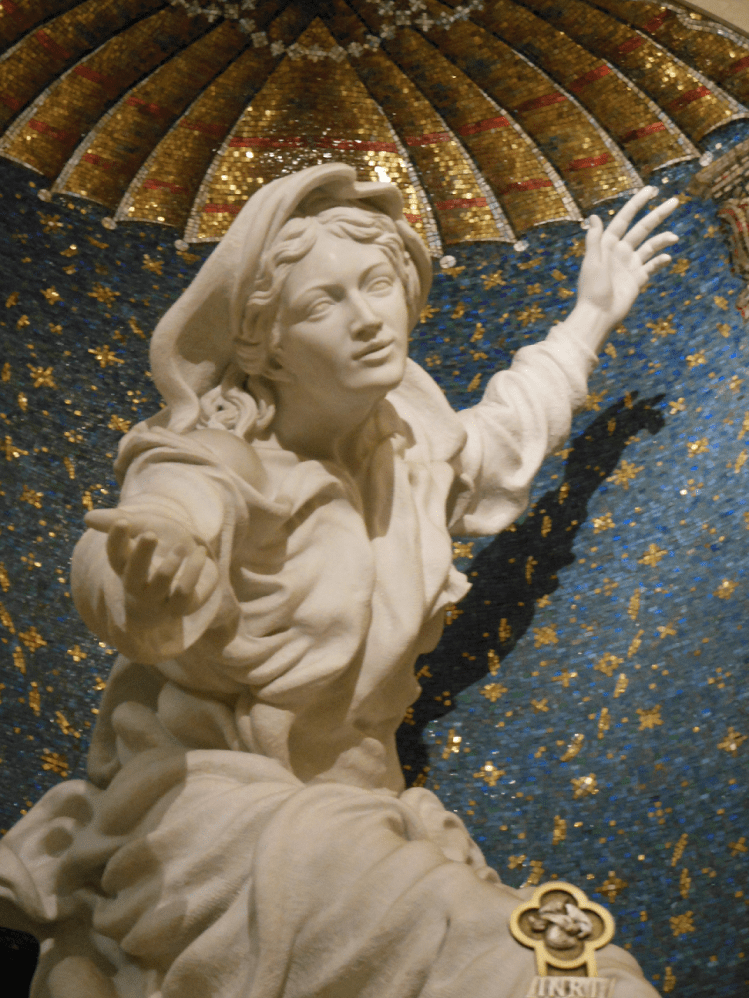
Mary at the Cathedral of St. Matthew the Apostle, Washington DC

Rosary and repentance

October is the month dedicated to the Rosary. As I watched a recent video from Fr. Mike Schmitz on its biblical roots, he pointed out a common message in the Marian apparitions included the actions of repentance and of praying the rosary. 

I don’t think I ever considered the rosary as a tool towards repentance. I’ve always thought of it as a way to walk with Jesus and Mary through their life on earth. But as I began to ponder, even just the first set of joyful mysteries, there is so much in them that can both help us to identify how we can improve as a disciple of Jesus as well as accompany Him through the major events of His life. 

The joyful mysteries are all about the beginning of the Holy Family. They include both the joys of becoming a family with the nativity of Jesus, as well as the challenges of finding their Son in the Temple. With Jesus being a child, one might use it solely to instruct children about being mindful of their parents, however, I think the same can go for adults as well! As an adult, do we care for the elders in our family, be it a grandparent, parent, aunt/uncle, or even an older sibling? How can we bring the light of Christ to these relationships? The fourth commandment to honor your father and mother is one of the moral directives God gave the Israelites through Moses. Many of the other commandments that follow the fourth could also be used for reflection in terms of how they affect family life and our participation in it. 

The sorrowful mysteries may be easier to correlate with repentance due to the suffering that Jesus endured. Walking through these events of Jesus’ life brings to mind the cost of our sins. Yet the secular world around us constantly expects us to always seek comfort and ease. While we don’t need to chase after suffering, do we allow it in our lives when it does come? Do we see it as a way to grow closer to God? God is generous in both His blessings and the challenges He allows, but neither should be handled just on our own. Do we look to share our blessings with others and seek support from God and neighbor when troubles arise? There are numerous accounts of saints who had some sort of medical issue, but yet had joyful exuberance. Do we seek their intercession when our tempers are short due to pain or misfortune?

The luminous mysteries, or more specifically, the third mystery is paired with repentance. Reflecting on the proclamation of the Kingdom of God, it includes the call to conversion. In the beginning of Mark’s Gospel, Jesus says, “The kingdom of God is at hand. Repent, and believe in the gospel.” (Mk 1:15) These mysteries underscore a life of faith. They remind us of the sacraments we’ve received and that we are to live our lives according to the grace given to us in these sacraments. How much do we look to our faith to guide us in making decisions? Do we practice our faith regularly and make time to pray and deepen our relationship with God?

The glorious mysteries seem to be farthest from repentance, yet it is these mysteries that give us a reason to repent. We are not stuck in our sins! Jesus has redeemed us and repaired our ability to have a relationship with God. He has given us a model of His life to follow. These mysteries are the hope we have that we can improve. The first step we must take is to acknowledge our sins. We take ownership of the wrongs we have committed, and with full sorrow, ask for God’s mercy and do our best to avoid these. It may take a lifetime of practice, but Jesus’ resurrection, the descent of the Holy Spirit, and even the assumption of Mary, focuses our attention on a world beyond what we see. If we want to participate fully in that world, we need to seek a relationship with God now

The rosary is a powerful weapon. Let us use this month to practice wielding the rosary to illuminate what separates us from God, to give us the grace to seek His mercy, and gratitude for all the blessings it brings.

Mary at the Cathedral of St. Matthew the Apostle, Washington DC

No singular purpose

This week the Church celebrates the Assumption of Mary into heaven. It’s a perfectly placed holy day to remind us of who we are and where we are going.

August means summer is just about over and, for those who have children, another school year is about to start. All too soon we will be replacing shorts and t-shirts with long pants and cozy sweaters as well as finishing another calendar year. The older I get the faster time seems to pass. The culture that surrounds us seems to live on emotions alone which can change faster than the wind, and produce just as much chaos and turmoil as any windstorm or tornado. While there is value in living in the moment, we also should not be hyper focused on solely how we feel as the barometer of our life. One can’t seem to escape the headlines or sound bites indicating an epidemic of depression. Too many see their value based on fleeting ideals of their career, their bank account, their status in society, or even their popularity on social media. Yet the Church reminds us Catholics to stop and remember the Blessed Virgin Mary.

Our baptism welcomed us into the family of God. Our purpose is not a secular one based on what we can measure here on earth, but rather how we reflect and imitate the love of God to each other. From the first chapter in Luke’s Gospel, Mary sings God’s praise to Elizabeth. Instead of reflecting on the message she received about her own miracle, she rushed to assist her kinswoman Elizabeth. One could argue that Mary’s purpose was to be the Mother of Jesus during His time on earth. But her motherhood didn’t end when Jesus died on the cross because He gave her a new role as Mother of the Church. 

Parenthood is not just a title, but a multi-faceted job that takes one’s whole self, requires sacrifice, can be painful and yet produces a joy that can only be experienced and not explained. Aspects of Mary’s spiritual motherhood can be found in praying the Litany of Loreto, which has over 50 titles for her. There are 15 titles that include the word “Mother,” 7 titles containing “Virgin,” and 13 titles with “Queen.” Some titles describe how she intercedes on our behalf and others are comparisons that paint a more tangible perspective of a mirror, a tower or a vessel. Praying and reflecting on the litany reminds us that God has not placed us here for a single moment in time, but rather at a particular period of time to accomplish His will in many different ways. While we can evaluate how we respond to God’s will and how much we have pursued a relationship with Him, we cannot be the final judge of how much we accomplished as that is in the hands of God.

The feast of the Assumption reminds us that there is more to life than the daily grind. Eternal life with God is possible if we have a relationship with Him now and seek to do His will as Mary did. God brought Mary full circle at the end of her life by bringing her, body and soul, into heaven. This is not something she could achieve as a mere creature created by God. This is a supreme gift from Almighty God as a blessing to Mary for fulfilling His will on earth. At the moment of her conception, she was preserved from original sin and at the hour of her death her body was spared any decay or corruption by being assumed into heaven. Mary is enjoying now what we hope to, God willing, after our resurrection from the dead. 

The summer draws to a conclusion and the daylight hours grow fewer. Another year ends and our time on earth is shortened. Yet our hope is in the Lord as our source of light and life. Our journey is not through this time but towards God as we seek to know Him as our Father and love Him by choosing His will over ours. May the Blessed Mother of God, Mary Most Holy, intercede for us with her motherly wisdom. 

Mary at the Cathedral of St. Matthew the Apostle, Washington DC

A very human mother

Jesus gave his mother Mary to be our spiritual mother just before He died on the cross. However, I think it’s very easy to forget that Mary was a very human mother to Jesus. 

When Mary gave her consent to Gabriel to be the mother of the Savior, she was not just a mere host for a divine creature. Rather God was able to fertilize her egg so that Jesus would receive His human flesh from Mary. While the conception of Jesus had a supernatural component, God allowed the natural progression of human time to: form Jesus in Mary’s womb, have Mary give birth naturally to Jesus, have Mary and Joseph raise Jesus from a baby to a boy to a teenager until He became a man. Jesus was fully human (and fully divine), and experienced all the emotions a human being can. Mary was a witness to her Son’s humanity throughout His life, but most especially when He was a child. If Jesus fell carrying the cross, He certainly must have taken a tumble like all children do as they are learning to walk or during play with other children. And if these incidents resulted in skinned knees and bruises, Jesus probably cried a number of times, just as He would as an adult when He wept for His dead friend Lazarus. In the movie, The Passion of the Christ, there is one scene I remember when Jesus was washing up before a meal and playfully splashed His mother. While movies are afforded the ability to add scenes that may not be historically documented, I loved that this was included because it beautifully illustrated the bond between mother and Son and their shared humanity. While there may not be documentation for that incident, I’m sure there were plenty of that type while Jesus was growing up. 

While most of Jesus’ early years are undocumented in the Gospels, there is no doubt that Mary and Jesus shared an intense mother-son bond. While the best example of this is Mary at the foot of the cross, another example is at the wedding feast in Cana. It is at Mary’s prompting that Jesus performs His first public miracle. Reflections of this Gospel passage are mostly from a spiritual perspective, but what about from a purely human exchange? Mary knows Jesus and what He is capable of doing: working miracles. She does not ask Him to make more wine, rather she simply informs Him of the issue at hand: “They have no wine.” (John 2:3) Many commentaries have analyzed Jesus’ response, but since Jesus was at the beginning of His ministry, perhaps it was not yet time to have such a big public miracle, like the multiplication of the loaves and fishes. Yet Mary is keen to make sure that the wedding feast is not marred by the embarrassment of running out of wine. Perhaps her exchange with Jesus was a private conversation and only those in the most intimate circle of friends were aware. Mary does not know how Jesus will solve the issue, but directs the wait staff to follow Jesus’ directions, which end up sounding very ordinary until they are directed to draw some water and have the headwaiter taste it. In John’s Gospel, he conveys, “…and his disciples began to believe in Him.” (John 2:11). It seems as if only the disciples who accompanied Him at this point were aware of the miracle. The Gospel does not seem to indicate that anyone else from the wedding were aware of what happened; or maybe they were too busy enjoying the result of the miracle to comprehend what happened. 

As we celebrate Mother’s Day this coming weekend, let us remember the motherhood of Mary, in its very human aspects, for it is in the culmination of these human experiences that she becomes a spiritual mother to us all.

Mary at the Cathedral of St. Matthew the Apostle, Washington DC

The final sorrow

It seems fitting that during Holy Week, as we approach the Triduum, we pause to remember the seventh and final sorrow of Mary: Jesus is laid in the tomb. (John 19:39-42)

After a gruesome crucifixion, Jesus was really and truly gone from this life. The only thing left was to bury His remains. And the tomb seems to be a finality of his essence. All that promise of everlasting life, of healing, and of love, now seems lost. 

Due to the solemnity of the sabbath, Jesus had to be hastily buried. Even in the final moments of tending to His body, He could not receive the attentive preparation that was the norm. This must have added insult to pain Mary was already feeling from Jesus’ death. If Mary was there at the foot of the cross, I’m sure she was there at His tomb. Did she help arrange His body inside of the carved rock? Perhaps. Most likely, though, she had to watch as others rolled the large stone that sealed the entrance.

We know Mary had complete trust in God. If this was His will, while she may not have understood it completely, still she tried her best to be the support Jesus needed in His last moments. Did Mary stay and grieve at the rock tomb? I think anyone who has ever buried a loved one can have empathy for what Mary felt at that moment. The question of lingering because you don’t want to completely say goodbye, but knowing that there is nothing you can do and staying there staring at the gravesite will change nothing. Jesus did not leave her completely alone, as He put her into the care of the beloved apostle John. 

Mary still had a purpose on earth, and the first step was to keep living. That in itself can be its own sorrow — moving on when such a large portion of your life is absent. Even if Mary had understood all of Jesus’ teachings and knew He would rise again in three days, the pain of seeing Jesus being tortured to death may not have allowed Mary to focus on that future event. While the Acts of the Apostles record Mary as being present at Pentecost, perhaps that was not the only time the Apostles gathered around her. Maybe God allowed her to be present and be the unifying element for the Apostles in the time immediately after Jesus’ burial. Gathering around her, they would have shared their common grief and their common hope in God’s will. 

While most of the Apostles were looking for an earthly kingdom, the burial of Jesus gave them time to reflect on the time they spent with Jesus and all that He communicated to them. I can imagine the eleven men, maybe more and perhaps with the women who accompanied the traveling party, simultaneously shedding tears and recalling the events that had the most impact on them. This time of “remember when …” would be the first oral Gospel as they shared the memories, maybe even mingling some laughter in with the tears.

“…for nothing will be impossible for God,” the angel had told Mary at the Annunciation. (Lk 1:37) Those words ran deeper than just the incarnation of Jesus or the fruitfulness of her barren relative Elizabeth. God had given Mary the ability to cope with being exiled in Egypt, with losing Jesus in the Temple in His last vestige of childhood, with prompting Jesus to perform His first miracle, and with everything He accomplished in His ministry, even to His passion and death. I wouldn’t be disappointed if Mary felt overwhelmed with these last events, and perhaps it would make her seem more relatable if she did. However, in our moments of greatest trials, God has given us Mary as a role model to follow in trusting Him. When in our toughest challenges we can say that all things are possible for God and we can get through this, we do so because of what was shared in the Gospels about Mary.

The stone rolled to seal Jesus in His tomb, while it may have seemed final, was not the end of the story. Mary didn’t know how the story would end, but we do. We know that life does not simply end on earth, but the soul continues to live on and can potentially be in the presence of God and all who love Him. The tomb is the final sorrow, because what comes next will overwhelm any pain or trial. But to get there, Mary and all the disciples needed to lean on God for strength and support. They needed to trust in His will. 

Let us pray this Holy Week that we too, may trust in God even when things seem impossible, and ask Mary to help lead us through the finality of the tomb-like darkness we experience in this life.