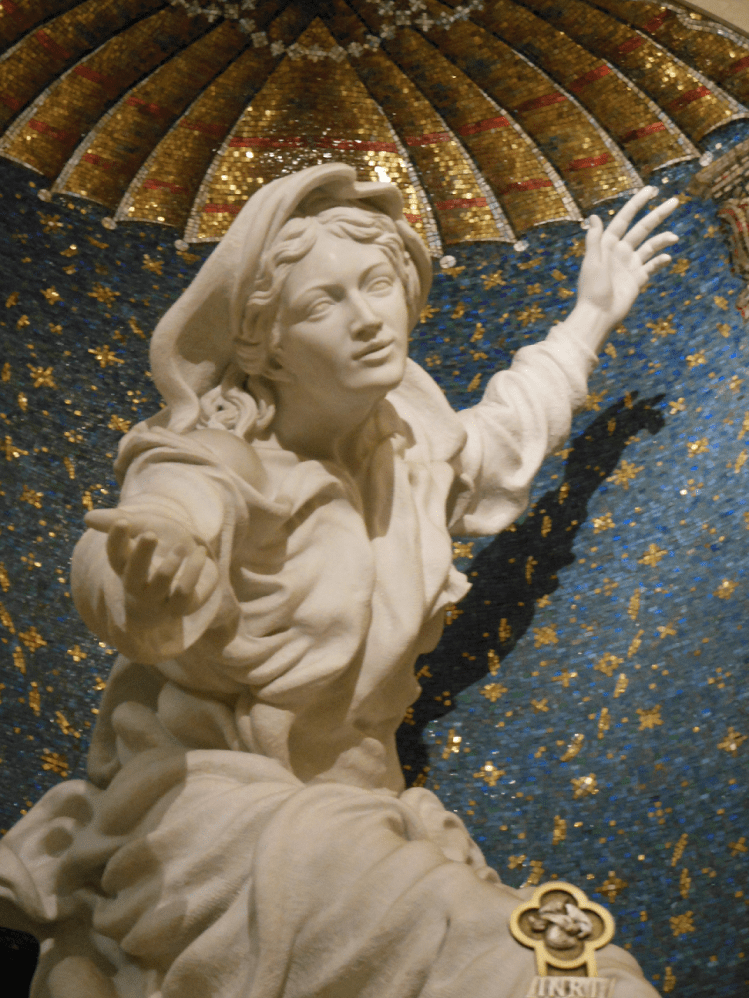
Mary at the Cathedral of St. Matthew the Apostle, Washington DC

Journey to a new beginning

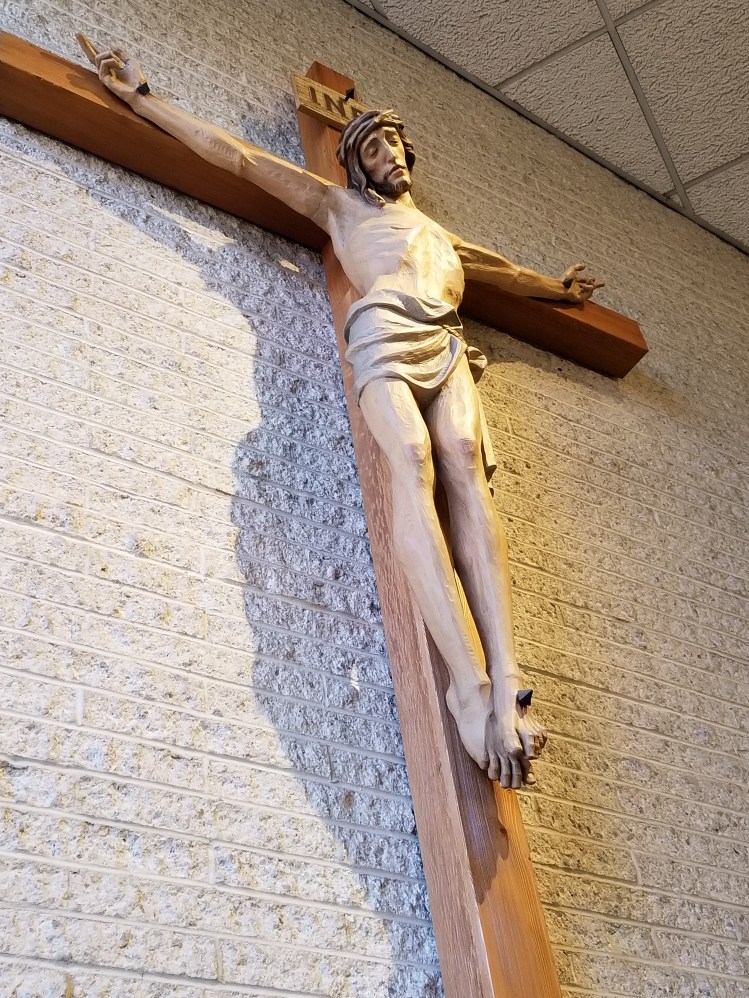
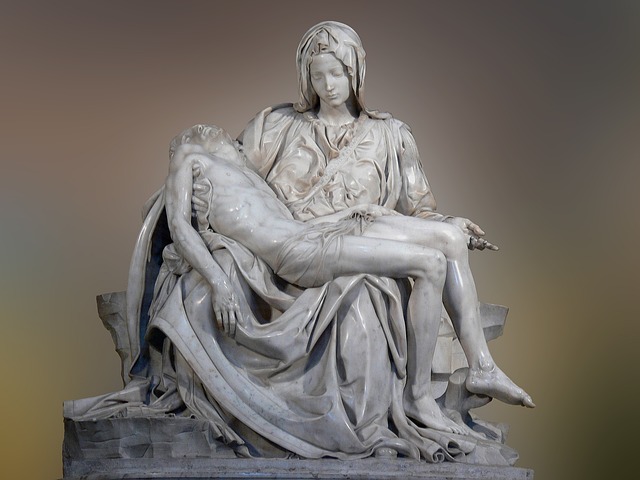
Mary only observed the effects of Jesus’ scourging: the blood soaked through His clothes as He walked towards the place of His death. Yet the events of Jesus’ Passion and Death would provide many moments where the sword that Simeon prophesied would pierce deeply. The fourth sorrow of Mary is watching Jesus as He carried the cross towards His execution. 

While the Gospels don’t mention Jesus meeting Mary during His struggle to Golgotha, according to an article on EWTN, it is based on tradition that this event indeed occurred. The Gospels do indicate that Mary was at the foot of the cross, so she would have had to travel the same/similar road herself to get there. It is plausible that whether they were near enough to touch one another, or only close enough to make eye contact, they could have very well met on that road.

Was Mary amongst the crowd that was stirred up by the Pharisees at the praetorium? Did she hear them call for the release of Barabbas? Did she witness the crowd calling for Jesus to be crucified like a criminal? Tradition and the Gospels are silent on how much Mary observed prior to the actual death of Jesus. However, the tradition of Jesus meeting Mary as He carried the cross evokes a painful reunion for both. Mary watched Jesus grow from a little baby to an adult man, who was ready to give His life for the salvation of souls. She saw the precious Blood staining the woven garments He wore, potentially ones that she made with her own two hands. She saw the depth of depravity by the soldiers in the crown of thorns piercing His head. The protruding wood of the cross He carried was unmistakable. 

While the first three sorrows of Mary marked occasions in Jesus’ childhood, there are no mentions in the Gospel of His adolescence or in His ministry that was a cause of sorrow for Mary. I’m sure there were times, like in so many families, where Jesus’ words or actions could have been challenging for a mother. Mary assented to God’s will at the time of His conception. Her ability to do so illustrates her great trust in God. Mary knew Jesus was not an ordinary baby who would have an ordinary life. When the time for His ministry came about, she encouraged His first miracle. Still, being an itinerant teacher must have brought challenges and discouragements on occasion. But were those instances enough to prepare her for what was to come? As much as Jesus tried to prepare the disciples, most of them fled at His arrest. The Gospels capture Jesus indicating the Resurrection, something that we are familiar with, to be a concept that was foreign to His followers (Mark 9:10). Even if Mary was aware of what was to come, future joy is very hard to see when the current pain and suffering are so overwhelming.

The way of the cross seemed to be the end. After all, is there anything more final than death? Well, for God, death is not the last word. Rather it is a tool used to illustrate the power, and the love, of God. It shows that God is far beyond our being and that He has control even over something that seems so final to us. As Jesus walks towards Golgotha, it is not a journey to His end, but rather to a new beginning. As Christians, we too, will walk through the valley of death, but our baptism promises us that our soul will live on. If we choose to trust God and His will for us, our relationship with Him will be transformed beyond our wildest imagination. And at the end of time, our souls will be reunited with our bodies, so that in both body and soul, we can share in the love that God is, as it flows from Father to Son to Holy Spirit. 

We are almost at the half-way point of Lent. Regardless of how challenging or overwhelming our practices are this year, it’s not too late to reach out to Mary for assistance as we strive to grow closer to God and recognize what is prohibiting us from embracing God’s will. No matter the pain and sorrow we will face, Mary will walk us through until we reach the joy of Jesus. 

Mary at the Cathedral of St. Matthew the Apostle, Washington DC

Life on the run

So, to continue on from last week… the second sorrow of Mary is the flight into Egypt. While Matthew’s Gospel addresses it only in a few short lines, (Matt 2:13-21), there is much to ponder within the text provided.

Joseph was warned in a dream to take his family and depart to Egypt. Upon rising in the middle of the night, they left. Did Joseph need to awaken Mary or was she awake and tending to Jesus? Can you imagine having your sleep disturbed only to find out you need to leave on a long journey immediately? Even if she was awake, the dreadful news that the precious Child was in danger must have been disturbing to hear. With a destination of Egypt, a place where the Israelites had fled from slavery, Mary, and Joseph too, had to put all their trust in God. Just because they were caring for the Son of God, didn’t mean they would have an easy road. The detour to Egypt probably had a number of challenges, especially since they didn’t have the time to prepare for the journey. Yet, it was for the protection of Jesus, and so they made the trip.

Aliens. No, not the kind from outer space but rather those who travel from one country to seek asylum in another, safer country. That’s what the Holy Family were: aliens in Egypt. Moving to another country where you need to learn a new language, new customs, and a new way of life is challenging for anyone, but to do it with an infant surely poses many difficulties that most may not even be able to imagine. They had no friends or relatives that could help them get started, just the grace of God. If the reception at Bethlehem, among their kinfolk, left them out with the animals, what kind of welcome did they receive in Egypt? Were they looked upon with suspicion? Did the Egyptian people gossip about this strange family coming from a foreign land into theirs, wondering why they left their own homeland? Especially since Mary and Joseph were devout Jews, they must have been totally out-of-place there. Were there any synagogues there? Were they able to have a little taste of home and worship in the manner they did when living in Israel? 

News does travel fast, and I wouldn’t be surprised if they heard about the massacre of the infants in Bethlehem and realized that if they had stayed, Jesus would have been one of them. As a new mom, Mary must have been heartbroken to learn about all the needless killing; all the mothers who lost their sons while she still had Jesus. Relief and anguish all rolled up together, and she could do nothing to comfort those women. Nothing to let them know that the Child their sons died for was safe and why it was so important that He remain so. Jesus was safe for the moment, but the time would come when Mary would need to let Him go, watching as He suffered and died for us all.

As we journey through this Lent, let us keep in mind that there are those who don’t speak our language and are looking for a safer place to live. Let us remember that when we treat them with the dignity of being a child of God, we honor the sacrifice the Holy Family made in their time of exile into Egypt. Let us look at the excess we have in our closets and pantry and see how we can donate to others who need it more than we do, no matter what circumstances cause their need. Let us comfort those who have lost loved ones, especially their children, with our prayers, our friendship, and a shoulder to cry on. Lent is an opportunity to practice mercy towards others. Let us open our hearts and ask God what we can do to help those in need.

Catholic Girl Journey Logo

Random acts of prayer

We are just a week away from the beginning of Lent. And I’ve already begun to see Catholic blog headlines saying not to give up chocolate for the penitential season, but to add something to one’s prayer routine, like a seasonal meditation or scripture reading. However, I suggest adding something that you can continue well after the Lent is over: random acts of prayer.

Yes, you read that correctly. I said random acts of prayer and not random acts of kindness. What’s the difference? When we are kind to another, we make the choice of what and how to be kind. For example, holding open the door for someone who is behind us as we enter a building. Is it a nice thing to do? Surely! However, random acts of prayer are when we leave the kind action up to God. This is when we drive by a house, say a prayer and ask God to bless whomever lives there in what they need the most. There are so many times when we ask God for specific things, like a job for one person or healing for another. While those folks may need those things, it may not be their most pressing need. How awesome is it to let the God who created the entire universe with all its diversity,  decide how best to bless a person? 

In praying for another in the random way, we have no idea of the outcome. Perhaps when we go to heaven, we’ll find out the impact of all these random prayers. Even if we never know, it’s good for our soul to pray for others in this anonymous way. First, it makes us be aware of our surroundings — that there are children of God in a building, car, or park that need His blessings just as much as we do. Second, it reminds us that we don’t have control over everything. One aspect of original sin was that Adam and Eve were not just looking at tasty fruit, but to gain more knowledge and control. Third, it gives us the opportunity to “let go and let God” handle it, which requires regular practice. Lastly, it reminds us of all the ways God has blessed us in seemingly random ways. Some may refer to these circumstances as coincidence, but I see them as an opportunity God uses to get our attention. 

Usually my random acts of prayer have been made while driving. Whenever someone is kind and allows me to merge onto the highway or lets me go at a stop sign, I do try to say a Hail Mary or Glory Be and ask God to bless them in some way during the day. Sometimes I wonder what that blessing is: a close parking spot at their destination, or green traffic lights all the way. This is probably the easiest way to practice this type of prayer because we will never know the impact of our prayer said for that driver. But random acts of prayer can be practiced anywhere, in any circumstance. For instance, the next time you’re at the grocery store, you can silently say a prayer for another customer or the clerk while they ring up your order. But we don’t even need to leave the house to practice praying like this. Maybe we ask God to bless the person in the world who needs it the most at that moment of our prayer. The randomness of whom we choose is only limited to our imagination. 

I believe God answers all prayers. I trust that He knows better than I do what another needs. But by specifically praying for another in this random and anonymous way, I create a spiritual bond with someone I may not meet until we’re in heaven. And what a joyful day that will be!

Catholic Girl Journey Logo

Listen

Listen. I’ve heard this word several times in several different ways, many of which pertain to the spiritual life. This past Sunday’s first reading was yet again another example  which illustrates the need to listen to God. 

In preparing for Sunday Mass, I usually read the day’s readings to become familiar with them so that I can be open to any inspiration that comes to me when hearing it at Mass. However, this time, hearing the call of Samuel made me chuckle a bit. The reading is taken from the first book of Samuel (3:3-10,19), and to have two books of the Bible named after him, you know he plays an important role in salvation history. Some may not see the humor in the events, but if this was played out on television or in a movie, it would be a comedic scene. We find Samuel — whose mother Hannah prayed for him, weaned him, then dedicated him to the temple —  sleeping in the presence of God. When he hears his name, he immediately runs to Eli, the high priest. Eli, who was not the most faithful of priests, failed to recognize that it was God calling Samuel. It took three times before Eli realized that it could be God calling the youth. Three times the boy goes running to Eli saying, “Here I am, you called me.” Eli sends the boy back to bed twice before telling him how he should respond to God if he’s called again. 

Because Samuel was dedicated to the temple, he was raised there and Eli was responsible for his education. Samuel was a very willing child, jumping up from being awakened in a sound sleep to come to the aid of who he thought was calling him. Notice how respectful God is of Samuel (and of us). He doesn’t say to him, “Samuel, this is God, listen to what I have to say.” Rather He just calls him by name. It’s Samuel who needs to acknowledge the calling and invite God to speak to him. God wants a relationship with each of us; however, He will not force His way on us, we need to invite Him into our lives and be open to the gifts He bestows. Samuel grew up to become the last of the great judges of Israel. When the people ask for a king to rule over them, he is heartbroken on behalf of God, whom they are rejecting as their king. The Israelites want to be “just like everyone else” around them, with a king who leads them into battle. It is Samuel who would anoint the first King of Israel, Saul, as well as the great king who succeeds him, David. 

I firmly believe that God has a wonderful sense of humor, and this portrayal of a calling lessens my anxiety about not responding to God’s guidance immediately. We live in such a noisy world that I do have doubts that I can consistently hear and understand what God is calling me to do. This illustrates how patient God is with us, as well as persistent! He calls Samuel four times before he responds to Him. Are we that persistent with our prayers to God? His timing is certainly different from ours and we can be very quick to dismiss God’s help if it doesn’t come in the time and manner we wish. God is always listening to us, but are we paying attention to Him? 

We may not hear His voice calling us by name, but He does make His presence known to us in a manner that we can understand and accept. For some, hearing the voice of God would be terrifying and nullify our ability to freely choose to listen to Him. Perhaps it’s in our dreams that He makes His way known to us like He did for Joseph. Maybe it’s in the repetition of a word or topic that gets our attention. He created us and He knows the best way to communicate to us. We just need to still our minds and hearts and invite Him into our lives.

Catholic Girl Journey Logo

Calm surrender

While watching a recent episode of Cesar Millan’s show, Better Human, Better Dog, it occurred to me that dog training and spirituality have some commonalities. 

While I’m not a habitual watcher of the show, I have seen a number of episodes and am familiar with many of the techniques that Cesar demonstrates. In any of the shows I’ve watched, the theme is always to have the dog achieve the “calm surrender” state. It seems like magic when Cesar gets a barking dog to just sit down next to him and not be disturbed by the people around it. That calm surrender state does not change the personality of the dog, but rather allows the dog to be around other animals and people and able to interact with them in a respectful way. It seems much like what God asks of us: to allow God to be our center and for us to surrender ourselves to His will. When we do that, it does not make us any less than who we are, but makes us more of who we’re supposed to be because we’re fulfilling the role God intended for us. 

While Cesar Millan makes it look easy for dogs to get into the calm surrender state, for Christians trying to surrender their will to God seems a lot more challenging. Or maybe it’s just me, but as much as I try and pray for that willing surrender, I do get nervous and anxious about situations and future events. I may tell God that I’m putting it all in His hands and then minutes later I find myself thinking about that same issue again. Perhaps it’s God giving me the opportunity to practice, then again, with the amount of practice I’ve had, why am I not an expert by now?!

Other similarities are discipline and boundaries. Dogs need to learn how to behave within “the pack.” When in a family of humans, the humans are the leaders and set the boundaries of what is acceptable behavior, like not jumping up on a person as they walk through the door or getting right into a person’s face. The simple “shushing” sound that Cesar makes is incredibly effective for dogs to respond to a simple chastisement. When practiced consistently, dogs not only learn what’s allowed but they also enter into the calm surrender state in lieu of acting out. Unfortunately, even with the 10 Commandments and the Beatitudes, practicing a Christian way of life is easier said than done. I have many good intentions, yet there always seems to be some reason that I find blocks my ability to act. When it comes to checking social media or relaxing by watching television, I seem to find the time to do those activities. But I’m in good company, as even Paul wrote to the Romans, “The willing is ready at hand, but doing the good is not. For I do not do the good I want, but I do the evil I do not want.” (Romans 7: 18-19)

Perhaps the difficulties I face are because I’m more of a cat person, or at least more like my independent Vera, who insists on affection only when she wants it and loudly protests my lack of attention if meals are not provided on time. I wonder if I’m limiting my interactions with God to the routine prayer times and only petitioning God instead of rounding out my prayer with adoration, contrition and thanksgiving. Although when Vera curls up in my lap at the end of day and purrs herself into a gentle snore, any mischief she may have gotten up to is quickly forgotten. Even more generous is God, as His mercy is readily available to me in the sacraments. 

Dogs, cats, and fellow creatures can teach us much about the spiritual life. Perhaps it’s one of the reasons God provided such an incredible amount of diversity on earth. Each person can relate to some animal and find that special bond of understanding that defies description. Truly knowing another creature — their habits, their personality, and their instincts — can give us a unique perspective in our relationship with God. 

Catholic Girl Journey Logo

King or president?

We are in the last days of the liturgical year, heralded by celebrating the feast of Christ, the King of the Universe, last Sunday. In our modern era, do we really understand — and accept — Christ as our King?

Earthly kings, just like other parallels to the sacred, are imperfect reflections of a relationship with the divine. Ever since God led the Israelites out of Egypt, God intended to be King of the people, sending judges and prophets only when the people went astray. However, by the time of Samuel, the people were so consumed with mirroring their surrounding countries, that they asked Samuel for God to designate a king to lead them. While Samuel was quite unhappy about this, God allowed it, but not without first clarifying the consequences of this request. (Spelled out in 1 Samuel 8:10-18.) A king would  take the best of everything and require the people to do his bidding. The king makes all the decisions and the people of the realm are but mere servants,  carrying out whatever tasks his majesty declares. 

Today in many countries, the ruler is not a single person, but rather a government of elected officials who collectively make laws.  In these countries it is necessary to have a single person represent them and that office is held by either a president or a prime minister. Here in the United States, it has been almost 250 years since we rebelled against a monarchy, so how can we claim Christ as our “king”? Or is it easier to correlate Him as our spiritual president? Do we “elect” Him to the office because we agree with His teachings? Or do we feel we can pick and choose what we like and don’t like, because that’s the perspective we have for our government? Do we complain about what God has — or has not — done in our lives, as if He answered to us and our rights and wants are the only things that matter? Do we view God in a what-have-you-done-for-me-lately mentality? 

For a freedom-loving country, it can be hard to recognize God as the supreme ruler of our lives. Letting go and letting God lead us, even when we do want to choose it on an intellectual level, can still result in a struggle against one’s will. It can seem like we say, “Yes, God, but…” rather than submitting to His will instead of ours. SImilar to rights of the king as identified in 1 Samuel, God does require the best of us; He wants our first fruits. Yet unlike an earthly king, God does not hoard what we give Him, nor use it trivally. Rather He receives it, multiplies it, and shares it not just with ourselves, but with others as well. We don’t receive back what we give, but we receive it transformed and elevated in a way only the Divine can do. Even knowing all this, and that what we can receive will be better than what we give, we still struggle with God as our only  King. 

We are blessed that Christ is a merciful King, understanding our human nature and quick to forgive us when we seek reconciliation with Him. It may be a struggle of our wills, but through prayer, petition, and the grace of God, Christ can be King of our lives.

Catholic Girl Journey Logo

Sitting and waiting

For the first time, since I learned to drive at 16, I am without a car. Nothing bad has happened, it’s just that my lease on my current car ended and the one I am purchasing won’t be in until the end of the week. This has  given me time to reflect on waiting and preparation, and aptly so since the Church’s theme of the final weeks of the liturgical year is preparing for the end. 

Since it’s just me, I have no other choice but to drive anywhere I need, or want, to go. (Until now, of course.) Now I have to rely on the goodness of others to get me where I need to be. I’m very grateful that I am a full-time remote employee, working from home, so I don’t have to worry about a daily commute. However, any church functions that I participate in, as well as Sunday Mass, I’ve asked others to be my “wheels.” My friends are wonderfully supportive; and we’ve used the opportunity to attend craft fairs and go out to dinner, since they needed to drive me around.  This has really been a blessing which I truly appreciate. 

Even with these wonderful encounters, I don’t want to be rude to my friends by making them wait for me if I’m not ready at our rendezvous time. My goal has been to be ready 5 or 10 minutes early, just in case they arrive earlier. In reality, I have been ready much earlier than that, and thus I’ve had to wait. I didn’t want to start anything that I couldn’t quickly put away. I didn’t want to be in another area of the house, in case I didn’t hear them when they arrived. I was concerned about picking up any one of my hobbies as I can get so lost in them that I might lose track of time. The sensible thing was to sit and wait, looking out the window. I was ready. I was prepared. And then my mind began to ponder.

When one is prepared and waiting, especially for something that is imminent, one is on hyper alert, looking at every flash of movement and ready to spring into action. Is this what God expects of us in terms of readiness when our final moment on earth happens? Does our human nature allow us to be that hyper vigilant for extended periods of time? If we’re going to live another 10, 20, 50 or more years, how can we be prepared for our final hour? Unlike waiting for a ride, our final moment will not wait until we are prepared, we won’t miss it, nor inconvenience someone if we’re not ready. Perhaps to be ready for the end is not so much about being hyper vigilant, but rather to be vigilant in our day-to-day, recognizing the opportunities God gives us to be His hands, His feet, His ears, and His smile to those we meet. When we seek to do His will, we’re not waiting for Him to come to us, we’re actively seeking Him out, spiritually walking towards Him. 

Perhaps that’s what it means to be prepared for the end: to walk the journey towards God, looking for Him in every person we encounter and letting His love flow through us to others. If we always see life as a path that leads to God, then there is no sitting and no waiting for the end, there’s just the action of living and witnessing to all we meet along the way. 

Catholic Girl Journey Logo

Finding in need

God gives us what we need, when we need it. I truly believe that. However sometimes the patience needed for God’s timing can be a challenge.

There are a number of things, both professionally and personally, that are causing me to wait. I have continually prayed to Him that these circumstances were fully in His command. The prayer is part reminder to me that I have no control over the situations and partly to God to remind Him that I’m still waiting. Perhaps God is being His overgenerous self in giving me the opportunity to practice two virtues at once: trust in Him and patience. I have received little glimmers that give me hope, but sometimes the day-to-day can overwhelm the little blessings along the way. In His infinite wisdom, God had a way to illustrate to me, once again, that He will provide when I need it.

A few months ago I was about to place an order from a catalog using a gift card I had received, only the card was not where I thought I had placed it. I had looked in many alternative places that it may have been, but my searches were fruitless. I then started to wonder if I had accidentally thrown out the card with a previous catalog when I was tidying up. Disappointment churned inside me and I chose not to order. It wasn’t anything that I absolutely needed at the moment and tried to face the consequences of my rushed cleaning efforts by shrugging off the unnecessary. Recently, I realized that I was starting to run low on some items and knew I needed to place an order soon. I dreaded ordering and was trying to delay since I thought I had lost the gift card and with the cost of everything rising, it would have really come in handy. However, as I was rearranging my decor to bring in some autumn themed items, I was astonished to find the gift card! I laughed loudly and looked up at the sky and said a hardy, “Thank YOU God!” Then I promptly sat down and cried, overwhelmed that God truly does take care of us. It wasn’t the lottery, it didn’t solve all my issues and worries, but to me it is a shining example of how God can help us even in the most ordinary ways. 

This past Sunday’s first reading featured Naaman’s cure from leprosy by simply plunging into the Jordan river seven times. Recognizing the power of God, he vowed to worship the Lord as the one, true God. The Gospel told a similar story of Jesus healing 10 lepers and only one returned to thank Him. While leprosy may be the most obvious similarity, the real message is that by turning to God in our affliction, we find our relationship with Him. We continue the conversation with God when we allow His blessing to fill us and respond with humble and thankful hearts. 

We find when we are in need, not in want. We thank God for His blessings yesterday, today, and tomorrow, since He will provide and answer us when it is in our best interest; we just need to be open and aware of the possibilities.

Mary at the Cathedral of St. Matthew the Apostle, Washington DC

Reflections on a Queen

Mass on a Thursday evening? I was so excited, that I pushed the questioning thoughts out of my head. I was going to go to a weekday Mass!

When I lived in Pennsylvania, the daily Mass schedule was one that fit into my workday. Since moving to Virginia that has not been the case and I’ve missed being able to spend time with God, hearing His word and receiving Him more than just once a week. When I saw the announcement in the Flocknote of a  Thursday evening Mass for the nativity of the Blessed Virgin Mary, I was thrilled! I knew the attendance would be small, but I didn’t realize that a particular population of the parish was responsible for organizing the Mass. I must admit I felt a little out of place and a bit unprepared. Most attending were Indian or Asian and as families came into the church, they placed bunches of flowers on a table. I thought it was an odd place to put them and wished I had known about the tradition. While the Mass proceeded as usual, after the homily, the attention turned back to the flowers, which had been released from their wrappings in order to pick them up individually. Row by row, we processed down, took a flower and then processed over to the statue of the Virgin Mary where large vases were placed to receive the flower tribute. Even though there were plenty of flowers for everyone, I did have some reservations about participating since I didn’t bring any flowers. I hope they do this next year, so I can fully participate!

The feast of the nativity of the Blessed Virgin Mary is rather unique in the church. For most saints, we celebrate what would be their death day, as that is the day they pass from this life into eternity. So why is it important to celebrate Mary’s birthday? It’s really quite simple: it is through Mary that Jesus took on flesh and became human; through Mary’s humanity Jesus enters into our world. Since Mary conceived through the power of the Holy Spirit, the only DNA that Jesus had was from her. It is most appropriate that we celebrate Mary’s birth so that in the fullness of time, Jesus was born into the world. 

Although the feast is more about Mary’s humanity, her role as the Mother of God is ever present, even in the Gospel reading for that Mass. Mary’s selflessness in allowing God’s will to be done through her makes her a model for us to strive towards. Her motherly concern extends through all time and to all children of God. Mary does have many titles, including Queen of Heaven and Earth. Her queenship is based on her powerful intercession on our behalf to Jesus. She always wants God’s will for us and will help us to seek a deeper relationship with God. I must admit I found it rather ironic when I heard the sad news that the passing of Queen Elizabeth II of the United Kingdom happened that same day. Perhaps the Queen of Heaven welcomed Queen Elizabeth to eternity? While her majesty was a pale comparison to the Blessed Virgin Mary, she did emulate some similar qualities, including making oneself a gift to others. She made a vow to serve the people of her country, and she did so until the very end. How much better would the world be if we all practiced a bit more of giving ourselves to others, rather than demanding what we want because we think it is our right to do so.

Celebrating Mary’s birthday is yet another reminder that she, too, is one of us — human. She understands the craziness of life, the joys and the sorrows. Let us thank God for her and ask her to help us be a bit more like her in being open to God’s will for us.

Catholic Girl Journey Logo

Milk and honey

From a  billion-dollar lottery to the parable of the rich man in the Gospel, wealth was definitely the hot topic this past week. While attending a Catholic training conference over the weekend, even one of the speakers commented about God’s promise of “a land flowing with milk and honey.” (Exodus 3:8) Throw in the popular quote from Ecclesiastes about “all things are vanity” from Sunday’s first reading, and all references seem rather confusing. (Ecc 1:2)

During the RCIA training (Rite of Christian Initiation for Adults), the speaker referred to the land of milk and honey promised in the Old Testament as an indicator of how wildly God is in love with us. I started to think about what milk and honey could represent. Whole milk has a richness to it, coating the glass that contains it, and honey is sweet without being overly sweet. The taste of honey can reflect the location and pollen  from the flowers the bees used to make it and milk would have been primarily from sheep and goats in Old Testament times and locations. If the land was flowing with milk, then the amount of those animals grazing there  would have had to have been massive. Also, the weather would have had to be the right combination of both rain and sun so that there would be enough grass on which the animals could feed and enough flowers to bloom for the bees. With the right weather, both the animals and the bees could thrive. It all comes down, however, to trusting God. If we believe that He will provide for us, even when things look bleak, God will give us what we need, when we need it. 

I was very tempted to play the lottery last week. I know my chances to win, especially if I only bought one ticket, would be miniscule, but it only takes one to win. With such a large jackpot, I wasn’t even sure if I wanted to win, as that amount was just way too much. So how much is enough? If I wanted to retire today, I don’t know how much money I would need, especially with the soaring cost of everything. Would one million dollars be enough, or would I need a hundred million? And while retiring today would relieve me of the stress and drama of my current work situation, something else would ultimately come along to replace it. This is true, unless I put my total trust in God. We can learn from the various stories of the Saints, that a carefree life is one lived by doing God’s will, even amongst the hardships and difficulties that it brings. 

Perhaps winning enough to pay off my house and my car, and make the home improvements I want to make would be worth buying a ticket. For example, I want new windows (and there’s a lot of them!), but I don’t yet need them. However, do I trust that God will help me make good financial decisions so that when I do need to replace them, I will have the funds to do it? God gave us a model of work and rest to follow in the story of creation. He wants us to live life to the fullest and be the best version of ourselves. He wants us to work at improving ourselves and our fallen world. Our anxieties about money come from a need to control our circumstances and our future, to take what we want in the attempt to satisfy ourselves. Yet the Gospel reading reminds us that we can only control our response to what we receive. Most of us know the joy and satisfaction of a job well done. God wants us to experience that, balanced with rest and leisure, all while sharing an intimate relationship with Him in everything we do.

In sending Jesus, God has spared nothing to show us how much He loves us. His “crazy love” wants to shower us with the blessings of rich milk and sweet honey when we put our trust in Him. If we work for Him and with Him, He will provide. In the times when we are distracted by the world around us, God’s Word will remind us what is truly important: a life spent in love with Him.