Catholic Girl Journey Logo

Lord and Savior

Most Christians, regardless of denomination, will agree that in order to be called a Christian, you must first accept Jesus as Lord and Savior. But what does this mean and how does one do so?

The question of who Jesus is goes way back, all the way to the time of Jesus, Himself. To some, He was a miracle worker, healing those brought to Him. To others, He was the greatest teacher of all time, “for He taught them as one having authority, and not as their scribes.” (Matt 7:29) But to His closest disciples, He was more than a teacher, or healer, or even a prophet. He was the Anointed One, the Messiah; the Son of the Living God. Peter proclaims this on behalf of the Apostles in Matthew 16:16 and in John’s bread of life discourse, when others fall away because they find it too hard to believe in eating His flesh, Peter remarks that there is no place else to go, since Jesus has the words of eternal life. (John 6:68) As the early Church grew, it had to face heresies like Docetism, which claimed that Jesus was not fully human, only divine, and on the other side of the scale, Arianism, which taught that Jesus was created and not fully divine.

After 2,000 years, we can see not only the full story of Jesus but all the miraculous wonders it brought about since His time on earth. While I would like to say I would have believed in Jesus if I lived at the same time as He did, it’s impossible to know what choices I would have made. I’m grateful that I’m in the time and place I am and that I can lean on the Church and her history to have the wisdom to believe Jesus is the Son of God. Yet there is not just one title that fits Jesus in all that He is and does. One may argue that as Jesus is God, that should be sufficient, yet it lacks the acknowledgement that He took on flesh and lived on earth, not to mention His Passion, Death, and Resurrection. Even in the Nicene Creed that we reaffirm weekly at Mass, it’s not just a few titles that we use to describe what we believe about Jesus, but rather detailed aspects of His life and being, many of those included to combat heresies that seem to be cyclical in their appearance.

I’ve heard our modern times labeled as post-Christian. While secularism does seem the most popular way people live, there is often an appreciation for Jesus as a teacher or prophet. Yet this boils down Jesus to a nice guy who did good things. Perhaps that is a necessary step to having a belief in Jesus, but it does not go far enough. To make Jesus our Lord means that we put His teachings first, not picking and choosing which teachings we want to follow, but reorder our own desires to align with Jesus and His commandments and beatitudes. In a culture that demands to put ourselves as the most important consideration, Christianity is contrary in that we put self last, so that God and neighbor come first.

When we claim Jesus as our Savior, we acknowledge that we are sinners and need to be saved. The whole point of Jesus becoming human was to offer Himself, the only pure human, for the remission of sins against God. He had to be God in order to align the events of the Last Supper, the Crucifixion, and the Resurrection together. Jesus had to be human because it was for humanity that he took upon Himself the actions necessary for our redemption and to bridge the gap between humanity and the divine.

Each time we celebrate Mass, the sacraments, and pray, we are acknowledging Jesus as Lord. When we allow Jesus to rule in our homes, our hearts, our lives, and our choices, we honor Jesus as Lord. When we prepare and receive the sacraments of reconciliation and the eucharist, we are seeking Jesus as our Savior, the only one who can take away our sins and make us new. Accepting Jesus as our Lord and Savior is not just an intellectual thought, it is a belief that changes us to become the best version of ourselves because we follow where He leads.

Catholic Girl Journey Logo

Savoring the season

Merry Christmas! I realize that December 25 was last week, however, I don’t want Christmas to end just yet. And as a Catholic, I get to enjoy Christmas the whole season long!

A few days ago, I was watching a video blog on YouTube about different types of cruises. The woman said one of the many cruises she took was over Christmas, and while it was lovely, she was rather frustrated that Christmas music played the entire cruise, even after Christmas day itself. She indicated December 27 was her limit for playing the seasonal music until the following November. Ah! That’s the issue, I thought to myself. You start way too early! It’s no wonder you’re ready to move on, because you’ve started indulging in the holiday before preparing for it, so that when the actual time for celebration comes, you’re all celebrated out. This is why the liturgical calendar of the Catholic Church is so important. Like a mother, it knows that children want to skip straight to celebrating, so in its wisdom, we have the (almost) four weeks of Advent to prepare for Jesus. At Mass, we have songs that remind us to keep hope alive and that a Savior is coming, but is not quite here yet. It reminds us of the entire Old Testament, which saw generation after generation waiting for the Messiah. We can’t fully appreciate the gift God gives us in His Son unless we understand and know what it is like to be without Him and be waiting for Him.

We are still within the octave of Christmas, that is the liturgical celebration of eight days of Christmas as if it was Christmas itself. Traditionally, the timeframe for the Twelve days of Christmas was the time between Christmas and the feast of the Epiphany, which recalls the wise men visiting the Child Jesus. In a time before electric lights and artificial trees, decorations for the holiday were not displayed until Christmas eve, so that the season could be celebrated with the fresh greens. Oh, how I wish we had retained just a little of that sense of restraint! While I do spend time before Christmas baking and listening to Christmas music, I don’t fully engage in celebrating until the holiday is almost upon us. I don’t binge on Christmas movies too early in December but prefer to wait until the week of Christmas and after most of my preparations are completed. After putting in the time and energy to decorate, I want to enjoy the lights, the tree, and the nativity scene. Praying a rosary while gazing on the same infant Jesus in a manger that graced the under-the-tree stable my Dad built for it, is more than just nostalgia, but provides a real sense of connection and continuity of past, present, and future. 

The liturgical celebration of the Christmas season is from Christmas Eve though the feast of the Baptism of Jesus, usually the week following the Sunday solemnity of the Epiphany. While I’ll start to put my decorations away after the Epiphany, that’s to limit the exposure my cats have to them, lest they get too comfortable and begin to think they are toys to be played with. Until then, I want to immerse myself in the holiness of the season. The decorations are not meant to just be festive, but to be meaningful in regards to the season. After experiencing a time of expecting Jesus, we now receive the gift of a Savior. It’s a precious gift to treasure in our daily prayers as well as in our daily activities. We look at the special lights and remember the Light of the World who was born to save us from our sins. We look at the figures of Mary and Joseph kneeling before Jesus nestled in the manger’s hay and remember that God fulfills His promises far more spectacularly than we can ever imagine, but in His own time. Hearing songs like Joy to the World, O Come All Ye Faithful, and Silent Night stir our hearts to both rejoice and find comfort in a God who loves us so much, He became like us. 

While the secular world around us has rushed the season and is moving on to the next celebrations of the Superbowl, Valentine’s Day, and St. Patrick’s Day, let us linger a bit longer in this Christmas season, absorbing all the beauty and graces it can bestow.  

Catholic Girl Journey Logo

Glory and peace

In those two simple lines from Luke’s Gospel that the angels proclaim to the shepherds is the entire mission of Jesus: glory and peace. These two lines are very familiar. We basically say or sing them whenever the Gloria is used in Mass, which is most Sundays excluding Advent and Lent. They were even included in Linus’s scripture passage he quoted to Charlie Brown in the namesake’s animated Christmas special. Sometimes the passages that are very familiar are the least pondered. Have you ever thought what that proclamation by the entire heavenly host meant? In thinking about it, it seems so obvious that this is such an important message, since the whole choir of angels proclaims it. It’s like it has a heavenly set of exclamation marks at the end of it! 

Jesus’ whole life was lived with and for God the Father. His life on earth is the most perfect example of a life giving glory to God. “Jesus answered and said to them, ‘Amen, amen, I say to you, a son cannot do anything on his own, but only what he sees his father doing; for what he does, his son will do also.’” (John 5:19) Jesus, Himself, tells us that He is a reflection of God the Father and that all His works are works of the Father. As Jesus mirrors God, so we must strive to mirror Him as well. God has been very generous to us, so we, in turn, must share our blessings with others. Even if we lack material goods, our time, our energy, and even our very person can be used to show the love of God to others in need of it. The Blessed Mother did God’s will her whole life and that is why we show her the respect we do. When we pray a Hail Mary, we’re not praying to her, but rather through her and praising God for His most special creation that agreed to be the mother to His Son. When we praise God, we are giving Him the glory for His works. 

While our life objective is first and foremost to give glory to God, the angels’ proclamation assures us that we will be blessed with peace. If we look around the world today, one may begin to doubt, however, God’s peace surpasses any that can be achieved by man. God’s peace is gifted to us based on our response to Him. God would love to flood our souls with peace, but they need to be prepared. First, peace is brought through reconciliation with God. Jesus opened the door of peace through the forgiveness of sins when He was crucified, died, and rose again. He repaired the rift between heaven and earth and became our advocate to God the Father, since Jesus became like us in all ways but sin. 

When we acknowledge our sin — doing our will instead of God’s, we recognize we have a relationship with God. Another way God blesses us with peace is in our relationship to Him. When we seek Him out, return to Him through penance, and participate in the sacraments, we are cultivating a relationship with the Divine. A relationship with God does not demand special favors or only seeks to pray when one is in need. In both good times and troubles we seek to know God and to praise Him regardless of the circumstances. When we are able to rejoice in the moment we are at, we find the peace of God lifting us up. 

God is well aware of human limitations and frailties. He has given us the Commandments and the Beatitudes as the roadmap of how we should measure ourselves. Instead of looking to others and comparing our words, actions, and blessings, we need to weigh ourselves on how well we are living out the word of God. Here again we find the peace of God when our actions align with the instructions God has put forth. The more we act accordingly, the more we will be able to recognize the peace that comes from fulfilling God’s will for us. I sometimes think that when we are having particular trouble in making a decision, when we finally do choose God’s will instead of our own, there seems to be an extra blessing of peace bestowed on us that can almost seem tangible, and  at the very least, recognizable.

During this Christmastide, I do wish you joy as you glorify God for the blessing of His Son, and you are able to recognize the peace of God, which is truly beyond all understanding. (Phil 4:7)

Merry Christmas!

Catholic Girl Journey Logo

Ready to receive?

With the fourth Sunday of Advent looming in a few days, that means that Christmas is not far behind. However, the big question is not, “Is all your gift-giving ready?” but rather, “Are you ready to receive?”

The cliché is true: Jesus IS the reason for the season. When we believe this, our preparations include a spiritual aspect in everything we do. Yes, even from baking cookies to decorating the tree, each can include a spiritual element in preparing for December 25. In our holiday gatherings with family, friends, and co-workers, we see a reflection of Jesus in them; that they, too, are children of God. To use another cliché, when we “put Christ in Christmas,” our celebrations are more meaningful and more complete. 

I love singing along to Christmas songs and Joy to the World is my all-time favorite. Yet many times when it comes to singing hymns at Mass on Christmas day, I find myself rather verklempt. I’ve been singing for weeks about the newborn King, and Jesus in the manger, events that have taken place over 2,000 years ago, and when Christmas Day comes, it’s like it’s happening anew. I am awestruck that God would send His Son into our chaotic world, to live like us, and more importantly, to die for us. We can’t have Easter unless we have Christmas. In celebrating Christmas, we are embracing the gift God gave us, at a particular time, in a particular place. We are able to receive God’s gift to us, when we choose to follow His Son and all He taught us, accepting Him as our Lord and Savior.

While Jesus at one time walked the earth, He did ascend into heaven, and as such, is not bound by time or space. Through His Divine nature, Jesus gave us a gift for our lifetime: the Eucharist. While Christmas is technically a holy day of obligation, how can we not but feel obliged to participate in the most Holy Sacrifice of the Mass in remembrance and honor of God’s gift to us? Mass is the highest form of worship we have as Catholics, and Jesus is still giving of Himself even during our worship of Him. He gives us His Body, Blood, Soul, and Divinity in Holy Communion so that we can be one with Him, even in our imperfect state of humanity. How incredible it is that we can receive Jesus in a physical form during the celebration of His Incarnation as a physical person?!

While we may be ready to receive Jesus as a baby in Bethlehem and in our present-day Eucharist, it’s the other coming of Jesus that we might not be so ready for. Are we ready to receive Jesus when He comes again? We don’t know when the world will end, or when we will quit this world, but one of these events will happen and we will meet Jesus then. Will we be ready to receive Him? We will look forward to spending eternity with Him? Or will we feel cheated out of our bucket-list of things to accomplish? Are we tied to this physical world and all of its allurements?  We may not be able to answer these questions now, but depending on how much focus we put on Christ during our Christmas preparations and celebrations, we may be able to determine how much we need to adjust to be ready for Jesus to come again.

Christmas is truly a celebration of Jesus yesterday, today, and tomorrow, all rolled up into one very special holy day. In these last few days of Advent, let us reflect on all the ways Jesus comes to us and prepare our hearts, our souls, and our lives to receive Him.

Catholic Girl Journey Logo

Gift of acceptance

As we head into week three of Advent, the week of joyful anticipation, let’s turn our focus on Mary and her gift of acceptance.

The second week of Advent held two great feasts for Mary: the Immaculate Conception and Our Lady of Guadalupe. Mary does hold a dear place in the hearts and spirituality of Catholics. We see her guiding presence within the Gospels and even in the Acts of the Apostles. Many times meditations on the Annunciation, when the angel Gabriel came to Mary asking her to be the mother of God, focus on the visit itself and what it must have been like for her. But what if we took another look at a different angle, specifically, her acceptance.

How many times have we had experiences that were drastically different from what we expected? At times like this my family will comment, “that’s not what I signed up for!” At the time of Jesus, the Jews were expecting a much different Messiah than Jesus. They expected Him to rid the land of the Romans and restore the earthly kingdom. If that’s what Mary was expecting, she was definitely mistaken. Perhaps throughout His life, Jesus prepared her for His eventual Passion and Death, but she could not have known what was going to happen when she said yes. Did she know He would be an itinerant preacher? As she is mentioned in the Gospel at the places where Jesus was teaching, perhaps she accompanied Him on His travels. If she was expecting a more militant savior, the travel probably didn’t surprise her, but perhaps the teachings did. 

If we put ourselves in Mary’s place at the time of the Annunciation, what we can expect is her assessing the risk she was taking by saying yes. As a woman who was only betrothed, she faced scandal by her family, her community, and even her future husband, Joseph. She could have been ostracized or worse, by law stoned to death. And she still said yes. While Mary was still quite young, thought to be a teenager, she was still of an age to marry and have children in those times. But even in her short life at the time, she trusted in God, no matter what consequences came from it.  

God asks us to trust Him like Mary did. While He probably won’t send an angel messenger to obtain our agreement, He still wants us to be open to His Will, even during trials and challenges. As the Church acknowledges Mary’s conception free from original sin, we see that God prepared Mary in a very special way for the special role she has in salvation history. God prepares us in a similar way, for each blessing and challenge is built upon our response to the previous opportunities in our lives. Each time we are free to accept God’s will or to choose our own way, and with each decision, we must also accept the consequences that come as a result of our choices. 

Mary’s gift of acceptance to God has become a role model for us all to follow, regardless of the risks or the consequences. When we accept God’s will, there will be many blessings but also many trials, however, He will always be there for us and help us through it. It may not be what we expect for our lives, but if we are truly doing His will, then our expectations are changed from secular, worldly matters, to the goal of reaching heaven and spending eternity with God and with Mary.

Catholic Girl Journey

Giving to the Giver

What do you get the person who has everything? We’ve all struggled with family and friends who are a challenge when it comes to gift-giving. But what about the One who truly has everything, since He created it all: God? 

Matthew’s Gospel contains the visit of the magi, or wise men (Matt 2:1-12). What did these learned men give the newborn king? Gifts of great value which included gold, frankincense, and myrrh. These also correlate to Jesus symbolically to indicate His Kingship, His Divinity, and His Sacrifice. These men took the time and effort to visit the newborn and they were not about to bring Him cheap and worthless trinkets. It’s not like they were in the area and figured they would pop round to the nearest market to pick up a few baubles and drop in for a quick congratulatory visit. They undertook this journey, which itself was probably costly to each of them, because of the significance they understood from their study of the stars. While they are not named, they do not seem to be known by the Jews, even though they are familiar with the Jewish prophecy to be able to correctly understand and interpret the sign of the star. They did bring gifts for the baby, but the biggest gift of all was their time and attention, willingly given.

God has given us everything we have. Perhaps the greatest gift of all is our free will. This means that we always have a choice: to serve God or to serve ourselves. God wants us to freely choose Him. If we want to have a relationship with Him, then all our words and actions need to mirror Him. And God is magnificently generous with us. Even in our trials and challenges, we can find little blessings amongst the thorns. Sometimes the very painful events of our lives end up being transformed into the greatest blessings, even if we can’t see it when we are making our way through. 

Advent gives us a special opportunity to ponder the gifts of God and to think about how we respond to them. Do we wholeheartedly accept them, or do we treat them like an ugly Christmas sweater an old family member gave us and we force ourselves to smile and say a hollow thank you? What about the gift of the sacraments within the Mass and of reconciliation? Have they become items on our holiday checklist that we accommodate within our schedule out of a sense of obligation instead of approaching them humbly to make them the greatest joys of the season? While we can receive these sacraments outside of the Advent and Christmas timeframe, the preparatory nature of the liturgical time urges us to fully embrace the ability to have our sins forgiven, as we forgive those who have wronged us, as well as to receive Jesus, not just in a symbolic gesture, but really and truly in the Real Presence. Do we ask God to help us be as generous to others as He is with us? Or do we play it safe when creating our gift lists? 

Christmas is a lovely time of tradition, but we need to be cautious not to get mired in a sense of obligation, not just towards the celebrations with family and friends, but more importantly to specifically avoid celebrating Jesus’ birth as a duty. The best gift we can give the Giver is to freely choose to celebrate His birth by opening our hearts to Him and being receptive to all the graces, blessings, and challenges He bestows upon us. Why are we preparing ourselves during Advent? Because we believe in Jesus, we have been touched by Him, and we want to continue walking towards an eternity with Him.

Catholic Girl Journey Logo

The gift of haste

In just a few days, a new liturgical year will start, which is always the beginning of Advent. Notice that the year does not begin when Jesus is born, but rather with a time of preparation, a time of action. 

God gives us many gifts and blessings. He also provides us, through scripture, role models for us to emulate. Our circumstances will not be the same as those accounts in the Bible, but when we read of how people accept God’s Word, His Will, and His Blessings, we can better appreciate and accept the gifts He bestows on us. There are numerous places among the various books of the Bible where God or His messengers speak. Let’s look at three examples from the New Testament of how individuals responded to God’s message.

“During those days Mary set out and traveled to the hill country in haste to a town of Judah,” is how Luke describes Mary’s trip to her cousin, Elizabeth. (Lk 1:39) During the angel Gabriel’s visit to Mary at the annunciation, she learns her cousin is also pregnant. While Mary needs to do nothing but give her assent to become the mother of God, she can, however, do something for Elizabeth. In a time when travel took much longer than it does now, it most likely took four to five days for her to reach Elizabeth’s home. While Mary would eventually need to prepare for the birth of her own child, Elizabeth was far closer to giving birth. Mary sensed that Elizabeth would be in need of another pair of hands and quickly made her way there. While Gabriel mentions Elizabeth’s pregnancy, he does not give any direction to Mary in regards to visiting Elizabeth. Mary didn’t need to be told what to do, she just went. How many times when we receive a message do we take action? Do we wait and try and figure out what we should do, or do we let God’s will lead us in the action we should take?

“So they [the shepherds] went in haste and found Mary and Joseph, and the infant lying in the manger.” (Lk 2:16) Here is that lovely word again in Luke, this time it’s about the shepherds who are reacting to the angel’s announcement to them in their fields. The angels do give the shepherds a hint as to what they are to do with the wonderful news they received, they are to seek the infant Jesus swaddled and in a manger. Although the shepherds are still in shock from the angels’ visit, after a brief discussion and consensus, they do quickly make their way and find the circumstances just as they were told. We are the shepherds of today, each time we attend Mass and receive the Word of God. Do we reflect upon what God may be speaking to us through the Word we hear? Do we make haste to put into action what we hear? 

“John [the] Baptist appeared in the desert proclaiming a baptism of repentance for the forgiveness of sins. People of the whole Judean countryside and all the inhabitants of Jerusalem were going out to him and were being baptized by him in the Jordan River as they acknowledged their sins.” (Mk 1:4-5) Instead of angelic messengers, God sent John, the son of Elizabeth & Zechariah, to prepare the people to receive His Son. Through John’s preaching, the people realized their sins and wanted to change. Their baptism was a symbol, to the world, that they knew how they sinned and they were going to change to avoid it in the future. In the action they took to both be baptized as well as to make the necessary changes in their lives to avoid sin, they were opening their hearts, minds, and souls to God. They found out it was possible to be redeemed and were actively preparing to be so. Advent gives us the opportunity to prepare for Jesus in a similar, but much more profound way. We are able to receive the sacrament of reconciliation, making our souls as if we just rose from the waters of baptism with all the graces God wishes to bless us. While John’s preaching and baptism was directed by God, it didn’t have the same power of absolution that the sacrament has. Advent is the time to open our hearts, be honest in acknowledging our sin, and truly want to not only be forgiven, but also to amend our ways to avoid the sins again. We should make haste in Advent to the sacrament to prepare our souls to receive the Word when He comes to us.  

God’s message is meant to touch our hearts so deeply that we take action. When we receive God’s Word, we are meant to respond, to do God’s will, not just to listen and think it’s someone else’s responsibility. Let us focus this Advent to make haste in seeking God’s Word and Will for us and respond in action with the same swiftness. 

Catholic Girl Journey Logo

Feeling fine

I know I’m dating myself, but in my youth there was a song from the band R.E.M called It’s the end of the world as we know it (and I feel fine). As the liturgical year comes to a close, we are reminded about the end of times, and to make preparations for them instead of fearing them.

Honestly, the only thing I remember about the song is that refrain. It’s quite catchy and occasionally it will pop into my head and I’ll sing it over again a few times. But that line alone is powerful enough to reflect on, as it is in keeping with how we should approach the end of the world. In the Gospel of Matthew, chapter 24 contains Jesus’ teaching on the end of days. “You will hear of wars and reports of wars; see that you are not alarmed, for these things must happen, but it will not yet be the end. Nation will rise against nation, and kingdom against kingdom; there will be famines and earthquakes from place to place.” (Matt 24:6-7) From Jesus’ own words, it’s not just man-made calamities that will occur, but also those of the natural world. These tribulations will affect people at a survival level, and for those not directly affected, we are called to assist in whatever way we can. Those who are directly affected can say it is the end of their world as they know it. They will need to rebuild their lives, either in the same location, or travel elsewhere and seek to rebuild what they once had. It is not wrong to own property, furnishings, and clothes, we just need to have a detachment from them so that we are not crushed if we are affected by cataclysmic changes. When we are affected by disasters, we trust in God to lead us through and bless us as He sees fit to do so. That may be by generously giving us more than we need, or it may be giving us just enough to live without any luxuries, which may be less than what we’ve been accustomed to living.

Even without a declared war, violence can be experienced at any time or place. We cannot predict what another will do. We also cannot live in fear that something will happen, so we take proper precautions to be aware of our surroundings and be prepared for anything. Recalling back to my childhood, it seems the old saying, “Sticks and stones may break my bones but names will never hurt me,” is no longer common sense. Saying the wrong word or addressing a person incorrectly may be the tipping point for some to use violence as a way to respond to the perceived injury. The current social climate is one of being wary about others, who may not see an act of kindness the same as you or I would.

Thinking about these items from my youth remind me that the world has changed much since the 1980s; some good changes, and some very troubling changes. As digital and technological advances make artificial intelligence (AI) commonplace, it is also leading our society into places we are not yet prepared to go. We do not know how this will affect us even five years into the future, let alone the future of children being born at this time. AI is neither good nor bad in and of itself, but rather the results of how AI is used will determine how much of a detriment there is on the human race. The more we become reliant on it and allow it to think for us, the further away from the truth we will find ourselves. AI will lead us to the end of the world as we know it and into a different world. It may be in our lifetime or it may be in the next generation, but things will definitely be different. No matter what the advancements are, the world will never be the same as it is in this moment, and we can never come back to this moment either.

Change can be scary. It can be overwhelming, especially when there is a lot of change all at once. It can make our heads dizzy trying to keep up with the new “normal.” God, however, does not change. He is eternal. His teachings are true no matter how advanced or rustic we are. He will always be there for us and seek to have a relationship with us, no matter what craziness the world showers upon us. As we conclude the year dedicated to the virtue of hope, we are reminded once again, that when we hope in God and trust in His Divine Providence, He will see us through our trials and tribulations. He doesn’t promise a world without suffering, but rather that the suffering will have purpose and meaning far deeper than we will ever be able to understand this side of heaven. Even when things seem so bleak and crushing us, through our tears we can say that we feel fine because we have faith in God. Our emotions do not dictate our belief, but are rather a barometer of how the world is affecting us. We can feel both scared at the changes in the world as well as courage to practice our faith. We can be angry at the unnecessary violence in our neighborhoods, towns, and cities, but we can also feel the peace of God and the need to share it with those we meet. 

When we are centered on Jesus Christ as our model, we can face the end of the world as we know it and feel not just fine, but joyful at the coming of the kingdom of God. He is our supreme good and all we need, both now and forever in eternity.   

Catholic Girl Journey Logo

Catholic test drive

While meandering through the rabbit hole of YouTube, the algorithm served up two suggestions for me that were intriguing. Can faith, and the expression of it through a particular religion, be tried on or tested out?

Our world is very secular and every denomination claims to have open doors to those who are interested. The Catholic Church has a whole process around the entrance for converts: Order of Christian Initiation for Adults (OCIA). However, in the two videos I watched, these individuals weren’t necessarily interested in converting. They were more interested in having a better understanding of Catholicism and what it means to be a Catholic. The first person I watched took a very studious approach to his experience, while the second person’s perspective was one of a challenge. It was the second one, in particular, that made me think that the approach to religion was being equated to testing-driving a car. I know God calls people in many ways, and perhaps even if neither person converts, could these 30-day challenge videos encourage others to “try” Catholicism? 

Protestant Goes to Mass for 30 Days Straight

YouTuber Nash Georgiev posted his video a few days prior to when I watched it. I was impressed that he read several books in preparation for attending Mass. His goal was to understand Catholicism better, and, potentially, to be able to argue against the teachings based on his experience. In his thirst for knowledge of the faith, he seemed to be getting tired of the trite and repetitive brush-offs Protestants use to dismiss anything Catholic. Through his Bulgarian heritage, he was familiar with Orthodox Churches, and took time to appreciate and explain the symbolic details of the architecture in the Catholic Church he attended. Even with all the preparation Nash did — including reading parts of the Catechism of the Catholic Church, he was still confused as to what was happening at Mass. While he noticed that the congregation participated and responded to the priest, he wasn’t quite sure how to follow it. He also mentioned, of course, the amount of movement required during a Mass; the standing, the sitting, and the kneeling. If he was taking this “adventure” on by himself, it made sense that he was confused. While every Mass is open to anyone to attend, having a basic understanding of the actual actions, or someone who can explain in real time, is needed in order to see the fruits of attending. 

There were three main impacts that Nash indicated in his video. First, he was surprised to hear that Catholics pray for unity for all Christians. He had never heard another denomination do that. I think he expressed it well when he said he felt as if “Mother Church [was] waiting for her rebellious children to come home.” He also expressed how the Bible came to life within the act of worship, since so many prayers are based on, or directly from, Scriptures. What seems to have touched his heart is the reverence he saw Catholics giving to the Eucharist. As he was summarizing his experience, he expressed hesitation in participating in the symbolic communion service at his Protestant Church because of the depth of belief Catholics have in The Real Presence.

I thought Nash did a wonderful and respectful review of his 30 days attending Mass. Not even all Catholics attend daily! Perhaps with his newly open and receptive heart, his faith journey may lead him home to becoming Catholic.  

I Lived Like A Catholic For 30 Days

YouTuber Jacob Giron started his video by giving the count of how many Christian denominations there are. He posted his video about a month ago, and while he claims to be Christian, he didn’t seem to have any particular way to practice his faith. He mentioned his Catholic friends being disciplined in their prayers and Mass attendance and was using this 30-day challenge to see if Catholicism was right for him. There were three things he felt makes someone a Catholic: Mass, prayer, and confession. He was very eager to try all three, including confession!

Jacob began by talking with a priest, which I thought was an appropriate way to start. However, I think he was a bit disappointed that he didn’t receive a checklist of what to do and in what order. The first few days were focused on prayer. He pulled out his Bible and looked up the Lord’s Prayer in Matthew’s Gospel, and while he explained that he knew it, he also admitted that he never used “recited prayers.” Rather than going to Mass every day, Jacob’s attendance was limited to Sundays. It was rather humorous to hear him try to explain the kneelers. While I admit I did cringe when I saw him chewing gum when he entered the Church, he was cognizant to feel he was underdressed for Mass. He did talk with one of the parishioners who helped give him a bit more understanding of the Mass. Jacob seemed impressed with the unity of the Catholic Mass, in that all the Catholic Churches use the same Scripture readings around the world for any given Sunday. 

I wasn’t surprised at Jacob’s reflection on confession. Since he isn’t a Catholic, he really wasn’t prepared for the sacrament. His expectation was to just talk with the priest and seemed to be surprised at the ritual of it. While priests often do give pastoral counsel during confession, it’s usually when a person is prepared to confess specific sins, because they have reflected on what they have, or have not done. Without this approach, as well as proper remorse for one’s sins, one can’t fully receive the graces from the sacrament. In his summary, Jacob indicated he was not ready to make a commitment to becoming Catholic and still had many more questions. 

While the approaches and the intentions seemed to be different for each man, I’m not convinced a 30-day challenge is a good idea for faith and religion. Faith is a journey and it’s also a relationship; both with God as well as each person we meet. Our chosen religion is how we express and practice what we believe. I don’t think you can try-on a denomination to see if it fits you. The Catholic faith and its practice is for you to be molded into the likeness of Jesus, imitating Him and having a relationship with Him. Faith changes us into the best version of ourselves. To look for faith and a religious expression to be anything else, is wanting to play at being God. 

Exalt life

This past Sunday we celebrated the feast of the Exaltation of the Cross. Every year it is celebrated on September 14, and this year, because the 14th fell on a Sunday, the feast ranked higher than an ordinary Sunday. But why do Catholics celebrate an instrument of torture and death?

If you had asked a contemporary of Jesus what the cross meant to them, it was a form of occupation, punishment, torture, and death. It was reviled across all the Roman conquered lands since death on the cross was how the Romans punished those who revolted against them and the criminals within those regions. Roman citizens, however, were spared this gruesome method, and instead were beheaded — a faster and less painful form of capital punishment. The Romans perfected this form of execution and most lived in fear of it. 

The cross itself was rough, after all, it was a form of punishment, not something luxurious to be smoothed and sanded. It was crude and simple, but highly effective. And now we exalt it. Exalt has several definitions and two of them really speak to why we use that specific word. One definition is glorify and the other is elevate. When Jesus was raised up on the cross, His death was the final act of sacrifice for the debt of sin. He paid what we can never be able to with all the penances and sacrifices we take upon ourselves. The cross is seen as Christ’s throne. Jesus’ crowning achievement was redeeming us from certain, everlasting death. He restored the connection between humanity and the Divine. He has opened the doors, so to speak, for us to have a relationship with God, not only in this life, but for all eternity. 

The first few centuries were extremely difficult for Christians, yet more and more people converted to the faith, despite the potential of death. They could see that as hard as life was at that time, with daily living requiring laborious efforts, their hope was in eternal life with God. In the 4th century, Christianity became acceptable, thanks to the conversion of Emperor Constantine. His mother, St. Helena, is attributed to finding the True Cross on a pilgrimage to the Holy Land. The authenticity was determined by the result of miraculous healings for those that touched it. 

Today in many locations, there are relics, or pieces, of the True Cross available for veneration. One place is the Basilica of St. Andrew in Roanoke, Virginia, where I recently went on a pilgrimage. In a small room, dedicated just for the veneration of this most sacred object, one has the ability to kneel before it. For me, it was a moment of true humility. While it is only a tiny piece, I know that God does not need larger than life objects to make His presence felt. I can’t go back in time to provide comfort and support at the foot of the cross as Jesus died, but in that chapel, I was able to kneel before a piece of it and ask for forgiveness and the grace to forgive others. 

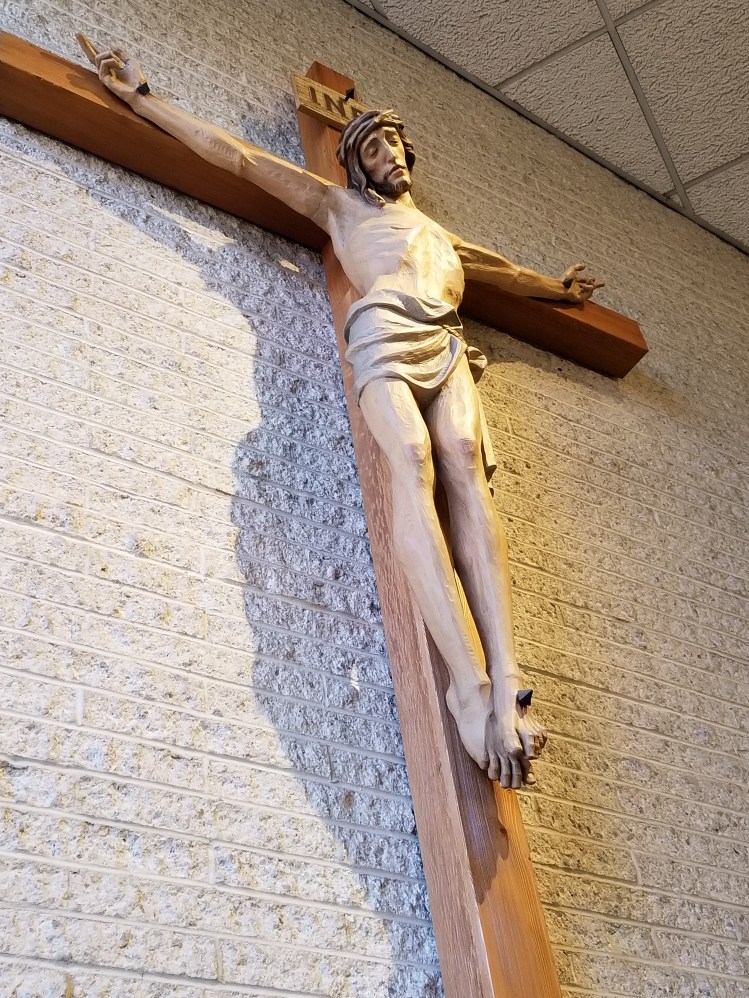
Whether it is a cross or a crucifix — that is a cross with the body of Jesus on it — we embrace Jesus and glorify God when we revere Christ’s sacrifice for us. We lift high in our homes crosses to remind us of what Jesus did for us. We wear a cross around our neck, wrist, or finger to remind us that we all have crosses in the many forms of challenges and trials of life to bear and we carry ours in solidarity with Jesus. In all our pain, sufferings, and sacrifices, we offer them up to God to transform them the way he did with the cross: turning from an object of death to a beacon of life. 

We elevate the cross for all to see, as Jesus on the cross was raised up to be a sacrifice for us all. We give thanks and glorify God for sending His Son to be our Savior. Truly, exalt is the most appropriate word to use since we fulfill both meanings of this one word. While it is officially celebrated on September 14th, let us not leave it to only that day to celebrate and thank God for all He has done for us through such a simple object.