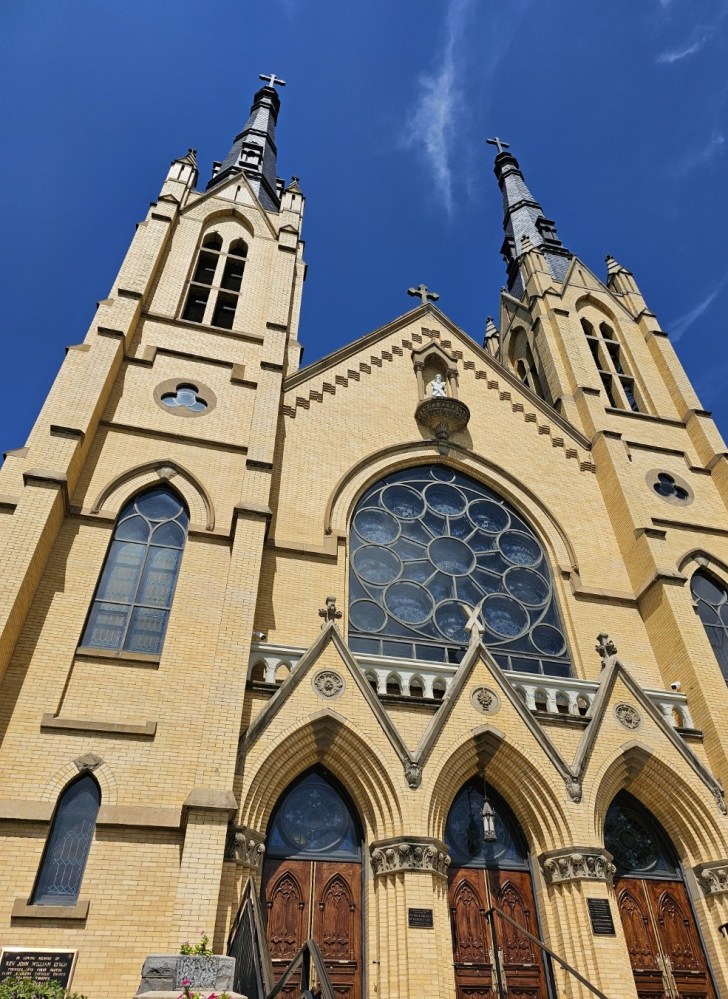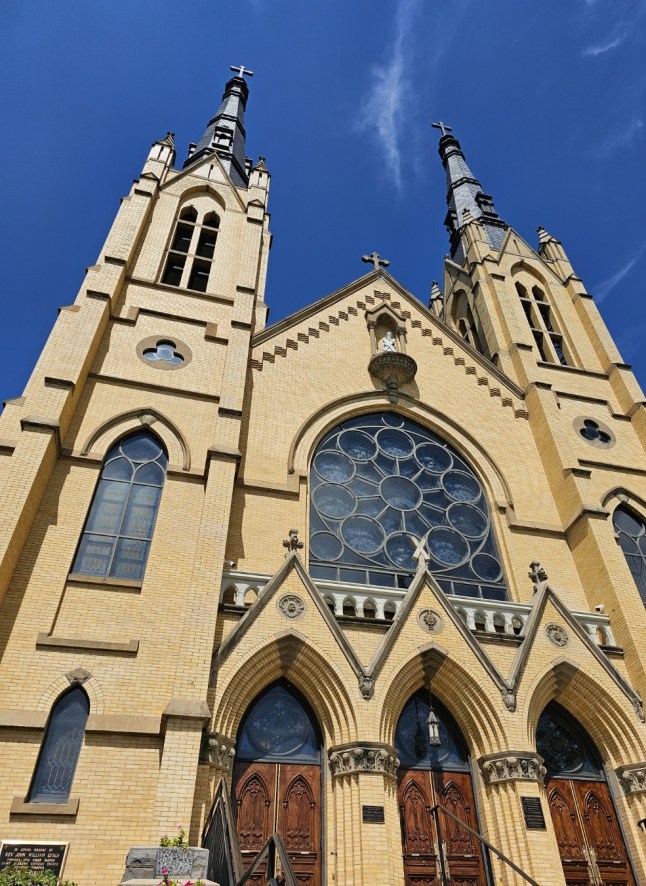
Basilica St. Andrews, Roanoke, VA

Basilicas, cathedrals, and shrines, oh my!

My parish offered a pilgrimage for the Jubilee of Hope to the Basilica of Saint Andrew in Roanoke, Virginia. It was like a mini retreat and we had a wonderful trip there. We received a tour of the basilica and the guide asked if we knew the difference between a basilica and a cathedral and if a church could be both. While I was positive that a church could be both, it got me wondering about the first question.

Growing up in the Archdiocese of Philadelphia, I recall people using one of the following: the basilica, the cathedral, or the cathedral basilica. However, as I was thinking back to my time in Philly, I couldn’t recall the actual name of the church! There was a part of me that wanted to call it St. Peter’s, but I squashed that thought, as that would be the Vatican. I was partially correct. The name is the Cathedral Basilica of Sts. Peter and Paul. But what makes a church either one of these designations, or both?

The easy one to start out with is the cathedral. It gets its name from the Latin cathedra meaning throne or chair. This designation is for the church that serves as the parish for the bishop, archbishop, or cardinal of a diocese or archdiocese. There is a special chair reserved for the use by the bishop on the altar of the cathedral. One may consider it the chief or main church of that diocese. If the diocese is large enough, there may be more than one cathedral serving that diocese, although each would be in a different location. 

It was interesting to learn what makes a church a basilica. First, it is a church of historical and architectural value and the designation can only be granted by the Pope. A basilica is tied to the Holy Father and is his home base to celebrate Mass when he travels to that region. The seal of the basilica will contain the crossed keys to indicate the connection with the Pope. Other signs of a basilica are the ombrellino, an umbrella-like structure made of red and gold fabric that originally was used to shelter the Pope, and the tintinnabulum or little bell, that is used to lead the procession when the Pope is celebrating Mass. The expectation of a basilica is to celebrate liturgical feasts with enhanced solemnity. They also serve as a place of pilgrimage and can bestow an indulgence when the specific criteria is met. 

Basilica St. Andrews, Roanoke, VA

When I was chatting with folks outside of my parish about my trip to the basilica, most initially thought of the one in Washington DC. However, that church is not just a basilica, but also a shrine. The Basilica of the National Shrine of the Immaculate Conception is a place to foster devotion, in this case, to the Blessed Virgin Mary under her title of the Immaculate Conception, since the United States is under her patronage via that title. A shrine is a sacred place and may contain a special relic, be on the site of a historical event, or the site of a spiritual event, like an apparition. When I hear the word shrine, especially as one who was raised in the Philadelphia area, I think of National Shrine of St. John Neumann and National Shrine of Our Lady of Czestochowa. These are places for pilgrims to travel and learn more about the faith, and participate in the Mass or other events hosted by the shrine. 

There are 70 national shrines in the United States, and over 90 basilicas. These sacred locations are a wonderful way to explore the spiritual riches in your own backyard, or to venture out somewhere new and seek God from a different perspective. 

Catholic Girl Journey Logo

Household harmony

Each person is a unique creation by God. And while differences can bring richness to life, it can also be a point of strife.

This past Sunday’s Gospel from Luke (Lk 12:49-53) seems out of character for Jesus. First He mentions setting the earth on fire; isn’t that what hell is supposed to be? Why would He want the world to burn? Then he talks about causing division, not just among nations but even within a family. The Messiah was to bring unity, so that all the tribes of Israel would be one nation. How can the Messiah bring a nation together when individual families are pitted against each other? 

There are several mentions in the Old Testament that describe God as a refiner or the analogy to God purifying His people like a refiner uses fire to burn away impurities. For those of us who are unfamiliar with refining precious metals, the refiner would continue to burn away the impurities until his own reflection could be seen in the metal. It is this understanding that makes the analogy so meaningful; God wants us to be reflections of Himself. God is love and mercy and wants us to mirror His love and mercy to each other. Since Jesus and the Father are One, Jesus wants what God the Father wants. Images of His Sacred Heart are illustrated with the refining flames of His love for us. As He loves us and purifies us with His Passion, Death, and Resurrection, He wants us to reflect that same ardor to our neighbor. His fire, however, is similar to that of the burning bush that Moses encountered, where it was fully engulfed in flames, yet did not cause the destruction of the tree. When we fully embrace the love Jesus has for us and reflect it towards others, we are like that tree in that we are not consumed by the fire, but rather become the best version of ourselves.

Being a reflection of Jesus in a secular world that prizes physical comforts and ease over the basic needs of others is going to cause agitation. Each person has free will, and thus we cannot force anyone, nor does Jesus, to believe and practice Jesus’ example. While we may strive to bring love, mercy, and peace to all we encounter, those on the receiving end may not appreciate our efforts. For example, if we spend time volunteering at the parish, that is time spent away from our family. This can seem like we care more for others than our family members, who may feel hurt and rejected. Instead of rejoicing that we can help others and share our talents with others, family members may respond with negative comments about our work. There are countless stories about saints whose family members tried to prevent them from following God’s calling. Divisions between the various Christian religions is also a source of grief for many. Even today, there are individuals who suffer family ruptures when they convert to Catholicism, which is ironic, since we all believe in Jesus and what He taught. 

Our earthly journey may be plagued by strife within our relationships. Sometimes others will be angry with us, while we hold grudges against another. When we allow the fire of Jesus’ love to penetrate our hardness of heart, we open ourselves and our relationships up for Him to heal. Perhaps it will be while we walk the earth, but for some it may not be repaired until purgatory. One thing that is for certain, heaven will be one household of harmony, since we will all be perfect reflections of God. 

Catholic Girl Journey Logo

Finding God’s presence

In a recent Bible study session, we reviewed Jesus and the Jewish Roots of the Eucharist by Dr. Brad Pitre, and I found more than just the topic, I found a correlation with the Mass.

In part of Dr. Pitre’s presentation, he talks about the Bread of the Presence in the first tabernacle that the Israelites had in the Temple. As he outlined the importance of the Bread of the Presence, he also illustrated that God was present in the Tabernacle in three ways. First was the Ark of the Covenant, which was the Throne of the Invisible God. This is for God, the Father. Second was the Bread of the Presence, which was set on the Golden Table. This Presence is Jesus, the Bread of Life. Finally, there was the Golden Lampstand, or Menorah, that held seven tongues of fire, which is the Holy Spirit. While the scriptures may not call out that this is the Triune God by those exact words, one can find the Trinity in the Bible, if you are looking.

What struck me as we were learning about this Tabernacle is that it looks just like the Mass. When you think about what was in the Ark of the Covenant, it was the Word of God: the Ten Commandments. Then there is the Bread of Presence. We’ve already established that this represents Jesus, so this would be the Eucharist. And just like in ancient times, before any filled tabernacle in today’s Catholic Churches, there is the sanctuary lamp that burns, illustrating the presence of Divinity. Mass is the worship of God, through Jesus and in the unity of the Holy Spirit (Doxology). As all three were present in the old Jewish covenant, so too are all three present in the new covenant established by Jesus at the Last Supper. The Liturgy of the Word and the Liturgy of the Eucharist are the two parts that make up the Mass, and they were in physical form in the Temple in Jerusalem.

While our finite minds cannot expect to comprehend or understand the Infinite Creator God, in all things He left signs of who He is. What sounds like exacting commands, perhaps a bit bizarre in Exodus, Numbers, and Leviticus — which is where the Bread of the Presence and the placement of the holy items in the Tabernacle are defined — are really a glimpse of God made visible to us. God understands that our human nature needs physical items to correlate spiritual realities. Any physical analogy will always have its limitations, but it’s in these analogies that God chooses to reveal parts of Himself to us. As Jesus first spoke the words of consecration over the bread and wine, the simple objects became His Real Presence. It wouldn’t have seemed strange for the Apostles, since they were familiar with the Bread of the Presence. Had it not been for this reference, Jesus’ actions would have been more difficult to understand. When the two disciples who traveled to Emmaus after the resurrection recognized Jesus in the breading of the bread, perhaps some of those scripture references Jesus used in their discourse included the Bread of the Presence. 

As Catholics, we believe in the Real Presence, that is the Body, Blood, Soul, and Divinity is in every consecrated host and drop in the chalice. This is an article of faith, something that science cannot prove, since it transcends the physical world and crosses into the spiritual. Numerous miracles studied by science show the host to be from a human heart, but again, science can only show the physical world, it cannot be used to discern a soul or divinity. It’s up to us to accept that belief in faith. Learning about how God prepared us through the Jewish people and their traditions strengthens our beliefs. Jesus lived and breathed as a Jew, celebrating all the rituals and customs. It is from this tradition that the Catholic Church was born.

Dr. Pitre’s presentation is an excellent resource for those who want to dive deeper into understanding the Eucharist and the richness the Jewish traditions contribute to our faith.

Catholic Girl Journey Logo

Unused doesn’t help

The Catholic Church has seven sacraments that bring the grace of God into our lives and helps us to have a relationship to Him. However, if we don’t utilize the sacraments, they cannot help us in our earthly journey towards heaven.

Out of the seven sacraments, four are typically only received once. Each Catholic can only be baptized and confirmed once. These are part of the initiation into the Catholic family and impart the grace and spirit of God. The other two, marriage and holy orders, are typically received only once, but each may have circumstances that allow for the sacrament to be received again (i.e. after a spouse passes, or as a priest becomes a bishop). That leaves three sacraments that are to be used frequently to help us on our way to eternal life.

Does your refrigerator, freezer and pantry contain food for you to eat? Do you expect the food to give you nutrition and sustain your body while it’s still on its respective shelves? Silly questions, aren’t they? Yet when we neglect to receive the Eucharist, that’s exactly what we are doing with our spiritual life. While some foods can be eaten raw or without any preparation, the Holy Sacrament is made to be received within the context of Mass, as both the Liturgy of the Word and of the Eucharist can prepare us for a worthy reception of the sacrament. Each time we receive the Precious Body of Jesus, we are to 1) welcome Him, 2) be open to the grace He brings, and 3) utilize the intimate moment to convey the deepest sense of our souls to Him. The Mass allows us to orient ourselves to Jesus by hearing the Word of God and giving us the opportunity to reflect on how His Word is speaking in our lives today. In the Liturgy of the Eucharist, we are present with Jesus as the priest offers the bread and wine. It is as if we, too, attended the Last Supper. We are called to remember that moment in time and give our assent to believing we are receiving the Body, Blood, Soul, and Divinity of Jesus under each of the species of the Holy Sacrament. Without regular reception of the Eucharist, we can spiritually starve our soul and our relationship with God.

Just like having food in the house does not give us the nutrition we need, having cleaning supplies does not mean our house is clean. Maybe you have a Roomba and don’t have to worry about vacuuming, but that device won’t dust and it won’t clean your countertops or your sinks. The spiritual version of cleaning supplies is confession. While frequent reception of Holy Communion will refresh your soul from venial sin, going to confession several times a year is great for spiritual deep cleaning. We are all sinners and are all works in progress. As we reflect on our thoughts, words, and actions and how they can be damaging to our relationship with God as well as those we interact with, the sacrament of Reconciliation gives us the opportunity to go deeper and ask God for help in specific areas that we find troublesome. It’s not enough to just tell the priest what you have done (or didn’t do), but you need to 1) be sorrowful for sins, 2) do the penance prescribed by the priest, and 3) intend never to commit the sins again. While the last one is hard, it’s the whole purpose of the sacrament. By being aware of what we are doing, we can catch ourselves before we get into a situation that is conducive to the sin we are trying to prevent. If gossiping is the sin we need to work on, then being mindful of what you say is important. It may take several trips to confession in order to get to the point where we can avoid the sin. We also need to be mindful that we can always slide back into that habit easily and that it may be something we spend our lifetime being sorry for, doing penance for, and trying our best to avoid situations where we slip back into that vice.

Lastly, just like food and cleaning supplies, medicine cannot help us with a fever or a headache if we don’t take it. The sacrament of the Anointing of the Sick is not just for people who are about to die; it’s for anyone with an illness that is seeking the grace of God to help them through it. This could be for a surgery, it could be for an illness that needs treatment — like cancer, or it can be for a long-term disease like depression. There is no limit on the amount of times you can receive the sacrament. As Jesus healed many throughout the Gospels, showing that He is the Savior of the world, this sacrament calls for the healing of the individual, both in spirit and body. While a bodily healing may not reflect the healing we would want, a soul open to Jesus can receive peace and strength for the suffering they are enduring. Catholics are invited to join all their sufferings with the Passion of Christ, especially those for which we seek the sacrament of Anointing. The sacrament may not cure a person from the bodily effects of the illness, but it does give them the spiritual focus to support them through their suffering.

The sacraments are gifts God has given us to use. When we participate in God’s will and seek a closer relationship with Him through the sacraments, we are given a taste of heaven on earth. Let us use these precious gifts with joy and gratitude to God who loves us so much that He bestowed them upon us.

Catholic Girl Journey Logo

Don’t tell God

Prayer is conversing with God. How many times, however, do we make a request of God, not a petition, but more of a command when we pray? Telling God what He must do is not prayer but arrogance. It illustrates the grasp for control that humans wrestle with since the serpent told Eve and Adam that they would be like gods if they only ate the forbidden fruit.

In last Sunday’s Gospel, Jesus encourages us to pray to God and to ask, seek, and knock for what we need. He tells us to be persistent, not to give up, but to continually petition God. (Lk 11:1-13) God the Father is the giver of all good gifts and we will be blessed in everything God gives to us. Yet in next Sunday’s Gospel, it appears to be almost the opposite. While the main theme is about greed, the passage starts with, “Someone in the crowd said to him, “Teacher, tell my brother to share the inheritance with me.” (Lk 12:13) That reminds me of when Martha instructed Jesus to tell her sister Mary to help her. Telling, requesting, or instructing God as to how something should be done will not achieve the results you want. 

While prayer is a conversation with God and we should feel comfortable to describe how we are feeling and what we need, it’s also an opportunity for us to be open to what God wants from us. Asking, seeking, and knocking are all attitudes of being humble and understanding that we can’t do everything ourselves. We must also listen, accept, and be open to answers and the real need for God’s assistance. If we are telling God what to do, then we are in a moment of anger and frustration, and we are venting, not having a conversation. While those are valid feelings to bring to God, He doesn’t want us to stay there, but wants to help us work through the feelings. Using the example of the brother wanting his sibling to share the inheritance, perhaps the initial prayer is for helping his sibling to see his need. Maybe the reason for the sibling’s stubbornness is due to an argument between the brothers and the prayer should be about making peace between them. And maybe it’s the requestor himself who is the one holding the grudge and needs God’s help to forgive his sibling.

When we petition God for help, we’re asking Him to mold us into the best version of ourselves. We are called to be holy and become saints who will live in God’s presence for all eternity. Sainthood is not just for those called to religious life, but rather every individual God creates, especially those who are baptized members of the Church. But God will not make us a saint because we tell Him to do so. Rather, we become saints because we seek God first, ask for God’s assistance, and continually knock on the doors of opportunity God provides to us. We pray “thy will be done on earth as it is in heaven.” Not our will to be in heaven, but God’s will that we reflect His image and likeness so that we can enter into heaven after the completion of our time on earth.

God wants to give us so many blessings. But if we do not have the maturity to recognize, appreciate, and share the gifts He gives us because we are focused on ourselves, then giving us more will not be in our best interest. Telling God what He needs to do only underscores that we are unprepared to receive all the blessings He wants to give us. We need to be persistent in seeking His help to become more like Him and to become as holy and blessed as He desires us to be.  

Catholic Girl Journey Logo

The struggle to change

Change happens every minute of every day. Sometimes it can be impactful, sometimes it can leave a mark, and sometimes we don’t even realize it. Change can happen to us in our circumstances, or it can be something we initiate. Any change, however, requires us to make choices of how we will adapt. With intentions of changing ourselves, we may have grand aspirations of what we can accomplish, but do we remember that we need to put in the hard work to achieve those expectations? Or is our initial reaction to the struggle a signal to change our minds or give up? Maybe we blame others when our expectations fall short. While the results of our choices may have been reasonable, the road to them may be very long and with lots of detours, so how can we give up when we’ve only gotten started?

The old adage, “you made your bed, now you need to lie in it” is all about accepting consequences for our actions. But when the results don’t measure up to what we expected, it is an uncomfortable experience. Life is not a simple mathematical calculation where you plug in two numbers and achieve a sum that can only be only one answer. When we respond to change, our choices can initiate the need for more change. It’s not the result we expect, but we need to be willing to be open to the opportunities when they present themselves. 

While I know I’ve made changes in the past that I’ve stuck with, there are probably more that fell to the wayside. Sometimes change is more than just altering a routine, it’s about adjusting our perspective and our response. A familiar routine is a comfort in times of change, but so is the attitude we use to approach our life. When we always think of things one way, it can be hard to get out of that mindset to think of other possibilities, even when we want to change ourselves! We can get caught in a stagnant loop in our mindset. Yet it is in these moments when, instead of digging deeper into ourselves, we need to seek God’s assistance. Perhaps we do need to make other changes that we may not recognize. Maybe the struggle is the opportunity to truly learn about ourselves. Our expectations are really our will. In praying to God, we need to trust in His guidance and accept the unexpected. We may eventually realize that what He desires for us is so much better than our initial expectations. 

Daily I pray, “Oh sweet Jesus, I surrender myself to you, take care of everything.” Yet as much as I trust in Christ to see me through, times of struggle are just that: a struggle. I don’t expect life to be all sunshine and roses, as we need some rain to make the sun seem that much brighter and to water the plants to make them bloom. In Paul’s second letter to the Corinthians he says, “Therefore, I am content with weaknesses, insults, hardships, persecutions, and constraints, for the sake of Christ; for when I am weak, then I am strong.” (2 Cor 12:10)

God gives us a lifetime to grow closer to Him. In our fallen world, that means that we need to change and become more like Him. The goal for our life is to build a solid relationship with God so that we can spend eternity with Him. We hope all the struggles, choices, and changes in this life will produce the fruit of heaven-ready souls. 

Catholic Girl Journey Logo

Food for the journey

While the weekday masses are now firmly back in Ordinary Time, the Sundays after Pentecost continue to highlight major components of the faith. Last week was the Most Holy Trinity and this weekend the focus is on Corpus Christi, or the Most Holy Body and Blood of Christ.

One way a parish can celebrate Corpus Christi is by processing with the consecrated Host in a monstrance. For some it may be a quaint way of keeping old traditions alive. However, there’s more than just tradition in this ancient practice. Look at the pieces of what goes into a procession: the Holy Presence of Jesus in the Host, the congregation walking behind, and songs of praise, thanksgiving, and adoration. This is like a miniature version of life. This is what we’re supposed to do on a daily basis: walk with God, allowing Him to lead us, and sing His praise in all that we do. In practicing on a small scale on this solemnity, we are exercising our faith muscles so that we can use them in our daily lives. 

The Eucharist is food for our life journey. While the Church asks us to attend Mass weekly, if we were able to attend daily, we could receive Holy Communion each time. However, regardless of how often we receive, we need to be on guard about it not becoming a habit. A habit, as described in Merriam-Webster is, “an acquired mode of behavior that has become nearly or completely involuntary.” Basically, when the Eucharist is received out of habit, then its effect on us is diminished. It’s similar to when Jesus visited His hometown, and because the people thought they knew Him and who He was, He was not able to perform many miracles amongst them. 

Attitude is the key for preventing such a precious gift from becoming a mere trinket. At each Mass, we prepare ourselves to receive Jesus in the Sacrament by being attentive and participating in the liturgical responses. We take the time of silence before receiving to open our hearts, to have an attitude of welcome for Jesus. Just before the Our Father is one of the most important prayers the priest says: the Eurcharistic Doxology: “Through him, with him, and in him, in the unity of the Holy Spirit, all glory and honor is yours, Almighty Father, forever and ever.” In this prayer, we lift up the Mass, with all our intentions through Jesus, uniting them with the Holy Spirit in an offering to God the Father. When we receive Jesus, the opposite happens: we allow Jesus to work through us, with us, and in us, and in unity with the Holy Spirit. We don’t receive the Sacrament to stay the same person we are in our sin, but rather to be transformed out of our sinfulness into the best version of ourselves. We strive to become the Body of Christ on earth by allowing Christ to use our hands and feet to do His will. The Sacrament not only feeds us spiritually, but stirs up the Holy Spirit we received in Baptism and Confirmation to continue the guidance long after our bodies have absorbed the Host. 

Corpus Christi is the Latin phrase for the Body of Christ. As we celebrate this food for our journey, let us welcome the solemnity and the sacrament it celebrates, so that we can be blessed with all the graces God can bestow to our open hearts. 

Resolutions and new beginnings

This year the Catholic Church is celebrating the Jubilee Year of Pilgrims of Hope. The theme conveys that we are on a journey in which we should keep a positive attitude, i.e. hope. But what really is hope?

I was watching a YouTube video recently where the commentator’s remark drew a distinction between hope and expectation. It’s caught in my subconscious, as it randomly pops into my thoughts. The word hope gets used quite frequently in a very casual manner. People hope for all green lights when traveling. After several days of rain, one hopes the sun will come out soon. But is this the type of hope we as Christians are supposed to have? Or, is hope like love, where there are several layers of meaning, depending on the context?

According to Merriam-Webster, the definitions of the word hope as a verb are: 1) to cherish a desire with anticipation, 2) to desire with expectation of obtainment or fulfillment, and 3) to expect with confidence: trust. As I read these three definitions, I nodded in agreement to each of them, however, it seems to me that hope is really all three of these together at once, rather than optional uses of the word. These definitions use the word expect in them, so how can hope and expectation be different? I think the last definition is the one that rings true for Christians, when we trust in God, we let His will be done, even when the outcome is totally not what we would plan for ourselves. Expectation seems to convey a sense that we know what the outcome will be, where hope is only anticipating a positive resolution.

I was surprised that the definition for hope did not convey a joyful aspect. We don’t hope for something bad to happen, but something that is good. Perhaps it is signaled in the first definition of “cherishing a desire.” But hope goes beyond merely wishing for something specific, it is an attitude of positivity in anticipation. There’s a sense of mystery to hope, and an awaiting of surprise. The expectation of hope is to be delighted in what comes about. Hope can be either a resolution, or a new beginning, or both! 

Being Pilgrims of Hope, our destination is heaven, which is also  the beginning of eternal life with God. We have some indication of what heaven could be like, but we won’t really know until we get there. In the letter to the Romans, St. Paul says, “Now hope that sees for itself is not hope. For who hopes for what one sees?” (Rom 8:24) If we look at the world around us, we can see many beautiful and wonderful things created by God. However, our world is a fallen world, and we can also see the corruption brought about by sin. Expecting heaven to be like our current world without corruption is as far as our limited human minds can comprehend. Yet hope also conveys that there is more than just our expectations. We will be fulfilled in our immersion in the glory of God in heaven. 

As we journey through this jubilee year, reflecting on what the word hope means to each of us is key to the celebration. According to the Catechism of the Catholic Church, “the virtue of hope responds to the aspiration to happiness which God has placed in the heart of every man…it opens up his heart in expectation of eternal beatitude.” (CCC 1818) May we leave our limited expectations of God and heaven behind and joyfully look forward to being with God, in the sacramental encounters in our life on earth, and in full communion with Him  in the life to come.

Shifting focus

Why do you go to Mass? While that seems like a simple question, how you answer it may reveal much about your relationship with God. 

Attending Mass on Sundays and holy days of obligation is one of the precepts of the Catholic Church. We are not “encouraged” to attend, but rather “expected” to do so. There may be some times when it does feel every bit of an obligation. However, if our sole reasoning each time is to check the box that says we’ve done our duty, it may be time to reevaluate our priorities. On a to-do list, attending Mass should not be just one other thing we do besides taking out the trash, cleaning the bathroom, and grocery shopping. While all these activities are important and need to be done, Mass is not just a thing to accomplish but a retreat from all the tedious tasks we have to cross off our list.

In the Mass, we praise and worship God. This can seem easy to do when there is robust music with familiar hymns so that everyone can sing along. We feel the energy of the music, we have a smile on our face, and it makes us feel good. If that is what is attracting us to attend Mass, that may be a sound reason initially, but it will not sustain our faith in the long run. When we attend Mass because it makes us feel good, we become the focus and reason for our attendance, not God. When there are times that Mass makes us feel good and satisfied when we leave, we can rejoice in that feeling, but we should never go expecting that feeling. 

Through the Mass we encounter Jesus in His fullness: Body, Blood, Soul, and Divinity. As the Mass is composed of two parts, the Liturgy of the Word and the Liturgy of the Eucharist, we receive Jesus in both His Word, through the Gospel, and in substance, Holy Communion. With each Mass we are given the opportunity to listen to Jesus speak to us as well as speak to Him when we pray after consuming the consecrated host. We can thank Him for all the blessings we’ve received, invoke His assistance for all the challenges before us, and ask forgiveness for all the times we’ve fallen into sin. Receiving the Precious Body and Blood of Jesus in the Holy Sacrament is the closest to heaven we have on earth. We physically are interacting with Jesus as He feeds us with Himself. 

When the reason we attend Mass becomes a visit with a friend, the focus is not on us and what we need to do or how it makes us feel, but rather on God. When we open our hearts to let Him speak through the priest and deacon, we allow God into ourselves and our lives. Reflecting on our visit may prompt us to make adjustments to our life and our interactions with others, sometimes tiny changes while others may seem to turn our world upside down. The result is making us the best version of ourselves that we can be, so that we can share the blessings we’ve received with others, bringing the love of God to them.

Mass is not about what we get out of it, but what we give instead. We give our time, our attention, and open our hearts to God. We share our blessings with others when we volunteer and donate to the collection. We reflect back to God how much we acknowledge and appreciate all He has given us by our attitude towards the Mass. Perhaps the next time we attend Mass, we can ask God how we need to shift our focus for Mass from ourselves and our needs, to Him and for the grace to do it. 

Tangles and knots

May is the month dedicated to Mary and recently I’ve been pondering one of her titles, Undoer of Knots. 

I was working on warping my loom, using a fine cotton yarn that I realized had been a bit too overspun. This resulted in the yarn wanting to twist unless it was under tension. Since a loom works by using the yarn under tension, it sounds like it would be a good use for it. However, one needs to actually get it on the loom in order to put it under tension. When one is dealing with 400 measured out strands of yarn, each about 3 yards long, it doesn’t take long for tangles to begin. As I warped the loom, I worked in small sections at a time, maybe about 20 or so ends. I could hardly believe my eyes. I would straighten the section and immediately upon releasing it, it would twist and kink up along the visible length I was working on. I was being given a challenge. Would I accept it? Or would I cut it all off and choose a different project?

I must confess there was more than one occasion that I wondered if it was worth it. This project is a practice item, I don’t have to do it. Why was I putting myself through such hassle? “It’s an opportunity to practice patience,” I told myself. But the other part of my brain would question me, “isn’t this supposed to be fun, why do you want to practice patience with this?” Another explanation I thought of was it being an opportunity to practice this particular weaving challenge, so that I know I can handle it when it comes to a project I specifically want to do, especially if it’s for a gift. Still my brain was challenging me and I was getting frustrated. Then I remembered one of Mary’s titles is Undoer of Knots. As my hands worked through the loops and tangles, I pondered on what this means for Mary, and how my current predicament could shed light on it.

The excess twist in the yarn was causing it to loop over other strands that were making their own loops. I didn’t necessarily have a knot, unless in my frustration I yanked too hard and the loop closed over the other strands. Given the fineness of the yarn, it became a really tight knot. I had to look carefully at the knot to find the outermost loop and gently tease it away from the other strands. 

When we pray to Mary to undo the knots in our lives, be it for help with our habitual sins, issues in our families or workplaces, or even our general world, we need to have patience as Mary is working. It takes time to undo a knot. It takes finesse to find which thread to pull and gently work with it. 

Undoing knots also requires great attention to detail, not just of the knot itself, but of the other threads around it. By working with one thread, another knot could be created elsewhere if one is not paying attention. When we pray for Mary’s intercession under this title, we are asking her to look at whatever situational knot we are experiencing, and to work at it from whichever angle will prevent another knot from surfacing. It can seem like our prayers are not being answered; however, if we allow Mary to intercede with Jesus for the best possible outcome, we can be assured that the knot will be undone.

When we invoke Mary’s assistance, we also need to remember that when we seek assistance, we need to be open to the Spirit’s prompting, but avoid overthinking and try to resolve the issue ourselves. When we seek to fix our problems, we can create more tangles and knots in our life-yarn that is straight and smooth. It’s very tempting to make a plan to address an issue and our take-charge culture feeds that impulse. However, when we realize the difficulty is too big for us to address on our own, we need to leave it firmly in the hands of our spiritual guardians. Like at the wedding feast in Cana, Mary’s response may be for us to follow whatever Jesus tells us to do. And like at the feast, filling up the ceremonial jars used for washing when wine was needed sounded crazy to the staff, we may be prompted to take action in a way that seems to have no connection with our problem. But Mary and Jesus are outside of time and space; they can see the impact of it all. When we pray, we need to trust in their intervention and be open to their guidance. 

While it seemed to take forever to warp the loom, I did succeed. I absolutely had moments of frustration, but I also had moments of mirth as I thought of Mary as the Undoer of Knots. I know that my knots were nothing that needed her intercession, but it was nice to feel a kinship with her doing the same action.