Catholic Girl Journey

Not done yet

He was being hunted at the Queen’s command. He just completed his biggest success and now after being chased ragged, he pleads for death and settles down to die. No, it’s not the plot to a recent novel. It’s the story of Elijah that we heard on Sunday. (1 Kings 19:4-8) But God was not done with him yet…

Elijah should have been feeling like he was on top of the world. He had just called down the power of God and defeated the prophets of Baal. However, Jezebel was greatly displeased at the turn of events and sent her army after him. While most of us will not be physically fleeing from an army, there are times in life when mentally, emotionally, and perhaps spiritually we feel like there is an army at our heels. We are without peace and it seems like no matter what we do, it’s never enough or there is no resolution in sight. We pray to God to make it stop. That is what we want but what is it that He wants for us?

God did answer Elijah’s prayer, just not in the way it was requested. Instead of taking his life, rather He gives Elijah what he needs to survive, not just for the day, but for the journey he makes to mount Horeb. It is there on the mountain that Elijah encounters God, not in the fire or storm or wind, but in the tiny, whispering sound. The way God answered Elijah’s prayer for death is by rousing him not once, but twice by an angel encouraging him to eat for his journey. How many times when we feel that we are at the end of what we can handle, do we push away the hand sent to help us? Did Elijah know it was an angel? Perhaps. Maybe he was only able to tell after all the events took place and he reflected upon what had happened.

God knows when we are at our wit’s end, and still we cry out to Him. It can be challenging to keep ourselves open to God’s will for us. The circumstances may not completely change, Jezebel was still queen when Elijah finally came back, but God will not abandon us. He will give us the food for the journey and the helping hand we need. Our angels may be disguised as members of our family, friends, neighbors or even strangers, for they are like angels because God has placed them in our lives to provide us aid. We may not see the hand of God helping us through our trials or hear His whispering voice of encouragement, but He remains with us, since He’s not done with us yet.

Catholic Girl Journey

The patience of God

God’s patience is on display throughout the whole of the Bible; however, this past Sunday’s continuation of the Bread of Life discourse really underscored just how much He is willing to suffer our hard-headedness as well as our hard-heartedness.

The gospel picks up when the crowd finds Jesus after being fed with the loaves and fishes. They are astonished that He would flee from their intention of making Him king (at least an earthly one). But Jesus cuts off their question by telling them they are seeking Him wrongly, not “…because you have seen signs but because you have eaten your fill of the loaves…”(John 6:26) Their response of “What must we do to perform the works of God?” (John 6:28) makes it appear that they are paying attention to what Jesus is saying. Jesus gives the definition that has become the standard for all Christianity: to have faith in the One whom the Father has sent.

In the most ironic turn of events possible, the Jews ask Him, “What sign can you do that we may see and believe in you? What can you do? Our ancestors ate manna in the desert…”  (John 6:30-31). Jesus’ initial proclamation to them, is ringing true: they have not seen the signs. Hello, didn’t they just eat the bread that was multiplied to the point there were leftovers? How could they ask for a sign like eating of bread when they experienced it first hand? If the seriousness of salvation wasn’t at the heart of this, it would almost be comical. And then Jesus’ loving, and may I say merciful, patience instructs them that it wasn’t Moses who provided the bread, but the Father. God the Father sees to all our needs, not our wants, but what we truly need. First and foremost is a relationship with Him. Despite the grumblings of the Israelites in the desert, God teaches them He can be relied on to sustain them. Jesus uses a very similar miracle to lay the foundation for what will be instituted on Holy Thursday: the Eucharist.

I must admit that in the 40+ years of hearing this story, it was only this year that I caught on to the depth of blindness displayed by the Jews. It now feels like I have a spotlight on my life to see where I am being blind and dumb to how the Spirit is trying to lead me. We have countless saints, both in example and insights to Jesus and yet we still ask God to give us signs. As this incident illustrates, God does not cast us off and leave us to our ignorance, but oh so patiently answers us, teaching again and again His ways. Let us pray for open hearts and minds to accept the answers He provides instead of insisting on our own.  

Catholic Girl Journey

Transformed

Which word would you use if you wanted to convey permanence: change or transform?

According to the Merriam-Webster dictionary, while the word transform is defined using the word change, change has three synonyms to convey subtle differences in meaning: alter, transform and switch. Defining change using the word transform includes a more precise nuance: to make radically different. And for “transform” itself, the definition is to change completely. This past Sunday’s gospel was the beginning of the Bread of Life discourse in John’s gospel.  It sets the stage for the next four weeks as Jesus teaches this difficult concept. We know it today as the Eucharist, but reaction of the people to Jesus’ proclamation was anything but welcoming.

How can He give us His flesh to eat? It’s not about puzzling the technicality of it, but rather thinking how utterly revolting the thought of eating the flesh of another human being would be. It was hard for those who had just feasted on the bread and fish that Jesus multiplied to hear they would need to eat His flesh one day. Many remained faithful in spite of this, learning only later how this could be accomplished.  It has never been an easy concept. Even after 2,000 years people can still find it hard to believe the little, white wisp of bread is Jesus: body, blood, soul, and divinity. It is not the priest himself who changes the bread into the Body of Jesus. Rather it is the priest using his ordained faculties, in the person of Christ, calling down from Heaven for the hosts to be transformed, to be changed completely, to be radically different than flour, water, and the juice of grapes.

As Catholics we believe that once the bread and wine are consecrated, they become and remain the Body and Blood of Jesus. From an outward appearance, they still look like bread and wine, but they have been permanently changed. Some Protestant denominations believe in this change, but they think of it as only temporary, lasting for just as long as the worship service. As I was reading a reflection about Sunday’s gospel, one of Jesus’ directives caught my attention, “Gather the fragments left over, so that nothing will be wasted.” (John 6:12) I don’t think this was Jesus just being frugal. The leftovers in this case were not transformed into Jesus’ Body and Blood, but they were the result of a miracle, and a miracle should not be tossed away in the trash or given to the animals to eat. Likewise when at Mass more hosts are consecrated than are needed, they are gathered up and stored in the tabernacle.

If we truly believe in Jesus’ permanent presence in the Eucharist, can we expect to stay the same person we are today after we receive Him? While our transformation may happen slowly over time, we can’t expect to believe, receive and stay the same. Jesus will never force us to change, but just a little opening in our heart to welcome Him in the reception of host and chalice is an opportunity for grace. Little by little, we too will not just be changed, but will be transformed, will be radically different, doing God’s will rather than our own will.  

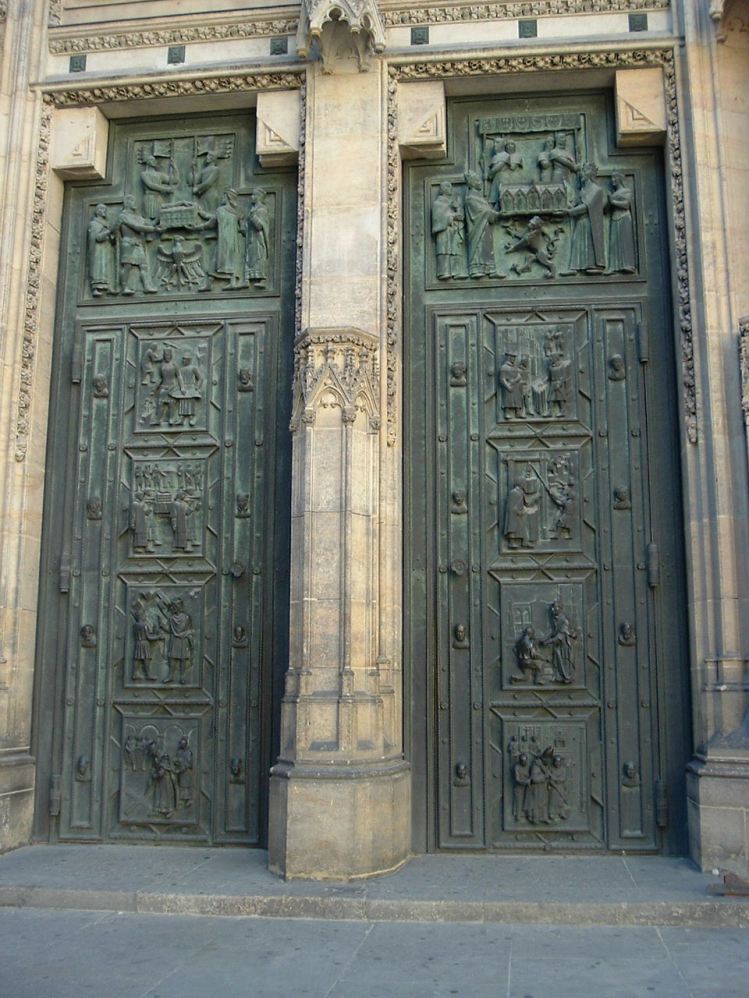
Doors of choice

The faith journey is one of many choices. Robert Frost in The Road Not Taken, describes “Two roads diverged,” but I prefer to think of them as doors. Regardless of how we describe them, they are a unique moments in time that can never be recaptured.

All through our lives we make choices: hundreds, thousands, millions maybe, every minute of each day. I find a door much more descriptive in describing choices than a road because sometimes you can’t see what lies on the other side of your choice. Some doors are enticing and you look forward to entering. Others are scary and forbidding making us want to avoid them.  Doors can also be made of all types of materials. Many may think of the standard wooden door, but doors can be of glass, metal, fabric, screen, tile, books, candy, or anything else one can imagine. Doors also open in a variety of ways: by being pulled towards you, by being pushed forward, lifted up or slid to one side.

Sometimes we are faced with a choice of doors that cause us to stop and make a decision in order to continue our journey, others may be discreetly on the side that we may never see, unless we are looking.  Some may be ornate and capture our attention. Some of these doors may feel like they are stuck shut or maybe they are without instructions how to open them, making us think they are not choices available to us.

Sometimes there are so many options, they encircle us and we feel trapped, even though we are surrounded by doors. Like the choice of buying a new home, there are many options, but even once we decide on the one, there will be many more choices that follow, giving the perception that we haven’t progressed at all.  It’s often that way with our faith journey where we know we are only going deeper and deeper into a mystery that may not be solved in this lifetime. Other doors, seem like old, familiar friends, for example the doors to our parish church.  The simple act of choosing to walk through the church doors each week for Sunday Mass is a singular choice. If we choose not to enter, it’s not a choice we can unmake. We may resolve to go to Mass the following Sunday, but our faith journey has been altered, and the choices of doors that will be available as we proceed will be different.

Once we walk through one of these choice-doors , there really isn’t any way to go back. The door that we have just come through is no longer the same door, since our decision changed the circumstances. Even if we were to turn around and go “back” through the door, what lies on the other side does not look exactly the same as when we left it. It may  be similar, but it is not the same. And the further we proceed, if we try to backtrack, the more different things will seem.

Our choices change us. Whenever we feel that we are not making progress, we need to remember that we have walked through too many doors to go back. Let us ask our guardian angels to help us choose the doors that will lead us to the ultimate door: heaven.

Catholic Girl Journey

Define help

How would you describe what it means to help? Is it someone rolling up their sleeves and pitching in to complete a task? Is it someone riding in and saving the day? Or is it opening your perspective to another’s?

While all three could define the word help, when we seek God’s help it may be the second one that we prefer, but it is the third one that actually occurs. It’s not unusual to pray to God for a specific outcome, even Jesus did that in His agony, so we are in good company. However, He did ask for the Father’s will to be done, whatever that might be. Too often it seems like we place our order for an outcome and then are disappointed when it does not happen as we desired. We may even conclude our prayers were not heard or answered. But perhaps the truth is that we were the ones that were not listening.

Asking for help can be scary. First we need to admit that we cannot do something. Then we need to listen to the one who is in a position to help us. Can you imagine seeking the aid of a piano teacher to learn how to play the instrument and then ignoring everything he or she instructs you to do?  Sometimes the remedy for our situation is not to our liking. As in the case of learning the piano, playing scales is not something most enjoy. It can be tedious and boring, but it is building a foundation and creating finger memories of the keys. And from learning the piano to asking for divine help, the resolution may not be instantaneous, it may come only after much time and the hard work of practice.

If we look to God for help, we need to be open, ready to accept anything. It means being humble and trusting in Him. When the occasional news story features a young child that saved a parent or family member by calling 911, it seems to surprise us, but why should it? The child’s actions are exactly the way we are to relate to God. A young child knows they cannot fix the situation, so they turn to whomever they think can, and sometimes that means calling 911. When we are in a situation we know we cannot change through human efforts, we need to turn to God the Father. It’s one thing to make the call, so to speak, but it is the next step that is truly important: trust. A young child trusts that whatever the 911 operator tells them will be the right thing to do. They do not second guess, they just do it to the best of their ability. We may call to God when we need His aid, but do we trust Him and follow what He tells us to do?

A humble and trusting heart does not seek its own will, but rather that of its Creator. May God convert our selfish stone hearts to open ones that not only seek His help, but follow where he leads.

Catholic Girl Journey

Finding praise in trials

The letters of Saint Paul give us timeless pearls of wisdom. This past Sunday’s reading from his second letter to the Corinthians (12:7-10) illustrates that he, too, was subject to trials and temptations. Yet even in weakness, he chooses to boast of his weakness to praise God.

I know Jesus is with me always, even when it seems like He is not close. Yet there is something about trials and temptations that make one feel completely alone. When you’re in the midst of that moment, it’s hard to feel like praising God. Rather you feel like you want to wave your arms over your head and shout up at the sky, “Hello, I’m down here! Remember me?! Can you help me out?” But what if we did praise God in that moment? What would it look like?

Would we thank God for the opportunity to be tried or tempted? Would we thank Him for not answering our prayers the way we want? Would we rejoice that we are found worthy of the difficulty? In our modern era, suffering and tribulation are seen as experiences to be avoided; rejoicing when in such circumstances sounds absurd. Yet if we ponder on the words of Jesus to Paul, “My grace is sufficient for you, for power is made perfect in weakness (2 Cor 12:9),” what other reaction could we possibly have? To act miserably would be to refuse the grace God is giving us.

Perhaps my favorite of all Paul’s writings is in Philippians, “Rejoice in the Lord always! I say it again. Rejoice!” (Phil 4:4) He does not ask us to just be happy, but to Rejoice!, and he repeats it for emphasis. He then goes on to say, “Present your needs to God in every form of prayer and in petitions full of gratitude.” (Phil 4:6) To me, that sounds a lot like being thankful in our times of tribulations.

So the next time we want to look towards heaven to say, “Really? Did You need to give me this?,” we need to check ourselves and say, “Thank you Jesus! You’ve given this to me and I know you will see me through it!” It may be a little challenging at first, and initially the enthusiasm may be a bit lacking, but if we persevere, we may be surprised at the outcome.

Catholic Girl Journey

Hypocrite

To some degree, we are all hypocrites. We profess our faith and morals, but we struggle to live up to them. Yet we are judged, condemned, and dismissed.

According to Merriam-Webster, one of the definitions of hypocrisy is “The false assumption of an appearance of virtue or religion.” It derives from a Greek word meaning playing a part on the stage, pretending to be something one is not. If we follow Jesus and His example, we need to love all people. To love another is not necessarily a warm, fuzzy feeling, but rather a choice to ‘will the good of the other’ as Bishop Robert Barron often explains. We can say we do; we can have the intention of doing it; but when it comes down to the choices we make, do we always do it? Do we do it when we drive our cars? Do we do it when another annoys us? Or do we complain about others being in the way or gossiping about a negative encounter? If we don’t practice what we believe, doesn’t that make us hypocrites?

While we can realize what we have done, be remorseful and confess our shortcomings to Jesus, the hypocritical actions may have consequences we do not even realize. I’ve heard it said a number of times by those who do not profess any religion, that the reason is because of hypocrites. I’m not sure if they choose not to participate in a religion because they don’t want to associate with people they deem hypocrites or that they don’t want to be judged as one. Yet it’s very easy to look around our own parish family and pass judgement on those from whom we expect more charity. If a person is going through a difficult circumstance, we may be praying for them and choose to give them their space to work through it, or choose not to say anything so they will not be embarrassed. However the lack of action can be seen, and judged, as being lazy, cold or uncaring. Jesus warns us about passing judgement on others, lest we be judged.

Jesus, our just judge, often called the Pharisees hypocrites. He reprimanded their behavior, speaking plainly about it, so that we can learn from their mistakes. The first step, is not to judge another as a hypocrite, or even more, not to judge another’s actions at all, leaving that to Jesus.  

Catholic Girl Journey

Removing the stumbling blocks

In a recent Gospel, Jesus comments about judging others and advises, “…first take the log out of your own eye, and then you will see clearly to take the speck out of your brother’s eye.” (Matthew 7:5) The whole faith journey is about improving and aligning, not just ourselves but all we come in contact with, to God’s will. It does need to start with each one of us, and the eye is not the only place where we will find stumbling blocks.

Passion is what drives many people. Others may refer to it as what we love: our families and friends, our neighborhoods, our careers, and the list continues. To describe it, we would say that it comes from the heart. So, what’s all in your heart? Do you share it with Jesus? All of it? It’s very easy to say that we do and very hard when it comes to the practice of it. When illness, strife, work and activities vie for our time, we say they lay heavy on our hearts. But imagine being small enough to be next to your heart and take inventory of it as you would a closet. How big and bulky are the items that are weighing you down? Can you even get in the closet of your heart? Now imagine wrangling items out of your heart and giving them to Jesus. What do you think He would do with them?

I picture Jesus taking the items from me and placing them in His heart. It’s a powerful image to consider. The things that I care about, so does He! But He will also put things into perspective as well. Just because they are important to me does not mean that I need to drag them around and worry about them. We carry around these stumbling blocks, not realizing that they are taking up precious space that should really belong to Jesus. Just like our physical hearts can get clogged up with cholesterol, our spiritual hearts can do the same with all the things we hold in there. And just like our physical heart, even if it gets cleaned out, we have to be cautious and watchful that it doesn’t get clogged up again.

Our Blessed Mother Mary, who was known to keep the actions and sayings of Jesus in her heart (Luke 2:51), can be a guide for us. She pondered the will of God and joyfully did it. Her thoughts and actions stemmed from a pure love of God; the passion that drove her to say ‘Yes’ to the annunciation as well as following Jesus to the hill of Calvary. Let us ask her to help us to unite our hearts with hers and Jesus’ and to help clear our hearts from the stumbling blocks that have built up in them.

Catholic Girl Journey

Daily success

The commencement speech by Admiral McRaven, providing reasons why a person should make his bed in the morning, prompted me to think about my routines and what equates to a successful day. I devised a list of five key activities to make each day successful. Three items are completed prior to other activities and two before bed.

As the Admiral indicated, the first thing to do after getting up out of bed in the morning is to make it. It does give a person a sense of accomplishment; plus, on days that are trying, a made bed is not nearly as inviting to go back to as a unmade bed. The second thing to do is pray. While it may seem a no-brainer on a Catholic faith blog, it is something that needs to be planned for and accommodated. I usually read the Magnificat morning prayers, the Mass readings and the reflection and then follow up with a rosary. All that can take anywhere from 30 minutes to an hour, depending on how focused (or awake) I am. Morning prayers are essential, as they provide a prospective to God acting both in your life and in the world.

Lastly for the morning routine is to take care of the dishes. It only takes a few moments to place the items in the dishwasher and I find it so encouraging to come home to a clean kitchen. I discovered, however, the days when I run the dishwasher at night as I’m heading off to bed, I usually end up leaving the breakfast dishes in the sink next morning. Unfortunately, those work days seem to be more stressful and I end up leaving the dinner dishes keeping the breakfast ones company in favor of having some “me” time. Realizing the chain of events that kept happening, I saw how important it is to not just take the time, but to make the time to unload/reload the dishwasher. There seems to be more “me” benefit to having an orderly kitchen then the few extra minutes I’d have doing something else.

After learning my lesson with dishes, the first action item to finish out the day on successful note is to clean up the dinner dishes! Even if the day was a complete failure, you have a made bed and a clean kitchen from the morning; why allow failure to continue? After cleaning up dinner, the next activity is evening prayer. The Magnificat evening prayer only takes about 5 minutes to read, although meditation can take longer. Taking the time to connect again with God about the high (blessing) and the low (suffering) points completes the perspective of God acting in your life. Thanking Him for the blessings and the ability to suffer through our trials can put both in perspective. Life’s not meant to be all of blessings or trials, but reflecting on our daily lives can provide a sense of peace and purpose to each.

Pulling back the bedcovers at the end of the day, if the only thing we accomplished are those five actions, we can call that day successful. We started the day with accomplishments and renewed our relationship with God. We completed the day by not letting the day’s failure to continue and brought our focus back to one who is the center of our lives.

Catholic Girl Journey

Challenging the comfort zone

As part of the gift I gave my niece on her high school graduation was a magnet that read, “Life begins at the end of your comfort zone.” I’m wondering if I really bought it for her, or because I need to be reminded of that.

Jesus’ teaching challenged the comfort zone during His time on earth, but He also  continues to challenge us in our time, especially in a secular culture. While it may not seem a big issue today, when Jesus talked to a woman He did not know, He was breaking a big taboo from His culture. Today, it may be easier for us to remain silent rather than speak the truth, but that is what we are called to do. Just like the woman at the well that Jesus spoke to, when He ignited her heart with the truth, she left her water jug and went to announce that truth to those who had previous shunned her. By our actions and our words, we are called to evangelize and bring the good news of Jesus to those around us.

As I search for a new job, some family suggested that I apply to companies closer to where they are located. While I don’t want to waste the time and resources of another company if I’m not ready to consider relocating to a different state, trying to determine if this is God’s will for me is not easy. I love my parish now and am active in many different ways. I have the opportunity for daily Mass and adoration is available 12 or more hours each day. Researching parishes in the new area, they seem to be active in different ways and may not have daily Mass or adoration. If my faith support system is not there, is a move a good option? Or am I so comfortable in my routine now that the thought of not having the same in the new location is serving as a deterrent? Perhaps moving to a location would allow me to try new ministries and grow my faith in different ways. Maybe the real challenge to my comfort zone is: can I allow Jesus to lead me where He wants me to go by providing a job offer in the location where I am to be, either my current location or a new one?

Jesus never promised His followers that life would be easy or that we would be comfortable with everything He asks us to do. He only promises that He will be with us every step of the way and that by doing His will, we will be happy in this life and forever with Him in the next.