Catholic Girl Journey Logo

Star sign

Pop quiz for you: who were the magi that came to visit Jesus and how many were there? Most people would answer they were “wise men” and there were three of them, but the Bible doesn’t mention how many there were, just that there was more than one. It’s from the number of gifts identified that we surmise the count, one person for each gift named. But who really were these men?

The Gospel of Matthew is the only one that mentions the visit, and the visitors are referred to as “magi,” which Merriam-Webster defines as the plural of magus, a member of a hereditary priestly class among the ancient Medes and Persians. The etymology of the word shares its root with the word magic. These were most definitely NOT descended from the Hebrews/Israelites. According to the Bible footnotes, while the origin indicates a member of the priestly caste, the word has expanded its meaning to a person who has more than human knowledge. In this circumstance, they were astrologers. So, how is it that these men came to visit Jesus, an unknown infant whose parents were poor and unremarkable to their fellow countrymen? 

Out of curiosity, I Googled how far Persia was from Bethlehem. Persia is considered to be Iran and the average distance for traveling between the two is about 1,000 miles which would have taken about three or four months. This is not a trip to be taken lightly or to make just to see what’s going on. This was a journey they prepared for, including provisioning gifts for the infant. Also according to the Bible footnotes, it was an ancient belief that a new star was an indicator of the birth of a new ruler. Was this their purpose in studying the stars? To find out what new rulers were born and visit them to maintain good relationships from a political perspective? It would explain why they visited the palace of Herod first, thinking that the newborn was located there. 

However, “They were overjoyed at seeing the star,” after their audience with Herod (Matt 2:10). This doesn’t sound like they were politically motivated, but rather by the star itself and the destination it heralded. Were they familiar with Israel and any prophecies regarding a rising star? They certainly had knowledge of Israel’s location in order to calculate the distance to where the star was rising over, as well as to calculate supplies for their journey. To gain that much knowledge and experience, they must have had great passion for the subject and much practice in its application. God blessed these men with skills to study and follow the stars so that they would take action when they saw this very special star. 

While in our earthly life, we will never know what it took for those men to make that journey, or even how many did. Was it 2, or 10, or 30? Did it take them 6 months, a year, or longer to complete the roundtrip journey? However, what is captured in the Bible is the importance of the results. The visit of the Magi has long been considered a reflection of the Word being accepted by the Gentile communities, those of non-Hebrew descent. God used what they knew to give them a sign, and they prepared themselves and took action. What does it take for us who are baptized in the Christian faith to see the signs God gives us in our daily lives? Do we seek Him out and take action to deepen our relationship with Him? 

As we  prepare to end our Christmas season celebration with the feast of the Epiphany of our Lord, let us pause and reflect on the “star” signs God has given us in the past, as well as  the wonder and awe in our relationship with the Lord. May we remain vigilant to the opportunities God will call us to in this new year.

Catholic Girl Journey Logo

Not just a manger

Merry Christmas! I saw a wonderful meme on Instagram recently that made me chuckle. The picture was of a manger and the caption said: The first king sized bed. Of course that got me pondering  the manger and what all it really is.

The definition of a manger, according to Merriam-Webster is, “a trough or open box in a stable designed to hold feed or fodder for livestock.” It could have been made out of rough timber or even stone back in Jesus’ day. Basically, it was a “table” where animals eat. Jesus came to be the bread of life to us and we come to the table of the Lord each week to consume the Eucharist. I don’t think that is a coincidence. 

Speaking of coming to the Lord’s table, the manger was the first altar, the first place where Jesus was worshiped as the Son of God by Mary, Joseph, the shepherds, and the wise men. What if a church replaced their altar with a manger, how would we react? Would we be indignant at being treated as if we were animals? Or would we see the depth of humility God illustrated in becoming Man to suffer, die, and be resurrected to bring us to salvation?

When the Ark of the Covenant was in the Temple in Jerusalem, it contained the Mercy seat, the place where God would appear to Moses. I think it could be considered a throne, as God gave lawful direction from there. However, I would say the manger is the first throne of God to have a visible Person on it. As an infant, I don’t think Jesus was sitting on it, but it was where he received the wise men who came to pay homage to the newborn king. The wise men logically first visited the palace, only to find out He was not there. When they came to the crude loggings, what must have been going through their minds? Or were they so awed by the site, that the beauty of God-becoming-Man overwhelmed them and was all their focus on the baby Jesus?

As the Instagram meme right labeled the manger, it was also a bed, or a crib if you want to be more specific. It was a safe place to lay the baby Jesus down, because of its container-like structure, He would not roll off and fall, nor would He roll around on the earth. It most likely was filled with hay, which if you ever felt it, would be one of the last materials you would want for bedding. Even the animals would get straw, which is not much better. It was probably rather prickly to the soft and sensitive newborn skin. It may have been tempered by a few layers of cloth to make it feel not quite so pinchy, but it would need quite a number of layers to make it truly comfortable. 

The manger is a table, an altar, a throne, and a bed. It’s one of the most memorable pieces of “furniture” (if you can call it that) in history. Yet it’s where the Son of God chose to rest His head for the first weeks or months of His life. In His first lesson to us, Jesus illustrates how God chooses the humble to teach the proud. We may all be sinners, but Jesus has a purpose for each one of us: no matter who we are, what we’ve done (or not done), or how far away we may think we are from Him…even the smallest, most seemingly inconsequential things, like a manger, are not beyond His gaze.

Let us spend some time this Christmas season to look upon the Christ child as He lay in the manger and ask Him to direct our thoughts, words, and actions to help others find their way to Him, as the angels did for the shepherds and the star for the wise men. 

Catholic Girl Journey Logo

Always prepare, always rejoice

Even though we are in the third week of Advent, Christmas is only a handful of days away. No matter how much we’ve prepared, we are called to rejoice in the commemoration of God becoming Man.

Many of the ornaments on my Christmas tree have sentimental value and my mind goes down memory lane as I decorate. When you stop and ponder the twists and turns of life, sometimes you can see one experience or event that prepared you for another, and which in turn prepared you for another. It’s like we’re in a constant state of preparation, but we’re unaware of it. Or maybe it’s the thought that whatever challenge you’re going through at the moment is preparing you for something in the future; giving you the strength to see you through that difficulty. The same perspective could be used to describe salvation history. The whole purpose of the Old Testament was to prepare the people of one nation to be the bearers of salvation to all the world. Generation after generation, God instructed the Israelites about who He is through the various prophets and holy people of the Old Testament. 

When we think of the New Testament, we think of Jesus and consider all the preparation of the prophets were achieved. Even though John the Baptist is in the New Testament, he is still a prophet of God preparing the people for Jesus. Perhaps his intensive methods correspond to his knowledge that all the preparation was about to meet the expectation: the Messiah. We should take comfort that even up to when Jesus started the very beginning of his ministry, John was still calling people to repent and prepare. For us, God is asking us to prepare up to the final minutes to Christmas, as we celebrate the fourth Sunday in Advent on Christmas eve. In our modern age of instantaneous, our inclination may be to gloss over the fourth Sunday in Advent and go straight into the Christmas festivities. However we only do ourselves a disservice when we rush through the opportunities to practice patience and how to wait. 

When we take the time to prepare, our ability to rejoice seems to be directly affected. When we feel prepared for anything — an exam, an interview, or even Christmas — the more confident we are and the better outcome.  At the same time, our hope in our salvation causes us to rejoice in the preparation. We know God’s love and mercy through the sacraments of penance and Eucharist. By celebrating these sacraments during our preparation we deepen our relationship with God. Year after year, Advent after Advent, we become closer to God, which prepares us for our ultimate purpose: to live in God’s presence forever in heaven. 

In these final days of Advent, let us prepare and rejoice. Jesus, our Savior, was born so He could conquer death by rising from the grave. Even Jesus knows what it’s like to wait; He had to wait 30 years to begin His ministry and complete the purpose God gave HIm. The Advent and Christmas season is the perfect time to lean on God to help us practice waiting while rejoicing in the hope of our salvation.

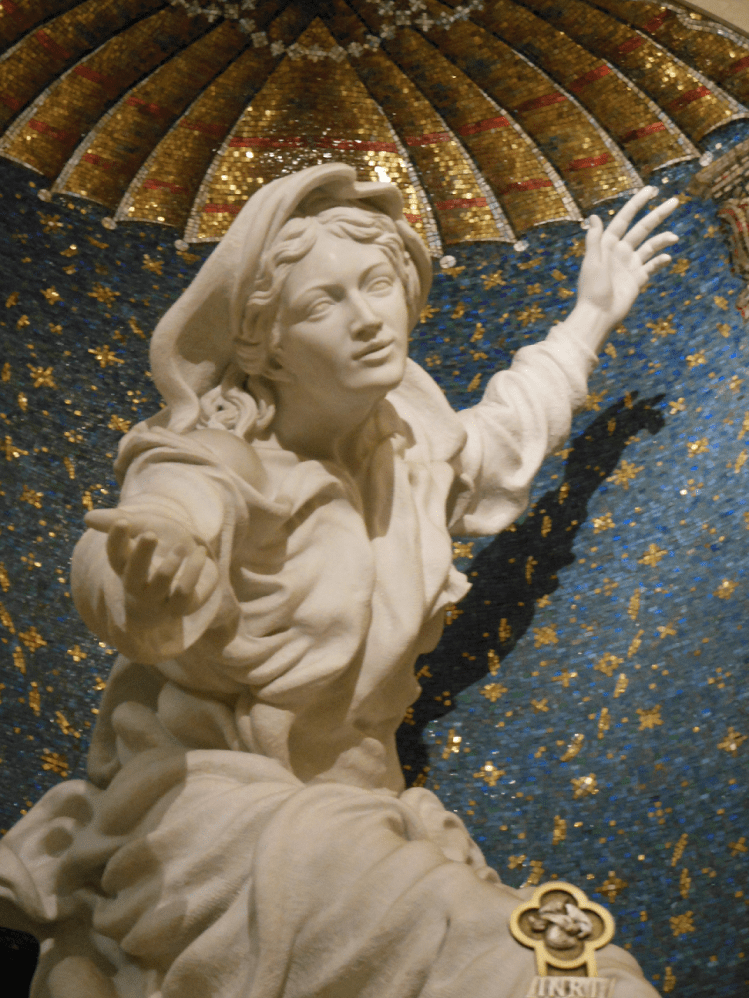
Mary at the Cathedral of St. Matthew the Apostle, Washington DC

Theotokos

Theotokos was once seen as a source of conflict. It means “Mother of God” or “or God-bearer.” In the early Church, there was debate over Mary being the Mother of God, since God is not a created being, yet she is the Mother of Jesus, who is the second person of the Triune God. The Council of Ephesus in the early 5th century confirmed this title on Mary, and the Eastern Church uses Theotokos as one of the titles for Mary.

No one questions that Mary did, indeed, give birth to Jesus. However, recently I was asked, if Mary was conceived without the stain of original sin, did she suffer in childbirth? My very first reaction was to shrug it off to say it doesn’t matter, it’s not a detail worth investigating. But as someone who has never given birth, that perspective could be rather myopic. Perhaps it’s better to take a step back and look at the whole picture of Mary and how God prepared her to be Christ’s mother. 

The fall of Eve produced the following two-fold curse: “I will intensify your toil in childbearing; in pain you shall bring forth children. Yet your urge shall be for your husband, and he shall rule over you.” (Gen 3:16) Eve’s curse is to desire her husband, and the fruit of that is a child. Thus while the desire is initially satisfied with pleasure, the pain of childbirth would be intensified or prolonged, seemingly to be a punishment for the initial desire. Yet, once the child comes, the desire does not go away, and the “curse” begins its cycle again. 

Because God intervened at Mary’s conception to keep her free from the taint of original sin, her desire was to please God. Mary was already betrothed to Joseph when Gabriel came to seek her consent. She was going to be a married woman. Perhaps if she did not give birth to the Son of God, she would have had a large family. Mary’s fiat to God’s plan turned her into a living tabernacle, a living ark of the covenant. What little of Joseph we do know, is that he understood the history of the Israelites and the covenant. He would be familiar with the ark, and that no one but the priests could touch it. He would have been familiar with the account of Uzzah, who reached out a hand to steady a tipping ark during its trip back to Jerusalem at the time of David, and was struck down because he was not worthy to do so. (2 Sam 6:6-9) Joseph realized just how special Mary and Jesus were, he would respect her and not seek to despoil her. From this viewpoint, the second portion of Eve’s curse is irrelevant. And for those who question when the various books in the New Testament refer to Jesus’ brothers, the Catechism of the Catholic Church explains the expression is used for those who have a close relationship in the Old Testament. (CCC 500)

Mary made many journeys as a pregnant woman: first to visit Elizabeth in the hill country of Judah (perhaps a “suburb” of Jerusalem?) and back north to Nazareth, and then back south beyond Jerusalem to Bethlehem to eventually give birth. Travel then was long and arduous, regardless of whether she traveled by foot, donkey or cart. After giving birth to Jesus, when she and Joseph took Jesus to the Temple, Simeon predicted a sword piercing her heart, which, while metaphoric, was a true suffering she experienced standing at the foot of the cross. The Church includes Simeon’s prophecy as the first of seven named sorrows that Mary endured. 

If we look again at Genesis, the translation uses the word “intensify,” which to me indicates that there would have been some duration of discomfort and/or pain associated with birth even before the fall of Eve. While the New Testament and Catechism is silent on the detail of how much pain Mary suffered during the birthing process, she would have had some level. But she certainly knows the pain when a child goes missing, is wrongfully accused, tortured, and put to death. Her solace in all of it was the grace of God. He prepared her to be the mother of His Son, and in doing so supported her during all her trials. 

After the visit of the shepherds, “Mary kept all these things, reflecting on them in her heart.” (Luke 2:19) The grace of God was alive in Mary, even before becoming Jesus’ mother, and intensified afterwards.  On the cross, Jesus gave Mary as mother to John, who represents the Church body throughout the ages. Mary had, and continues to have a relationship with God that is like no other. It is with confidence that we seek her intercession, aid, and assistance in praising God. And if God could prepare Mary so well to be Theotokos, how can we not think that He will prepare us for every blessing and trial in our life … if we let Him.

Catholic Girl Journey Logo

Rushed or ready?

I love the Christmas season, really I do! However, When I see Christmas decorations up around homes before Thanksgiving, my heart does sink a bit. I wonder, are they really ready for Christmas or are they just rushing it?

Call me old-fashioned, but I thought the Thanksgiving holiday ushered in the Christmas season. Santa Claus is usually the last float of any parade that day. I only start playing Christmas music the day after Thanksgiving. In a way, there’s a bit of a pattern to my Christmas preparations: first, I start listening to music and put the outside decorations up. Next, I begin to plan my cookie and bread baking, then shop for the necessary ingredients, and finally make the breads and cookies while listening to Christmas music. Lastly, because of Vera, I put up my Christmas tree in the week prior to Christmas day. It’s like a slow unfolding of the holiday season, just the right amount to be savored. 

When God promised redemption to Adam, Jesus didn’t immediately come. It required preparing a people, starting with Abraham, which grew into a nation through Jacob — which was renamed Israel. Through Moses, the people learned how to be the people of God, which then became a kingdom with David. Even at this point, the people were still not ready, and it took many generations of hardship, exile, and recovery before it was Jesus’ time to come. And when He finally came, He was rejected by those most knowledgeable of God: the Pharisees and the Saduccees. 

The wisdom of the Church gives us the opportunity to prepare ourselves by having 4 “weeks” of Advent, designated by Sundays. Since December 25 falls on a Monday this year, our Advent season is really only three weeks and day. I will gladly use the three weeks to prepare myself and my home for Christmas. I am a different person this year than I have been in previous years. I’ve had different experiences that have changed and shaped me. This year’s preparation for Christmas will be different from previous years, and that’s to be expected. While I may put the same decorations on the same tree I’ve had for years, listening to the same Christmas songs, I will see them in a slightly different way and the nostalgia they bring will be slightly different than they were the year before.  

Each year we need to take the time to prepare for the Christmas season, even if we follow a traditional plan for celebrating. God took His time in preparing humanity to receive Jesus, and we should not be in a rush to celebrate, but take the time to make ourselves ready and open to receive Jesus in the various ways He comes to us: as a baby in the Nativity, in the Eucharist at Mass, and as our judge and advocate at His second coming. 

Catholic Girl Journey Logo

Every day should be Sunday

It started as an innocent remark by a colleague on a conference call. “Every day is Monday; until the afternoon on Friday.” Just hearing that sounded like a depressing outlook on life!

Working in an office setting, it’s not uncommon on a Tuesday to hear another mention that day being their “Monday,” when they had Monday off. Typically it’s used to explain why that person is just catching up after being out a day, and most Mondays seem to be a bit slow to get into the swing of office work. Likewise if time off is planned for a Friday, the person may express their jubilance on Thursday by remarking that the day is their “Friday,” indicating the end of their workweek. The general consensus is that Monday is a dreaded day while Friday signals that the two weekend days that can be spent in a manner of personal choosing are eight or less hours away. I know there are people who so look forward to the weekend, that the five days in between is a grind and an annoyance; something to be tolerated but never celebrated.

Growing up, I observed my father, after coming home from work, saying how much he was looking forward to retiring. I felt that if I was going to spend so much time doing something to make money in order to live, I wanted to want to do it. It was one of the big reasons I pursued a college education. While I can’t say that I have a dream job or that it doesn’t seem like work, I’m not totally miserable either. It challenges me and keeps me thinking, and there are many aspects that I do enjoy. Yes, there are times when I have a “case of the Mondays,” but most times I’m wishing folks a happy (whatever-day-it-is), even a “Happy Monday.”

Looking at the days of the week from a spiritual perspective, however, everyday should be like Sunday. As Catholics, we are a resurrection people; we believe that Jesus rose from the dead and He will raise us up at the end of time. To remember and celebrate, we keep Sunday as our day of worship. We are obligated to attend and participate at Mass; for without the resurrection, there would be no Mass. By receiving Jesus in the Holy Eucharist, we are partaking in time and space what we will fully experience once we are reunited with our bodies at the end of time. Sunday is not a day for us to do whatever we want, but rather a day designated to pursue a relationship with God, strengthen our relationships with each other and prepare ourselves for our spiritual future, not our earthly future, which is quickly fading away. 

While Mass attendance is required on Sundays and Holy Days of Obligation, many churches do offer weekday Masses, and some even offer Mass every day — that is truly making every day a Sunday! However, for those who would like to attend Mass and cannot because of schedule conflicts or lack of availability, taking the time to read the Mass readings of the day and praying a Spiritual Communion prayer is the next best thing. While this cannot fully replace Mass attendance, it is an opportunity to open yourself to God and His will. 

Any day can be filled with drudgery, work, and activities that we would rather not be doing. Labeling all those days “Monday” is setting oneself up for misery. But if we offer the work we are doing to God and spend time each day seeking a relationship with Him and to do His will, our weeks will be all full of “Sundays.”

Catholic Girl Journey Logo

Are you ready?

If Jesus’ second coming back to earth was tomorrow, would you be ready?

We don’t quite know what the second coming of Jesus will be like, nor what happens afterwards. What we anticipate is that at His coming, the dead will rise and all will be judged and then His kingdom will reign forever. For those of us who are still alive, if we still have faults that need to be purged, will there be some sort of purgatory for us? What will we do in eternity? Will we have jobs? Will we need to support ourselves? Jesus mentioned He will prepare a place for us, so if all our needs are taken care of, will we be forever contemplating God in all of His divinity? How can we prepare ourselves for something we don’t know — or perhaps more accurately — can’t understand with our finite and earth-bound mind? 

Each November the Church reminds us that the end is near. It’s a lot nearer than it was when Jesus first came. However, with two millennia passed, it’s hard to imagine the end of the world. Tumultuous activities, both natural and man-made, are supposed to herald the end, but that’s also been a constant since the beginning of civilization. Men have been predicting the end for the same amount of time, claiming secret knowledge has been revealed to indicate when it will come. Jesus dispelled that notion, indicating that only the Father alone has that knowledge (Matt 24:36).

It is an interesting juxtaposition, with the end of the liturgical year talking about the end of things, and the beginning of the liturgical year preparing for the coming of Christ. While we think more of a preparation for Christmas, the Church is gently reminding us that we need to prepare for both, the celebration of the historical time when Jesus was born as a man, as well as taking a look at what we could do better in preparing if He was to come back to earth for the final judgment. We know we’re to live our life trying to do God’s will and cultivating a relationship with Him. But to think about what will happen afterwards can be a bit scary and uncomfortable. It’s much easier, fun, and comfortable to think about preparations for Christmas: what presents to buy, how to decorate, what food to make, and with whom we will celebrate. 

It’s very easy for us to get lost in the daily aspects of living life on earth. The role models we are to emulate, the saints, are celebrated at the beginning of November. This isn’t mere coincidence; this is the Church giving us the opportunity to focus on the goal of our lives as well as to dive deeper into the lives of those we know are spiritually closest to God. If we haven’t done so during this month, Advent is also a good time to seek out some saints that we don’t know very well and learn about their lives. These last two months of the year can be a supercharging spiritual renewal, if we pursue it. It’s like the Church is saying: A) here’s the goal and examples of saints to follow, B) the end is near, but don’t be afraid because, C) the end is really a new beginning in the life of Christ when He comes. If the world does not end, we should still be preparing ourselves for it as well as the coming of Jesus in our daily lives (in the people we encounter as well as in receiving the Holy Eucharist), as well as preparing to celebrate His birth as it occurred in history. That’s a lot to think about for a mere human brain!

While it’s not just during the last two months of the year we’re to focus on the end that will bring a new beginning, setting aside the time to focus and take stock of our spiritual welfare is a worthy endeavor. The Church gives us the reminder and the resources, it’s up to us to acknowledge and pursue it or take our chances that we still have time to prepare the day after tomorrow. 

Catholic Girl Journey Logo

Unity of the Church

Prayer is a vital activity for the family of the Church. It unites us across all generations, vocations, cultures, and paths of life. 

With the celebration of All Saints’ Day last week, as usual, the topic of saints becomes popular. Reviewing the list of American saints, as well as those on their way to sainthood — the blesseds and the venerables — many are priests or religious. It can be easy to forget that these saintly people are from families just like yours and mine. When we hear about the life of a saint, their entire life is summed up into just a few highlights. What makes these people saints is their choice to say “yes” to God’s plan for them and to rely on Him. However, during their lifetime, many people prayed for them, and many people invoked the saints of previous generations for their intercession to help them. We don’t often think that when the future saints lived on earth, they needed spiritual support and intercession from those around them.

A similar perspective can be found towards those having a vocation to the Church, either priests or religious consecrated life; they are also from families like ours. Realistically, we don’t know who God is calling and we should encourage the children within our families to consider the possibility. There are countless stories of saints who had a checkered youth that eventually sought out the religious life; just because a child doesn’t show any inclination towards God doesn’t mean He’s not calling them. Even if one doesn’t have a child, sibling, or other family member in religious life, praying for those who are, benefits the Church. If we ask a priest or religious to pray for us, we must also do the same for them. We may think that person is closer to God because of their vocation, but they are in the same need of the sacraments as we are. 

Future priests, consecrated religious, and saints are all around us and need our prayers. But how do we pray for them? While the simple standards of the Our Father, Hail Mary, and Glory Be are perfectly adequate; we can go a bit extra with a rosary or even having a Mass said with their intention. As the faithful, we are called to pray without ceasing, so even in our daily activities, we can offer up our simple tasks as prayerful intercession. Speaking of future saints, how about all those in purgatory? They are in need of our prayers, just as we are in need of theirs. They truly are much closer to God than we are. 

The Church is one big family in faith and prayer is the communication that transcends time and space. We are all called to holiness, we are all called to pray. Let us join together to support each other on our journey to becoming saints, living onwards in the presence of God. 

Catholic Girl Journey Logo

Merciful limits

It’s that time of year again, the change of the clocks back to Standard Time. But instead of bemoaning how much it will disrupt our lives, maybe we should take a deeper appreciation of the blessings God provides within the seasonal changes of nature.

I think we’ve all wished there were more hours in a day, or that the week was longer than seven days. In a way, humans have been trying to squeeze more life out of a day ever since we could control fire. Firelight allowed us to continue working and being able to see after sunset. With all the technology now, technically we could make a room bright enough to seem like it’s daylight 24 hours a day. However, we would pay a price for being awake for that length of time. Our bodies need sleep, just like they need the nutrition from the food we eat. Having more hours in a day may not enable us to get more done, as a portion of that time would need to be balanced with rest. It can be a struggle to unplug from technology at the end of the day; whether it’s television or apps on a mobile device, hours seem to pass by in minutes at the cost of sleep one needs to be fully functional. 

Here in Virginia, the longest day of the year provides almost 15 hours of sunlight, where the shortest provides about 9-½ hours. No matter how we adjust our clocks, in the winter we cannot make the sun shine more and a good portion of our day will be spent working in darkness. Yet the change in the amount of sunlight doesn’t just affect us, it also affects the earth as well. Less sunlight means plants go dormant. I recall learning about fallow fields in grade school, a method of allowing the soil to recover from a crop, so that the proper nutrient balance could be restored. It’s not just humans that need a rest, it’s also the earth! In God’s merciful wisdom, there are limits placed on day and night, as well as the seasons, and all creation is interlinked within these blessed parameters.

Looking around the natural world, it’s not just light and darkness that have limitations, but all creatures. In the diversity of the created world, something that is an advantage to one may be lacking in another. Birds of prey have particularly keen eyesight, however bats are notorious for being blind, yet their hearing makes up for what they cannot see. Two flying creatures who hunt in flight, but have drastically different food sources and ways of obtaining it. Another example is in procreation: an opossum can have a gestational period of 12 days, whereas an elephant can be about 22 months! With all our technology, we cannot either lengthen or reduce this natural process. We may try to control it by reducing or encouraging with artificial insemination the birthcount an animal will have, but the time of gestation will be the constant. 

When I see the various boundaries there are in the natural world, I start to wonder about the society and culture of today and how much humans continue to try to control all aspects of life, even down to the simplest things. We try to adjust clocks to make daylight more convenient for our needs. We want to work in the daylight, and usually longer than the required 8-hour day, yet we also want to have time for ourselves that is also in daylight. We no longer work within the natural boundaries but look to expand them in artificial ways. While I don’t think it’s possible within the culture and society to only work in daylight, perhaps we should take a cue from nature to rest up during the winter months, to slow down and refresh ourselves. 

God hasn’t imposed these limits to chain us, but rather so that we can live within a healthy range of adjustment. The changes in daylight don’t happen all at once, but occur over many days a minute or two at a time, so that the change is gradual. While God can work in extremes, creation reflects a God who is gentle with change and eases us through the days and seasons, both from a physical perspective as well as a spiritual one. Jesus didn’t come to earth immediately after Adam sinned, but rather in “the fullness of time.” (Gal. 4:4) Jesus also lived a full life, coming as a child, being born of the Virgin Mary after the typical nine months of growing in her womb. God walks with us at our speed, maybe even a bit slower, so that we can slow down and take notice, appreciating all the blessings He showers upon us. 

Catholic Girl Journey Logo

Inspired by God

While God loves us as we are at any given moment, He doesn’t want us to get “stuck.” God wants us to become the best version of ourselves and strives to help us along that path throughout our earthly journey.

Looking from just a logical perspective, it really doesn’t make sense that the early Christians succeeded in evangelizing when so many were being tortured and killed. These early followers changed their way of life and were ready to die rather than renounce their faith. We read in the Acts of the Apostles that they gathered as a community, shared the sacred meal, and would sell excess property and give the profits to the church to distribute. And it just wasn’t the Jewish people who welcomed this change, but also the Gentiles, as seen in the letters St. Paul writes to the various communities. The early Christians’ way of life reflected their response to the preaching of the Word of God. Just as in ancient times, Christians today continue to respond to God’s call and reflect His love in their communities.

When we see an act of charity being performed, we are touched by the goodness of others and want to assist. We say we are inspired by that action, but what does that really mean? The etymology of the word “inspired,”  rooted in Latin, means to breathe. The first use of the word in the 14th century carried a similar definition as today, according to Merriam-Webster, “to influence, move, or guide by divine or supernatural influence or action.” This definition evokes the story of creation in Genesis, when God animated Adam by breathing life into him. Going back even farther, God spoke all creation into being, and since one naturally exhales when speaking, every word of God contains His breath. When we are inspired, we are filled with awe in Divine Providence. We have the opportunity to react: will we respond with kindness and goodness, or to totally ignore any desire to be helpful? Our reaction either brings us closer to God or moves us further away. 

Through the inspiration of the Holy Spirit, God continues to reach out to us. It could be a call to lend our time, talent, or resources towards local needs identified by our parish or diocese. When we respond positively to the Spirit’s guidance, we change. We are a little less focused on ourselves. Little by little, if we allow it, we can move toward achieving our full, God given potential. This transformation is essential to the process of becoming a saint. Some may fear that becoming a saint means to live uncomfortably and to suffer all the time. However, if we’re being honest, even living a secular life can be uncomfortable and include suffering as well.  The difference is that when we center ourselves on God and accept His will for us, we can find meaning in our struggles and suffering. These situations present opportunities to practice trusting God by recognizing that He alone is in control. In fact, during their earthly life, many saints invited struggles and suffering as a way to get closer to God and to practice what it means to live and love like He does.

There are many sources of inspiration to lead us closer to God: the New Testament, biographies of the saints, the sky, the land, the sea, all of the animals, and the people we encounter in our daily lives. How will you allow the Holy Spirit to inspire you today?